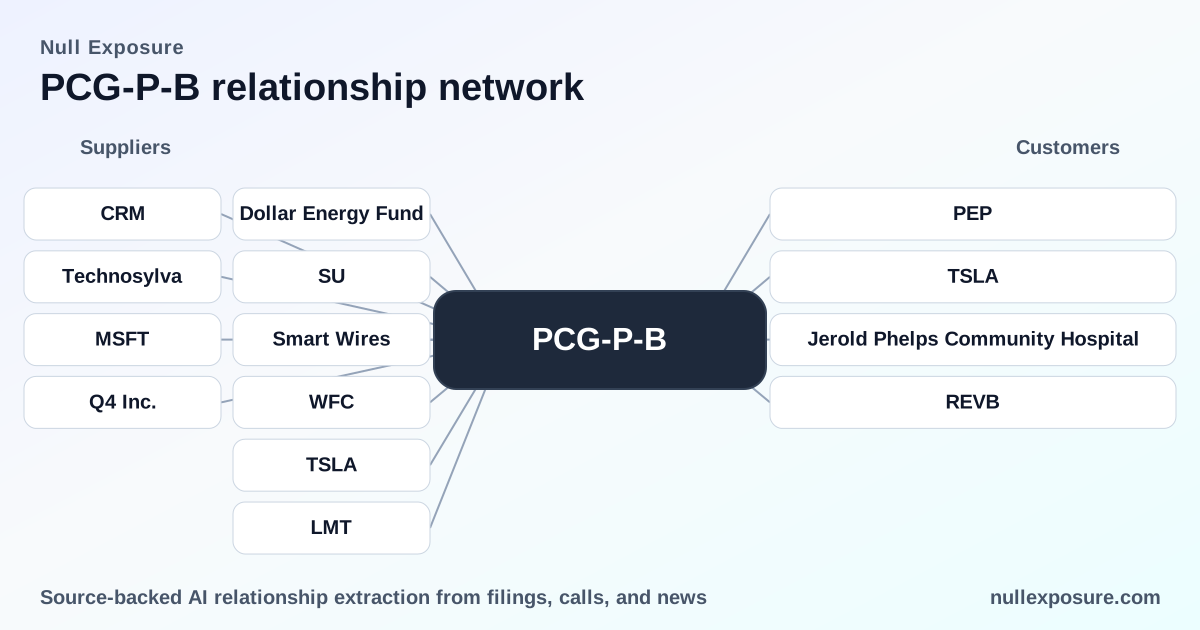
PCG-P-B: Customer Footprint and Commercial Exposures Investors Should Price In
Pacific Gas & Electric Company operates as a regulated electric and gas utility in Northern and Central California, monetizing through regulated tariffed energy sales, infrastructure connection fees and grid services; the PCG-P-B preferred shares represent a fixed-income claim that sits behind operating cash flows driven by these customer relationships. For investors and operators evaluating credit and exposure, the customer set spans global corporates investing in electrification, local municipalities and small businesses confronting reliability issues—each relationship influences revenue stability and reputational risk in different ways. Learn how these customer ties translate into commercial opportunity and contingent liability at NullExposure.
What the relationship map says about PG&E's commercial posture
PG&E combines a mature regulated monopoly position with transactional, project-based work when connecting large electrification customers. That creates a dual commercial profile: stable, tariffed revenue from broad residential and commercial load and lumpy, higher-margin connection and grid-hosting revenue from EV fleets, public chargers and large site upgrades. The 2025 Flex Connect initiative shows PG&E actively monetizes faster connection services for electrification customers while absorbing operational complexity and near-term capital requirements.
Key takeaway: investors should price PCG-P-B with both steady regulated cash flows and episodic execution risk from grid interconnections and outage-related liabilities.
The customer relationships — concise, source-backed snapshots
Below are every relationship extracted from the results, each with a plain-English summary and a short source reference.
-
PepsiCo / PEP — A PepsiCo bottling facility in Fresno enrolled in PG&E’s Flex Connect program to unlock additional grid capacity and ramp its electric semi-truck charging from roughly 30 vehicles to a full fleet of 50, reflecting corporate fleet electrification driving incremental connection revenue for PG&E. Source: PG&E investor press release on Flex Connect, FY2025 (investor.pgecorp.com).
-
PepsiCo (duplicate entry) — Same as above: the Fresno bottling site joined Flex Connect to accelerate charging capacity for a larger EV semi-truck fleet. Source: PG&E investor press release, FY2025.
-
Tesla / TSLA — Tesla submitted applications for PG&E service for multiple new Supercharger stations along key highway corridors in early 2024, indicating PG&E’s role as the network operator enabling fast-charging infrastructure rollouts. Source: PG&E investor press release, FY2025 (note references to early‑2024 applications).
-
TSLA (duplicate entry) — Same point: Tesla’s Supercharger applications represent commercial-scale connections that PG&E processes under its interconnection and service rules. Source: PG&E investor press release, FY2025.
-
Chino Yang Restaurant — Local small-business owners including Chino Yang signaled intent to file a class action against PG&E after December outages, alleging financial harm from unreliable electric service; this represents concentrated reputational and litigation exposure from distributed customers. Source: SFGate report on Sunset District outage impacts, FY2026 (May 2026 coverage).
-
Far East Restaurant — Affected small-business owner Bill Lee (Far East Restaurant) spoke alongside other plaintiffs in potential litigation tied to December power outages, underlining small commercial claims and community pressure in PG&E’s service territory. Source: SFGate reporting on planned class action, FY2026.
-
Jerold Phelps Community Hospital — Local reporting from 2022 noted PG&E had not confirmed capacity to serve the new hospital building required for seismic compliance, highlighting conditional delivery risk for critical community infrastructure projects. Source: Lost Coast Outpost coverage, FY2022 (September 2022).
-
City of Stockton — The City Council voted to transition away from PG&E as its central power source in a 2022 action, signaling municipal-level diversification initiatives that reduce long-term load concentration for the utility. Source: Stocktonia local government reporting, FY2022 (September 2022).
-
Revel / REVB — PG&E connected and powered new Revel EV chargers in San Francisco, Oakland and South San Francisco under the Flex Connect program, demonstrating support for third-party mobility infrastructure rollouts and incremental connection revenue. Source: PG&E investor press release on Flex Connect, FY2025.
-
REVB (duplicate entry) — Same as above: Revel’s West Coast expansion received PG&E connections and power service via Flex Connect provisions. Source: PG&E investor press release, FY2025.
Implications for revenue, concentration and execution risk
PG&E’s customer incidents in the results span large corporate electrification projects (PepsiCo, Tesla, Revel), municipal-level decisions (City of Stockton), critical facilities (Jerold Phelps Community Hospital) and small-business litigation (Sunset District restaurants). This mix implies:
- Revenue diversity: large corporate connections generate discrete fee and load growth; municipal and residential accounts underpin tariff revenue.
- Concentration dynamics: while no single corporate customer dominates the revenue base in this sample, the presence of high-profile customers (e.g., Tesla, PepsiCo) means project execution is both a revenue opportunity and a reputational lever.
- Execution and operational criticality: hospital electrification and small-business outage claims expose PG&E to non-financial risks that translate into contingent liabilities and regulatory scrutiny.
Operating-model signals investors should price
With no explicit constraints captured in the relationship set, treat the absence as a company-level signal: the available signals emphasize PG&E’s role as a regional monopoly executing large-scale connections and managing legacy reliability issues, rather than contract- or counterparty-specific constraints. From a contracting posture standpoint, PG&E exhibits a mixed approach: long-term regulated service for base load and shorter-term, commercially negotiated terms for accelerated connection programs like Flex Connect. Maturity is that of an incumbent regulated utility; criticality is high for local infrastructure; concentration is geographically concentrated to California but commercially diverse across customer types.
What this means for PCG-P-B holders
- Credit relevance: continued regulated cash flow supports preferred claims, but episodic connection capex and litigation or municipal defections increase earnings volatility and upside/downside to coverage metrics.
- Event sensitivity: preferred holders should monitor large project rollouts and outage litigation developments closely, since these can rapidly affect cash available for preferred dividends through regulatory or settlement outcomes.
- Active signals: corporate electrification contracts such as PepsiCo, Tesla and Revel signal future load growth that can be supportive if PG&E converts those projects into stable tariffed revenue.
For deeper, structured insight into how customer relationships translate to contingent exposures and credit dynamics, visit NullExposure homepage.
Bottom line for investors and operators
PG&E’s customer set reflects both opportunity and liability: electrification customers create incremental revenue streams through connection services, while outage-related litigation and municipal departures create downside pressure. Investors in PCG-P-B should balance the predictable nature of regulated returns against episodic execution and legal risk that affect available cash flows. For ongoing monitoring and relationship-level intelligence to inform position sizing, underwriting and operational planning, explore our analytical coverage at NullExposure.