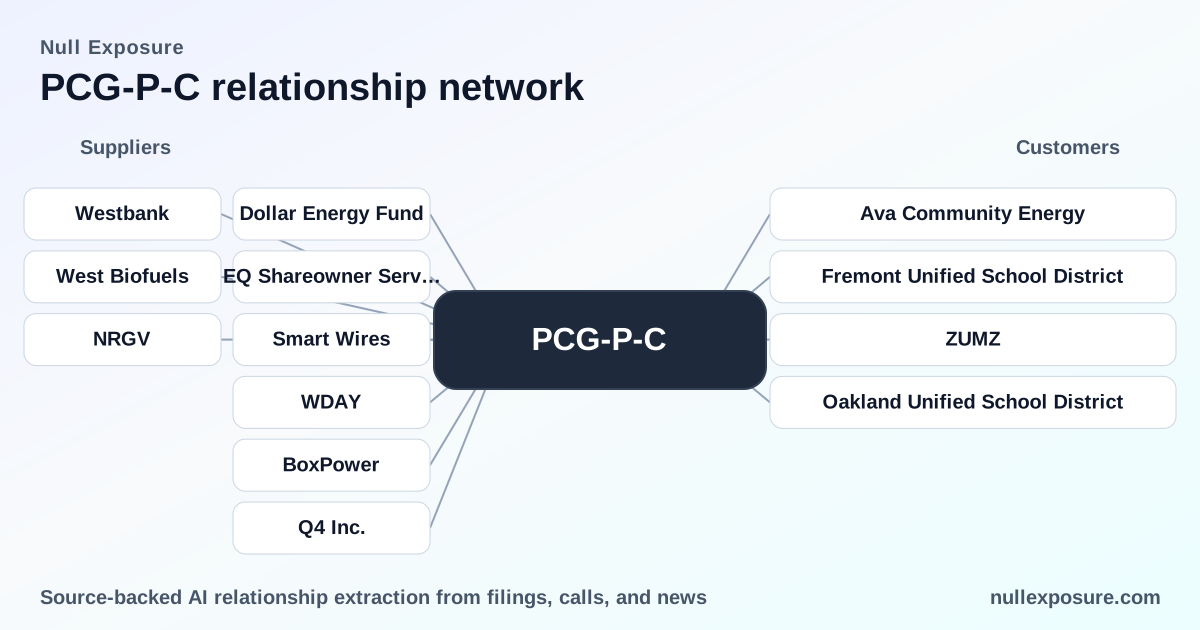
Pacific Gas & Electric (PCG-P-C): Customer Relationships That Define Service Footprint and Credit Dynamics
Thesis — Pacific Gas & Electric operates as a regulated energy delivery company that monetizes through rate-regulated transmission and distribution services, infrastructure investments, and contract-based programs with municipal, commercial and emerging mobility customers; the PCG-P-C preferred issuance is a capital-structure instrument backed by that regulated cash flow profile. For investors evaluating counterparty exposure and service concentration, the customer relationships below highlight both core delivery dependence and new program-driven revenue streams that influence credit durability and franchise value. Learn more at https://nullexposure.com/.
Why customers matter for holders of PCG preferred securities
PG&E’s revenue base is fundamentally tied to delivering energy over its grid, not to every entity that supplies generation. That creates two structural truths for investors: (1) delivery services are highly critical and contractual in nature, often with stable, rate-approved recovery; and (2) generation competition and community choice aggregators (CCAs) affect commodity economics but leave transmission rents intact. Taken together, the company’s customer relationships are a lens into operational risk (concentration, critical assets) and strategic opportunity (new commercial programs like vehicle-to-grid).
- Contracting posture: Predominantly regulated utility contracts with customers that are long-duration and tariff-driven rather than bespoke commercial contracts.
- Concentration and criticality: A mix of municipal, school district and small-business customers demonstrates broad exposure across customer sizes; the grid itself is a single critical asset delivering to all.
- Maturity: Relationships range from legacy service obligations to pilots launched since 2019, indicating a blend of stable revenue and program innovation.
Program wins and municipal partners: fleet electrification in the field
Fremont Unified School District
Fremont USD participates in PG&E’s EV Fleet program, which supported 17 electric school buses and 13 medium‑duty vehicles through incentives for charging infrastructure and equipment, reflecting PG&E’s role as facilitator of fleet electrification and infrastructure investment. According to a PR Newswire release in March 2026, this initiative aligns with the utility’s commercial fleet Vehicle‑to‑Everything (V2X) pilot. (PR Newswire, Mar 2026)
Oakland Unified School District
Oakland USD took part in PG&E’s earlier V2X deployment in 2024 and is cited as a precedent for expanded commercial fleet pilots; this shows PG&E leveraging district partnerships to scale vehicle-grid services. PR Newswire reported on this in the context of the 2025–2026 program expansion. (PR Newswire, Mar 2026)
Zum (ZUMZ)
Zum — the student‑transportation technology provider — is a named private partner in PG&E’s V2X pilot work, demonstrating commercial partner use of PG&E programs to deploy charging and vehicle-to-grid capabilities for school fleets. The PR Newswire item notes Zum’s role in the 2024 Oakland deployment and its link to the 2025 Fremont rollout. (PR Newswire, Mar 2026)
Regulatory and competitive pressures at the municipal level
San Francisco (City)
San Francisco’s negotiations with the state Public Utilities Commission involve pricing for long-distance transmission services, and the city continues to pay for service from PG&E’s transmission lines even as local energy strategies evolve. Reporting in the San Francisco Chronicle highlighted the city’s stance and its continued dependency on PG&E transmission capacities. (San Francisco Chronicle, May 2026)
Ava Community Energy
Ava Community Energy is serving as Stockton’s Community Choice Aggregator and procures or generates electricity while continuing to use PG&E’s distribution network to deliver power, illustrating the modern CCA model where commodity choice is decoupled from delivery. Coverage in Stocktonia described Ava’s April service start and its use of PG&E lines for delivery. (Stocktonia, Feb 2025)
Small‑business sensitivity to rate actions
50 Grand Restaurant and Bar
Small commercial customers experience the downstream impact of PG&E rate decisions: owners of the 50 Grand Restaurant and Bar told CBS Sacramento that monthly bills rose substantially since 2018, underscoring rate sensitivity for end‑user economics and the reputational risks utilities carry with visible small-business customers. CBS News Sacramento covered this anecdotal impact amid 2024 rate changes. (CBS Sacramento, 2024 reporting cited in 2026)
What these relationships collectively signal about operating risk and strategy
- Revenue stickiness from delivery: Even where CCAs or private fleet operators supply or manage energy, PG&E retains the delivery monopoly on its lines and the related regulated revenue recovery. That insulates preferred holders from some commodity-level dislocation while exposing them to regulatory and infrastructure risk.
- Program-driven growth in value‑added services: V2X and fleet electrification pilots with school districts and partners like Zum demonstrate new non-commodity services that can create incremental, rate‑approved investments and public‑policy alignment.
- Regulatory negotiation is a central risk vector: City‑level actions and PUC pricing debates (e.g., San Francisco) drive both short- and long-term cash‑flow uncertainty via rate cases and transmission pricing decisions.
- Customer politics and public sentiment matter: Stories about small businesses absorbing higher bills illustrate the reputational dimension that influences regulatory outcomes and potential political interventions.
No explicit constraints reported — what that implies
The dataset contains no explicit constraints tied to the PCG‑P‑C customer relationships. As a company-level signal, absence of reported constraints here is not a statement of operational unconstraint; it simply means this set of customer links does not include contract-specific encumbrances or named limitations. Investors should treat this absence as a prompt to review regulatory filings and rate case disclosures for explicit covenants or restrictions that could affect preferred‑class recoveries.
Bottom line for investors
Holdings tied to PCG-P-C are principally bets on regulated delivery economics and the utility’s ability to convert programmatic pilots into recoverable investments. Customer relationships across school districts, CCAs and small businesses demonstrate both resilient delivery revenue and pressure points from competitive generation choice and rate politics. For more depth on counterparty footprints and how customer composition affects capital structure risk, consult the Null Exposure research hub at https://nullexposure.com/.
Key takeaway: the delivery monopoly secures the backbone of cash flow for preferred claims, while innovation (V2X) and municipal dynamics define the marginal upside and regulatory downside.