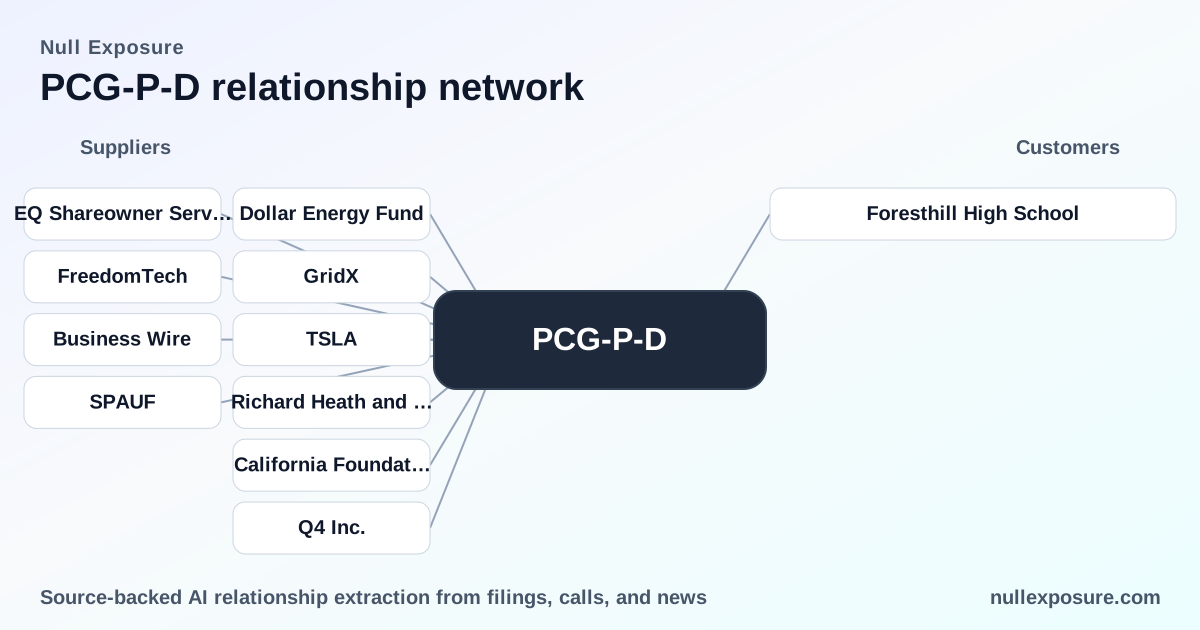
PG&E Preferred (PCG-P-D): Customer relationships that support a regulated utility income staple
Pacific Gas & Electric Company operates as one of California’s largest regulated utilities, delivering electricity and natural gas under state-regulated tariffs and long-term capital programs. The 5% First Redeemable Preferred Stock (PCG-P-D) monetizes through fixed dividend payments backed by PG&E’s place in the capital structure and the utility’s regulated cash flow profile; investors buy the issue for predictable income exposure to a mature utility franchise undergoing safety and distributed energy investments. Customer-facing integrations and community resilience projects—rather than volatile merchant businesses—drive the operational rationale behind preferred-holder protections and cashflow stability. Learn more about our coverage at Null Exposure.
Operational profile and monetization in plain terms
- PG&E generates revenue primarily through regulated rate-making mechanisms: the company invests in transmission, distribution, and safety programs and recovers those costs through approved tariffs and rate cases. The preferred security sits ahead of common equity for dividend claims, so credit and regulatory stability are the primary drivers of preferred security valuation, not growth in commodity volumes.
- The utility’s strategy emphasizes capital spending for safety, wildfire mitigation, and grid modernization; those investments create predictable authorized returns when accepted by regulators, underpinning dividend reliability for preferred instruments.
How specific customer relationships fit the picture These customer-level items illuminate two dimensions of PG&E’s operating footprint: distributed energy integration and community resilience during Public Safety Power Shutoffs (PSPS). Below I summarize every customer relationship flagged in the provided results.
Tesla: vehicle and charger participation in PG&E’s V2X program
PG&E announced that Tesla’s Cybertruck and Tesla hardware (PowerShare Gateway and Universal Wall Connector) are eligible to participate in PG&E’s Vehicle-to-Everything (V2X) program, enabling bidirectional flows and grid services from eligible Tesla vehicles and charging equipment. This integration expands PG&E’s aggregator and distributed resource capability and supports utility programs for demand flexibility and emergency backup capacity. According to Drive Tesla Canada, the announcement was documented in FY2026 coverage dated May 3, 2026.
Foresthill High School: backup battery included in PSPS resilience rollouts
PG&E installed a new backup battery system in Foresthill to reduce the impact of planned PSPS events, and the utility specifically referenced Foresthill High School—owner of an onsite 175 kW solar array—among the prioritized community facilities that retain power during outages. The deployment highlights PG&E’s strategy to pair energy storage with local generation to maintain critical services during fire-season shutoffs. CBS Sacramento reported this community resilience deployment in coverage dated March 10, 2026.
What these relationships reveal about PG&E’s operating posture
- Contracting posture: long-duration, programmatic customer engagement. Both relationships flow from utility-run programs (V2X enrollment, PSPS mitigation) rather than spot commercial sales, reinforcing a contracting model that is programmatic and regulated in nature.
- Concentration and criticality: regional but essential. PG&E serves geographically concentrated populations in California; customer relationships such as the Foresthill backup project underscore the essential-service nature of the business and the utility’s direct role in safeguarding community-critical assets.
- Maturity and strategic orientation: legacy utility modernizing through distributed resources. Integration with Tesla’s V2X technology and deployment of site-level storage indicate PG&E is transitioning legacy distribution assets toward a more distributed, resilient architecture while remaining squarely within regulated rate recovery frameworks.
- Note: the available constraints feed did not include any explicit contract-level constraints or red flags for these relationships; that absence is a company-level signal that no discrete contractual limitations were surfaced in the reviewed material.
Investment implications for PCG-P-D holders
- Income stability is supported by regulated program revenues and prioritized cost recovery. The relationships with Tesla and community resilience deployments are programmatic extensions of utility service rather than new merchant businesses, preserving the regulated cashflow profile that underpins preferred dividends.
- Operational risk remains concentrated in California policy and operational execution. While distributed energy and storage deployments reduce outage exposure, regulators and rate cases continue to be the vector for cost recovery—and thus the vector for dividend security. Historical liabilities and the need for continued investment in safety remain meaningful commercial risk vectors for investors.
- Technology partnerships expand optionality for grid services. The Tesla V2X integration creates optional new sources of value—load shifting and backup capacity—that PG&E can harness to reduce peak exposures and potentially offset incremental costs. Those operational benefits translate into better utilization of rate-base investments and reduced emergency outlays.
How operators should read these customer signals
- Grid operators and program managers should view the Tesla relationship as a signal to scale interoperability standards and customer enrollment pathways for V2X and DER participation—this is an operational lever to monetize flexibility under existing regulatory frameworks.
- Community resiliency projects like the Foresthill battery rollout serve as operational templates: replicate paired solar-plus-storage deployments at other critical facilities to limit PSPS impacts and stabilize customer outages while reducing reputational and emergency-response costs.
Risk factors that retain priority for investors
- Regulatory outcomes determine recoverability; the preferred instrument depends on the utility’s ability to earn authorized returns and recover capital investments.
- Execution risk on safety programs and wildfire mitigation continues to affect capital allocation and regulatory negotiations; successful execution supports preferred security resilience, while failures can compress distributable cash flows.
Conclusion: concise takeaways for investors and operators
- PG&E’s customer relationships documented here reinforce a regulated, program-based earnings profile that supports preferred dividends. The utility’s V2X integration with Tesla broadens distributed resource options; the Foresthill battery deployment demonstrates an ongoing focus on PSPS mitigation and critical-service continuity.
- For preferred-stock investors, the core questions are regulatory recoverability and operational execution; these customer engagements are constructive operational signals but do not materially alter the capital-structure dynamics that drive PCG-P-D valuation.
For a deeper read on how customer engagements affect utility cashflows and preferred security valuations, visit Null Exposure.