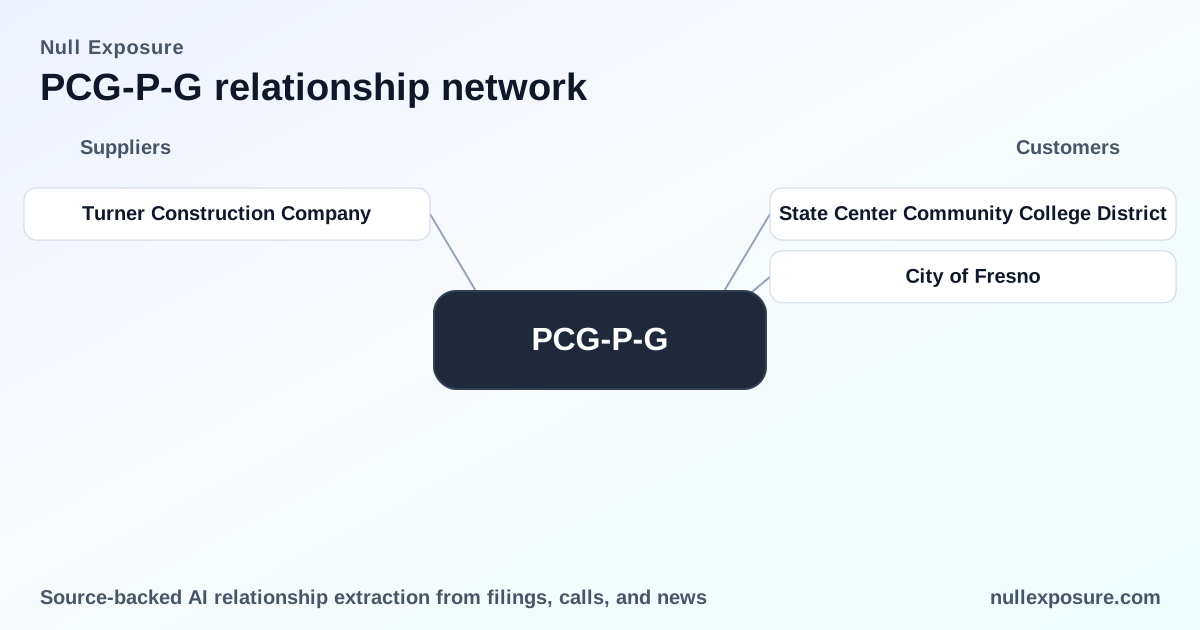
PCG-P-G: Preferred exposure to a regulated delivery monopoly with local customer friction
Pacific Gas & Electric Company operates as California’s dominant energy delivery utility, monetizing through regulated electricity and gas transmission and distribution charges; the PCG-P-G instrument is a 4.80% first preferred that targets investors seeking stable, senior dividend income within the utility sector. Investor returns hinge on PG&E’s regulated cash flows, the shape of delivery-rate decisions, and the company’s ability to manage local and municipal customer relationships that influence political and regulatory outcomes. For a broader view of customer-level connections and implications, visit https://nullexposure.com/.
Why customers matter to a preferred-holder: the operating model in plain English
PG&E’s business is built on a classic regulated-monopoly model: it bills end customers for commodity delivery and recovery of capital investments under state-regulated tariffs. That legal and economic framework creates predictable cash generation but also concentrates exposure in California regulatory cycles and local political dynamics. Contracting posture is largely long-dated and tariff-driven rather than short-term commercial contracting; criticality is high because many local entities depend on PG&E for transmission even when they procure generation elsewhere; geographic concentration is extreme — the company’s fortunes rise and fall with California policy and weather-driven operating risk; maturity is high, with legacy infrastructure and ongoing capital programs. The public reporting and coverage in the links below surface how those dynamics show up at the customer level.
Customer relationships — what the headlines report (each relationship covered)
State Center Community College District — municipal project delays and frustration
Officials for the State Center Community College District reported that PG&E has not energized certain campus projects, including Fresno City College parking structure and the West Fresno campus, signaling operational friction with a local institutional customer. According to ABC30 reporting from March 10, 2026, the district’s chancellor publicly criticized PG&E on project delivery timelines (https://abc30.com/post/pge-utility-bills-california-fresno-councilmembers-pacific-gas-and-electric/12403298/).
City of Fresno — political criticism of PG&E partnership
City of Fresno council members voiced explicit dissatisfaction with PG&E’s role as a corporate partner to local government, with one councilmember stating the utility is not a good corporate partner for the City of Fresno in a public forum. That comment was captured by ABC30 on March 10, 2026, reflecting municipal-level reputational and stakeholder-risk (https://abc30.com/post/pge-utility-bills-california-fresno-councilmembers-pacific-gas-and-electric/12403298/).
AVA Community Energy — delivery-only customers and rate adjustments
AVA Community Energy customers who receive only PG&E delivery services—i.e., community choice aggregation (CCA) customers—are affected by PG&E’s delivery-rate decisions; recent rate actions produced roughly a 7% reduction to electricity delivery charges for those customers. The San Francisco Chronicle reported this development on May 3, 2026, noting how PG&E’s delivery tariffs interact with CCAs such as AVA (https://www.sfchronicle.com/climate/article/pge-electricity-rate-temporary-19541190.php).
CleanPowerSF — another CCA impacted by delivery-rate changes
CleanPowerSF, San Francisco’s CCA, likewise sees its customers impacted by PG&E delivery charges; delivery-rate adjustments flow through to CCA-enrolled customers even when their generation is sourced elsewhere. The San Francisco Chronicle’s May 3, 2026 article highlights the approximately 7% delivery-rate reduction and the downstream impact on CleanPowerSF participants (https://www.sfchronicle.com/climate/article/pge-electricity-rate-temporary-19541190.php).
S.F. Public Utilities Commission — large local supplier still dependent on PG&E transmission
The San Francisco Public Utilities Commission supplies about 70% of the city’s electricity demand, but its customers still rely on PG&E for transmission into homes and businesses, underscoring PG&E’s role as a critical transmission provider even where local generation is strong. That relationship was described in the San Francisco Examiner coverage, which frames PG&E as indispensable for physical delivery (https://www.sfexaminer.com/news/clean-local-power-wins-in-s-f-against-pg-e-monopoly/article_e9429e2c-5187-11ed-93b7-6f1bdaef3e8e.html).
What these customer signals imply for PCG-P-G investors
- Regulatory sensitivity is the primary macro risk driver. Delivery-rate adjustments directly affect the revenue base that supports dividends on preferred stock. The recent approximately 7% delivery-rate reduction cited in coverage is a concrete example of how tariff decisions transmit to cash flow.
- Operational execution and municipal relationships matter for reputational and timing risks. Public criticisms from the City of Fresno and delays in energizing public projects (Fresno college projects) are operational headlines that have downstream effects on political capital and regulatory scrutiny.
- High criticality, low counterparty diversification. Even when city utilities or CCAs supply generation, they still depend on PG&E’s transmission; this underscores the company’s systemic importance in California and fortifies its standing as a provider of essential, regulated services.
- Mature asset base with ongoing capital needs. The nature of utility capital programs, grid hardening, and environmental compliance drives steady capex and rate-case interactions; preferred dividends are sensitive to the interplay of allowed returns and recovery mechanisms established by regulators.
For investors who want to map customer relationships to risk exposures in greater depth, NullExposure offers structured customer analytics and commentary — see https://nullexposure.com/ for further coverage.
Practical risk checklist for portfolio managers
- Monitor California Public Utilities Commission and CPUC rate-case timetables and decisions, as delivery rates are the primary lever for cash-flow variability.
- Track large municipal sentiment and service complaints; local government criticism can precipitate political interventions and rate scrutiny.
- Watch CCA dynamics: CCAs change where generation revenue accrues, but transmission dependence keeps PG&E economically relevant.
- Review capital recovery orders and allowable ROE outcomes to assess the sustainability of preferred dividends.
Bottom line
PCG-P-G offers senior, fixed-percentage preferred claims on a utility whose cash flow is anchored in regulated delivery business lines but exposed to concentrated geographic and political risks. Customer-level headlines from Fresno to San Francisco illustrate both the company’s critical infrastructure role and the operational/political frictions that influence regulatory outcomes and, indirectly, preferred-holder security. For deeper, relationship-level intelligence and continual monitoring, visit https://nullexposure.com/.