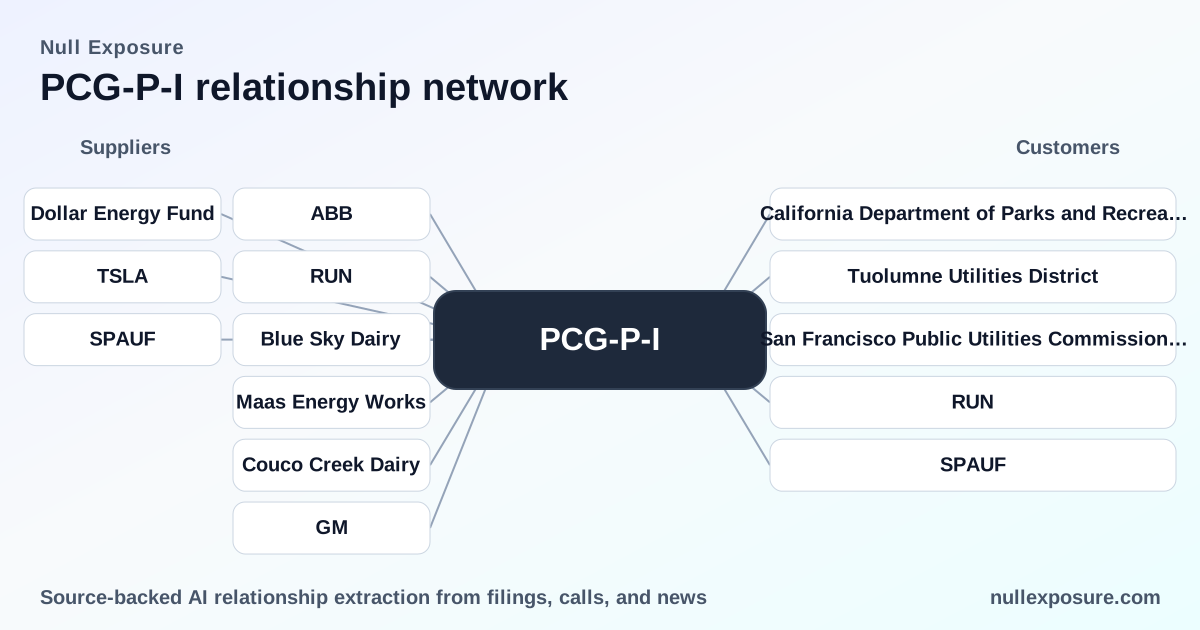
PCG-P-I: Customer Relationships That Matter to Preferred Holders
Pacific Gas and Electric Company (PG&E) operates as a regulated, vertically integrated utility serving Northern and Central California, monetizing through rate-regulated electricity and natural gas delivery, infrastructure investments, and long-term service agreements; holders of the PCG-P-I preferred issue receive a fixed dividend that reflects the company’s access to predictable regulated cash flow and balance-sheet priorities. For investors and operators, the quality and stability of PG&E’s customer and counterparty relationships are direct inputs into rate outcomes, regulatory exposure, and operational risk. For a concise view of related signals, visit Null Exposure.
Why customer relationships matter for a preferred stake
Preferred securities are sensitive to cash-flow predictability and capital structure decisions. Counterparty disruptions, municipal customer disputes, or coordination failures with distributed-energy aggregators can translate into tariff pressures or unexpected capital needs—all relevant to the credit profile behind a fixed dividend. The relationships below illustrate three operational vectors: asset disposition and land management, water and municipal supply dependency, and distributed-energy integration through virtual power plant (VPP) pilots.
What the feed shows — relationship-by-relationship review
California Department of Parks and Recreation
PG&E has agreed to transfer a 4,500‑acre parcel known as the “North Ranch” into a conservation easement and to pursue transferring ownership to a public agency such as the California Department of Parks and Recreation or a nonprofit or tribe. This is a property- and liability-management action that reduces PG&E’s land-holding exposure and signals active de-risking of legacy assets (TechXplore, March 2026).
Source: TechXplore news report on the North Ranch agreement (FY2025 / first seen March 10, 2026).
Tuolumne Utilities District
The Tuolumne Utilities District publicly urged customers to reduce water use after severe damage to PG&E’s Main Tuolumne Canal, which supplies roughly 95% of the district’s drinking water—an operational incident with direct municipal service impact and potential cost-sharing or recovery implications for PG&E (ABC10, FY2026).
Source: ABC10 local news coverage of canal damage and TUD’s response (first seen March 10, 2026).
San Francisco Public Utilities Commission (SFPUC)
Contract friction surfaced where developers and the SFPUC waited nearly a year for PG&E to provide a cost estimate needed to energize new housing; the delay highlights execution and customer-service frictions with municipal wholesale buyers and permitting stakeholders (KQED, FY2023). This type of delay imposes developer costs and can create political pressure that flows back to regulators.
Source: KQED feature on PG&E construction timelines and SFPUC interactions (FY2023 reporting).
RUN (Aggregator / Market Participant)
PG&E’s SAVE demonstration VPP provides participating aggregators with week‑ahead hourly signals tied to grid needs; RUN is listed among participating aggregators receiving those signals. This relationship positions PG&E as a coordinator of distributed resources and as a potential buyer/seller of flexibility services in pilot commercial arrangements (PR Newswire, FY2025).
Source: PR Newswire release announcing SAVE VPP participants and operational design (FY2025).
Sunrun
Sunrun is explicitly named as a participating aggregator in PG&E’s SAVE virtual power plant pilot, receiving operational signals from PG&E to align distributed solar + storage assets with grid needs—this expands PG&E’s interface with residential aggregators and introduces new coordination and settlement pathways (PR Newswire, FY2025).
Source: PR Newswire release on the SAVE VPP program and named participants (FY2025).
SPAN
SPAN is included among the SAVE pilot aggregators, indicating PG&E’s engagement with inverter and home-energy-platform vendors to orchestrate behind‑the‑meter resources; this reflects a strategic shift toward market-facing orchestration of distributed assets rather than pure top-down load control (PR Newswire, FY2025).
Source: PR Newswire announcement on SAVE participants and week‑ahead signal mechanics (FY2025).
How these relationships shape the operating model and investor constraints
No explicit contracting constraints were captured in the feed for PCG-P-I customer relationships; as a company-level signal, the absence of extracted constraints indicates our sources did not surface binding contract excerpts or quoted covenants tied to these relationships in the reviewed items. Independently of that absence, the relationship set suggests the following operating characteristics that are material for preferred investors:
- Contracting posture: PG&E operates under long-term regulated tariffs for core supply and increasingly negotiates operational protocols with municipalities and aggregators for emergent services (e.g., VPP signals). This posture combines regulated rate-setting with bilateral operational agreements for flexibility services.
- Concentration: Municipal and regional utilities (SFPUC, Tuolumne Utilities District) and large-scale aggregators are high-concentration counterparties for specific services—damage to a core asset like the Main Tuolumne Canal demonstrates single-point dependency risk.
- Criticality: The relationships are operationally critical—water-supply infrastructure, municipal electrification timelines, and the integration of distributed resources directly affect system reliability and regulatory scrutiny.
- Maturity: Traditional wholesale/municipal relationships are mature but show execution friction; emerging aggregator engagements (SAVE pilot with Sunrun, RUN, SPAN) are early-stage commercialization of distributed flexibility, implying evolving contracts and settlement mechanisms.
These characteristics combine to produce a hybrid risk profile: stable regulated cash flows for core commodity delivery, paired with execution and operational risk concentrated in key assets and nascent partnerships.
Investor implications and risk checklist
- Operational incidents translate to rate and reputational risk. The Tuolumne canal damage and protracted estimate delays for SFPUC customers are examples where operational failure or poor execution can trigger regulatory scrutiny and cost recovery debates.
- Distributed-energy engagements offer upside but add complexity. SAVE-style VPP pilots position PG&E to monetize grid services but require robust settlement and IT/operational coordination; counterparty performance risk shifts some delivery uncertainty to aggregators.
- Asset disposition reduces balance-sheet tail risk. The transfer/conservation of North Ranch acreage is a de-risking step that reduces future liability and aligns with public-agency land stewardship.
Key operational questions for preferred investors: How will PG&E allocate capex between reliability fixes and VPP/DER integration? How will regulators treat cost recovery for new orchestration systems? Answering these will determine the stability of preferred dividends under stress.
Final read and next steps
Bottom line: The customer relationships in the feed confirm PG&E’s dual reality—a core regulated utility with predictable revenue drivers and a set of high-criticality, high-execution relationships that introduce episodic risk. Investors in PCG-P-I should treat core cash flows as structurally stable while monitoring municipal incidents and pilot-scale aggregator programs as potential sources of volatility or regulatory attention.
For a deeper signal view across PG&E’s counterparties and customer interactions, visit Null Exposure.