Procore (PCOR): A subscription-software platform turning construction workflows into predictable recurring revenue
Procore operates a cloud-based construction management platform and monetizes primarily through subscription fees priced by product mix and annual construction volume, sold largely via a direct sales force to a mix of small businesses, mid-market firms, very large enterprises and public owners. Investors should value Procore as a recurring-revenue software vendor whose growth and margin expansion depend on enterprise adoption, integrations that increase platform stickiness, and geographic expansion beyond a U.S.-weighted revenue base. For further background or quick access to our coverage hub, visit https://nullexposure.com/.
How Procore sells and where the cash flows come from
Procore generates substantially all revenue from subscriptions that are structured as annual, multi‑year, or pooled multi‑year contracts tied to customers’ construction volume. Contracts are typically sold by a geographically and segment-specialized direct sales team, with pricing set by the number and mix of products purchased and the fixed aggregate dollar volume of construction work run through the platform. The company presents itself as both a seller and a cloud service provider: it sells access to software while operating the cloud platform customers consume.
- Procore reported strong customer scale with 17,088 customers on the platform as of December 31, 2024, reflecting steady year-over-year growth and a high gross retention rate that the company cites as evidence of recurring usage and renewal behavior.
- Revenue remains concentrated in the U.S., with the company reporting approximately 85% of revenue from U.S. billing locations in 2024; international expansion is explicit in the firm's mission to be a global platform.
These structural points — subscription pricing tied to construction volume, long-term contracting options, and heavy U.S. revenue concentration — define both the upside (predictable ARR, enterprise upgrades) and the principal risks (domestic macro sensitivity, foreign execution).
Operating constraints and what they imply for investors
Procore’s contract and customer profile produce a clear set of operating characteristics investors must price into the equity:
- Contracting posture is recurring and defensible. The company sells annual and multi-year subscriptions, plus pooled contracts over two- to three-year periods, which anchors revenue visibility and reduces churn exposure compared with transactional arrangements.
- Customer concentration across segments increases optionality. Procore serves small businesses through global enterprises and government owners; SMBs contribute a smaller share of ARR while mid-market and enterprise customers drive the bulk of revenue — a profile that supports upsell economics but requires sustained enterprise sales execution.
- Criticality and renewal dynamics favor retention. Procore cites a high gross retention rate, indicating its platform serves an operational role on active jobsites and becomes harder to replace once embedded.
- Geographic concentration is a double-edged sword. The U.S. dominance (85% of revenue in 2024) supports consistent ARR growth tied to a large domestic construction market but also concentrates exposure to U.S. construction cycles and spending dynamics.
- Platform nature and integrations matter. As a cloud-based service with mobile and web access, Procore’s competitive position depends on integrations that improve site visibility and equipment/resource management — partnerships that accelerate stickiness and data-driven use cases.
These constraints are company-level signals about maturity, contract stability, and concentration; they shape expected cash-flow stability and the scope for margin operating leverage.
Customer relationships that move the needle
Below is a concise coverage of every named customer relationship in public results and what each connection implies for strategic value.
NVIDIA (NVDA)
NVIDIA is positioning Procore’s continuous digital thread as a foundational layer for building AI factories, which positions Procore as a core software layer for digitally enabled, high-value infrastructure projects and could expand Procore’s role into enterprise AI-driven construction workflows. This linkage was reported in a market commentary on May 3, 2026 by Simply Wall St that highlighted NVIDIA’s use of Procore’s platform in AI infrastructure projects.
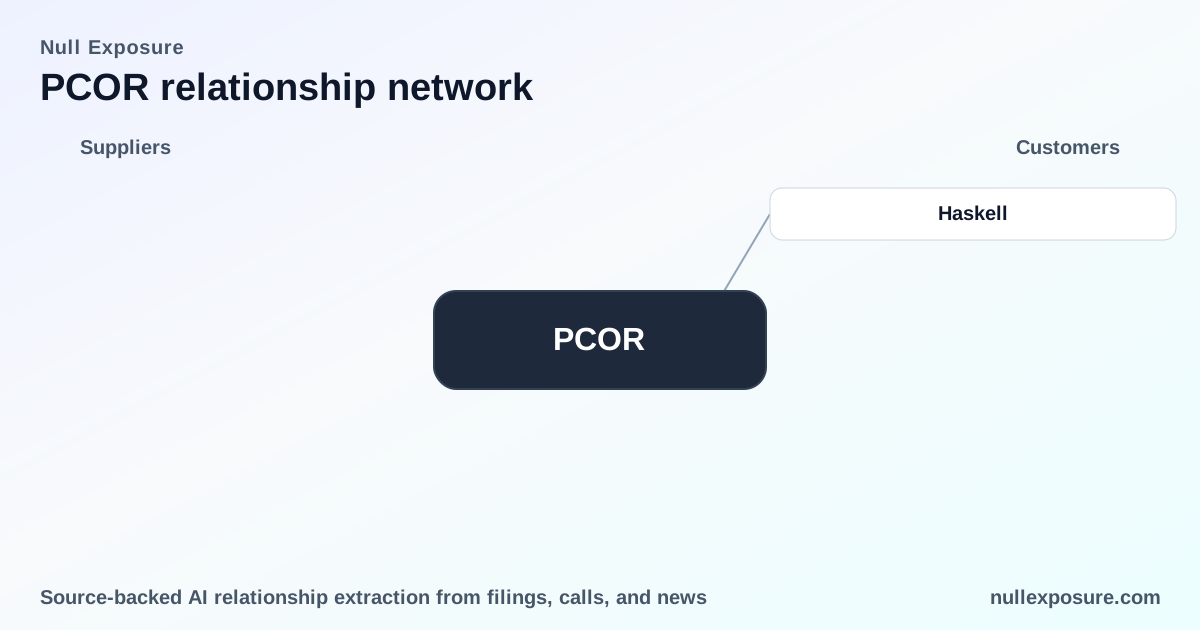
Haskell
Contractor Haskell reported immediate ROI from deploying Procore AI on a single project, saving superintendents multiple hours per day and demonstrating the platform’s tangible on-site productivity benefits that support expansion into adjacent projects. The outcome was described in a Tikr blog post dated March 10, 2026 that summarized customer-reported savings and productivity gains.
United Rentals (URI)
Procore and United Rentals announced a telematics partnership and integration in February 2026 enabling rental equipment data to flow directly into Procore’s Resource Management module, improving asset visibility and simplifying equipment management across jobsites — a concrete example of ecosystem integration that increases platform reliance. That partnership and its implications were reported by Simply Wall St in March 2026 covering the announced integration.
What these relationships mean for valuation and execution risk
Collectively, these relationships illustrate three strategic vectors that influence Procore’s valuation:
- Platform-led expansion into adjacent workflows. The NVIDIA reference elevates Procore’s platform beyond project management into high-value, digitally enabled infrastructure use cases, supporting a higher long-term multiple if Procore captures specialized enterprise demand.
- Demonstrable productivity ROI at the project level. Customer cases like Haskell provide proof points that justify subscription pricing and support upsell to AI-enabled modules.
- Integration-led stickiness through ecosystem partners. The United Rentals telematics tie demonstrates how data integrations convert peripheral vendors into distribution partners and deepen customer entrenchment.
These vectors underpin a premium growth multiple if Procore continues to convert pilot customers into enterprise-wide deployments, maintain high gross retention, and execute on international expansion while managing a sales-heavy cost base.
Risk profile summarized for investors
- Concentration risk: Heavy reliance on U.S. revenue (85% in 2024) ties growth to domestic construction cycles.
- Execution risk: Growth depends on enterprise sales and integration momentum to move mid-market clients into multi-product bundles.
- Margin leverage potential: High gross profit and subscription economics support future operating leverage, contingent on controlling sales and R&D spend as the company scales internationally.
For investors focused on software-led infrastructure plays, Procore offers a recurring-revenue business with clear avenues for expansion into AI and telematics-driven workflows; the near-term valuation must balance that strategic optionality against concentrated geography and the cost of scaling enterprise sales.
If you want a concise dashboard or deeper relationship mapping across Procore’s partner ecosystem, our research hub hosts curated analyst notes and relationship trackers at https://nullexposure.com/.
Bold takeaway: Procore is a subscription-first platform whose most valuable near-term assets are ecosystem integrations and enterprise AI use cases that convert project-level productivity proof into durable ARR expansion.