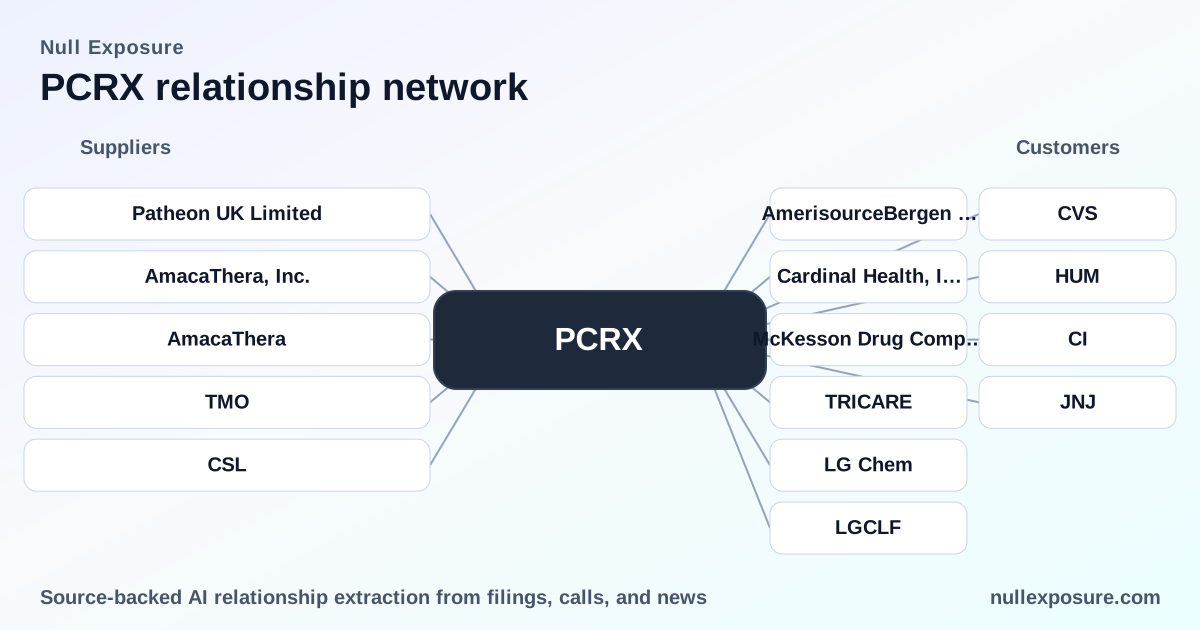
Pacira BioSciences (PCRX): Customer relationships that drive an EXPAREL‑centric business
Pacira BioSciences commercializes non‑opioid pain therapies—principally EXPAREL, which accounted for the bulk of revenue—and monetizes through product sales to hospitals and clinics via national wholesalers, direct device sales for iovera, and licensing/royalty arrangements with international partners. Revenue concentration with a small set of large wholesalers, expanding strategic partnerships (J&J MedTech, LG Chem), and evolving payer coverage are the three commercial dynamics investors should prioritize when modeling growth and downside risk. For a concise view of Pacira’s commercial footprint, visit https://nullexposure.com/.
Big wholesalers drive the revenue plumbing
Pacira routes the majority of its pharmaceutical product sales through a small group of national wholesalers—these relationships are material to near‑term cash flow and working capital.
- McKesson Drug Company — Pacira’s FY2024 Form 10‑K discloses McKesson accounted for 34% of total revenue for the year ended December 31, 2024, making McKesson the single largest distribution customer in that period. (Pacira 2024 Form 10‑K, FY2024)
- Cardinal Health, Inc. — Cardinal was the second large wholesaler, representing 23% of Pacira’s 2024 revenue per the company’s FY2024 filings. (Pacira 2024 Form 10‑K, FY2024)
- AmerisourceBergen Health Corporation — AmerisourceBergen rounded out the three large wholesalers, contributing 20% of 2024 revenue, according to Pacira’s disclosures. (Pacira 2024 Form 10‑K, FY2024)
Key takeaway: Pacira’s distribution and cash collection profile is highly concentrated with three large wholesalers, which amplifies counterparty and working‑capital risk.
Strategic partners expand reach and create non‑sales revenue
Pacira is deliberately expanding beyond the U.S. pull‑through model by locking in partners who will commercialize EXPAREL internationally and drive royalty and transfer‑price income.
- LG Chem — Pacira signed an exclusive commercial agreement giving LG Chem rights to commercialize EXPAREL in select Asia‑Pacific markets, with Pacira receiving an upfront payment, transfer pricing for supply, and tiered royalties on future sales; Pacira will continue to manufacture EXPAREL product for the arrangement. (Pacira press release reported on GlobeNewswire and Biospectrum Asia, Jan–Feb 2026)
- LGCLF (reported listings) — Financial and market outlets covering the LG Chem transaction referred to LG Chem’s ticker in market writeups, confirming the same commercial terms and exclusivity for the region. (Market reports on TradingView and Finviz, March 2026)
- Johnson & Johnson MedTech / J&J MedTech / JNJ — Pacira disclosed a strategic collaboration with J&J MedTech to extend promotional reach and leverage J&J’s commercial channels; the company described J&J MedTech as a core partner in investor communications and expects the relationship to add traction for ZILRETTA and other products. (Pacira proxy filing and earnings commentary, Apr–May 2026)
Key takeaway: These partnerships convert U.S. product leadership into international royalty/transfer‑price revenue while preserving Pacira’s manufacturing role and exposure to product demand.
For more on Pacira’s partner strategy and how it affects revenue mix, see https://nullexposure.com/.
Payers and policy changes: upside for access, downside for utilization
Pacira’s go‑to‑market success depends on payer coverage decisions and formulary placement; management flagged a meaningful policy shift among several large payers during Q4 commentary.
- Aetna — Management cited Aetna as one of the large payers showing a policy change that improves access to Pacira’s products, indicating broader payer momentum. (Pacira Q4 2025 earnings call, Mar 7, 2026)
- Cigna — Cigna was identified among payers where recent policy updates are materially changing coverage for Pacira’s therapies. (Pacira Q4 2025 earnings call, Mar 7, 2026)
- TRICARE — The company called out TRICARE as part of a group of payers implementing notable policy shifts relevant to product access. (Pacira Q4 2025 earnings call, Mar 7, 2026)
- Humana — Humana was named alongside other major insurers as part of the coverage developments Pacira highlighted. (Pacira Q4 2025 earnings call, Mar 7, 2026)
- CVS — Pacira’s earnings commentary included CVS among the large payers/retail PBM ecosystem that has updated policy in ways management described as meaningful for utilization. (Pacira Q4 2025 earnings call, Mar 7, 2026)
Key takeaway: Broader payer acceptance materially improves addressable market for EXPAREL and ZILRETTA; conversely, payer reversals would compress utilization and revenue.
How each named relationship fits the model (plain terms, with sources)
- TRICARE — Pacira’s Q4 2025 commentary listed TRICARE among payers implementing policy shifts that broaden access to Pacira’s therapies. (Pacira Q4 2025 earnings call, Mar 7, 2026)
- Cardinal Health, Inc. — Per Pacira’s FY2024 10‑K, Cardinal contributed 23% of 2024 revenue, a large single‑counterparty concentration for distribution and receivables. (Pacira 2024 Form 10‑K)
- McKesson Drug Company — McKesson accounted for 34% of 2024 revenue, the largest wholesale customer disclosed in Pacira’s FY2024 10‑K. (Pacira 2024 Form 10‑K)
- AmerisourceBergen Health Corporation — AmerisourceBergen represented 20% of 2024 revenue, completing the three‑wholesaler concentration cited by management. (Pacira 2024 Form 10‑K)
- LG Chem — Multiple press releases and market reports in early 2026 describe an exclusive APAC commercialization deal giving LG Chem rights to EXPAREL and establishing upfront payments, transfer pricing, and tiered royalties. (Pacira press release; GlobeNewswire, Biospectrum Asia; TradingView/Finviz coverage, Jan–Mar 2026)
- LGCLF — Market writeups referencing LG Chem’s ticker echoed the same transaction terms and timeline for APAC commercialization reported by Pacira and news outlets. (TradingView and Finviz, March 2026)
- Aetna — Named on Pacira’s Q4 2025 earnings call as a payer where policy shifts improve product access. (Pacira Q4 2025 earnings call, Mar 7, 2026)
- Johnson & Johnson MedTech — The company cited a strategic collaboration with J&J MedTech in investor materials and earnings commentary as a lever to expand promotional reach and patient access. (Pacira proxy filing and Q4 2025 earnings commentary, Apr–May 2026)
- J&J MedTech — Management reiterated expectations that the J&J MedTech collaboration will gain traction and expand Pacira’s commercial footprint in 2026. (Pacira Q4 2025 earnings call, Mar 7, 2026)
- JNJ — Public filings and earnings transcripts reference JNJ as the corporate parent and partner in the MedTech collaboration. (Pacira investor disclosures, Apr–May 2026)
- CVS — Listed by management among large payers/retail PBMs undergoing policy shifts that affect access and utilization. (Pacira Q4 2025 earnings call, Mar 7, 2026)
- Humana — Cited in the same earnings commentary as a payer making notable coverage changes favorable to Pacira’s offerings. (Pacira Q4 2025 earnings call, Mar 7, 2026)
- Cigna — Included with other large insurers in management’s discussion of favorable policy shifts during Q4 2025. (Pacira Q4 2025 earnings call, Mar 7, 2026)
Operating and business‑model constraints investors should bake into models
- Concentration: Pacira’s receivables and revenue are concentrated with a small number of large wholesalers; the company flags this as a material exposure to non‑payment or contract changes. (Company disclosures in FY2024 10‑K)
- Product concentration / criticality: EXPAREL generated 78% of 2024 revenue, making Pacira’s near‑term performance tightly correlated to Exparel demand and reimbursement. ZILRETTA represented ~17% of 2024 revenue, but EXPAREL is the dominant cash engine. (Pacira FY2024 disclosures)
- Geography / market maturity: Pacira’s commercial footprint is primarily U.S. today (ZILRETTA and iovera approvals and sales concentrated in North America), while EMEA and APAC are smaller or in early stages; LG Chem’s APAC deal shifts international expansion toward a staged, partner‑led model beginning in 2027. (Pacira 10‑K and 2026 partnership releases)
- Contracting posture: Pacira sells through wholesalers but retains manufacturing control and uses drop‑ship logistics for EXPAREL, which limits stock held by wholesalers but concentrates receivable and negotiation exposure. (Pacira FY2024 Form 10‑K)
- Relationship maturity: The J&J MedTech and LG Chem arrangements are early strategic partnerships intended to scale commercial reach through 2027–2030, which implies a multi‑year cadence before they materially replace U.S. wholesaler volumes. (Company investor communications, 2026)
What to watch next
- Wholesaler revenue share updates and any change in accounts receivable concentration.
- Measure of commercial traction from the J&J MedTech collaboration and LG Chem APAC launch (timing and royalty realization).
- Payer policy updates at the large insurers (Aetna, Cigna, Humana, TRICARE, CVS) that drive utilization and unit pricing.
- Quarterly disclosure of EXPAREL vs. ZILRETTA split and progress on iovera direct sales.
Pacira’s commercial map is straightforward: high dependency on EXPAREL sold through three wholesalers in the U.S., with international expansion funded through partnerships that generate upfront, transfer‑price, and royalty income. That profile delivers strong upside if partnerships scale and payers sustain favorable policies, and sharp downside if a large wholesaler or payer reverses course. For a deeper comparison of partnership structures and concentration risk across similar specialty pharmaceutical companies, visit https://nullexposure.com/.