PCS customer relationships: what handsets, roaming and affiliate loans tell investors
PCS operates as a wireless-services operator that generates revenue through device sales, service and interconnect roaming fees, and financial arrangements tied to spectrum and license transactions. The company monetizes by selling handsets into insurance/repair channels, exchanging traffic with roaming partners under interconnection agreements, and financing related parties to accelerate spectrum acquisitions — each activity exposing PCS to different commercial and credit dynamics that matter for valuation. For direct follow-up on these relationship signals, see our company coverage at https://nullexposure.com/.
Quick investor thesis
PCS’s business model mixes operational network revenue with non‑core balance‑sheet activity: recurring service and interconnect flows underpin cash generation, while device sales and large related‑party loans introduce episodic revenue and credit exposure. Investors should treat service economics and interconnect arrangements as the core earnings driver, and view handset sales and affiliate financing as margin-volatility and counterparty‑risk vectors that require discrete diligence.
The customer and partner relationships in record
Below I cover every relationship surfaced in the available public record and summarize the commercial fact pattern and source.
-
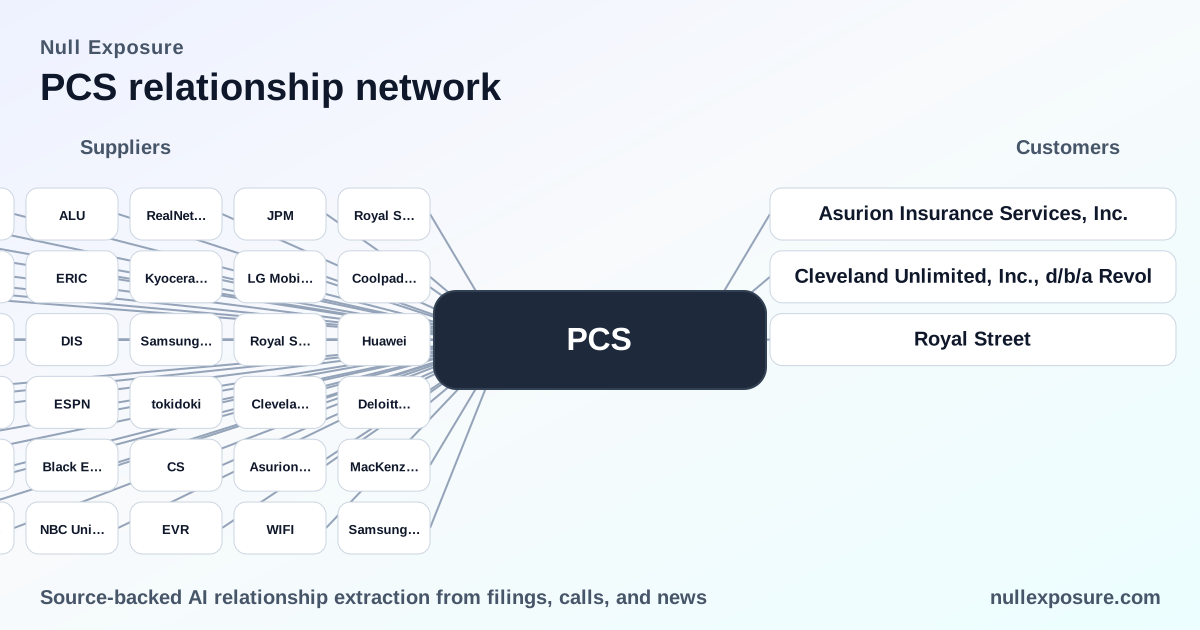
Asurion Insurance Services, Inc.
PCS sold handsets to Asurion, with reported sales of approximately $12.7 million in 2006 (and similar amounts in 2005 and 2004). This channel represents device revenue sold into the insurance/repair market rather than direct retail subscriptions. Source: SEC filing (see https://www.sec.gov/Archives/edgar/data/1283699/000095013407008244/d42548a3exv99w1.htm), excerpted reporting the handset sales amounts for the years ended December 31, 2006–2004. -
Cleveland Unlimited, Inc., d/b/a Revol
Effective June 19, 2006 PCS (MetroPCS Wireless, Inc. in the filing) entered an Interconnection and Traffic Exchange Agreement (TEA) with Cleveland Unlimited (Revol), establishing reciprocal wireless roaming services. This is an operationally critical contract for footprint and revenue from off‑network usage. Source: SEC filing (see https://www.sec.gov/Archives/edgar/data/1283699/000095013407008244/d42548a3exv99w1.htm), TEA notice dated June 19, 2006. -
Royal Street
As of December 31, 2006 Royal Street had borrowed $394 million from PCS under a loan agreement, approximately $294 million of which financed the acquisition of new licenses. That loan represents significant related‑party financing tied directly to spectrum and license expansion. Source: SEC filing (see https://www.sec.gov/Archives/edgar/data/1283699/000095013407008244/d42548a3exv99w1.htm), loan-balance disclosure as of Dec 31, 2006.
What these relationships reveal about PCS’s operating posture
Together the disclosures sketch a company with three distinct commercial behaviors:
-
A core operating stance focused on network services and interconnect cooperation. The TEA with Revol reflects standard carrier practice: mutual roaming and traffic exchange are strategically critical to coverage and incremental interconnect revenue.
-
A commercial supply relationship that generates modest, transactional device revenue. The Asurion sales—low‑double‑digit millions in a single year—signal a repeatable but non‑transformational revenue stream that supports device turnover and customer experience but does not replace service ARPU.
-
Active balance‑sheet deployment to support spectrum growth. The large loan to Royal Street demonstrates willingness to extend sizeable credit to related parties to secure licenses, which can accelerate strategic footprint expansion but introduces concentrated credit risk into PCS’s financial profile.
These characteristics collectively define PCS’s contracting posture: standard carrier interconnect contracts, transactional commercial sales, and concentrated, strategic financing. Absence of other constraint disclosures in the available record limits granular analysis of term lengths, collateral, and default covenants; however, the combination above is sufficient to flag where operational and financial risk concentrates.
Key risk and value implications for investors
- Counterparty credit risk is meaningful: a near‑$400 million loan to a related borrower is material to balance‑sheet risk and recovery dynamics; investors must probe covenant protections and repayment mechanics.
- Operational criticality centers on interconnect agreements: TEAs underpin network economics and roaming revenue; any renegotiation or termination risk affects both service availability and revenues.
- Revenue concentration is low on device sales but strategically relevant: device sales to an insurance provider like Asurion are relatively modest in scale, yet they smooth handset replacement flow and support customer retention programs.
- Strategic upside exists via license financing: financing that accelerates spectrum acquisition can be value‑accretive if licenses translate into higher service revenue and market share; however, value realization depends on execution and regulatory outcomes.
Bottom line: PCS’s core value driver is recurring service and interconnect economics; device sales and affiliate financing are secondary drivers that create asymmetric upside and downside.
Due diligence checklist for the next stage
- Obtain current versions of the TEAs and interconnect agreements to confirm rate methodologies, term lengths, and termination triggers.
- Review the Royal Street loan documentation for covenants, amortization, collateral and related‑party disclosures.
- Quantify handset sales as a percent of total revenue to assess how device channels influence gross margins and working capital.
- Reconcile historic disclosures to current filings to detect material changes in counterparties or exposures.
For an organized view of PCS’s counterparties and contract signals, visit https://nullexposure.com/ for our company coverage and follow‑on documents.
Final takeaway
PCS runs a hybrid model: stable, recurring network commerce sits alongside episodic device distribution and large related‑party financing. Investors must prioritize contract terms and counterparty credit when modeling long‑term cash flow and downside scenarios. The public filing excerpts cited above provide a clear starting point; deeper diligence on current contracts, loan documentation and the state of interconnect relationships will determine whether the affiliation and financing strategy enhances shareholder value or concentrates risk.