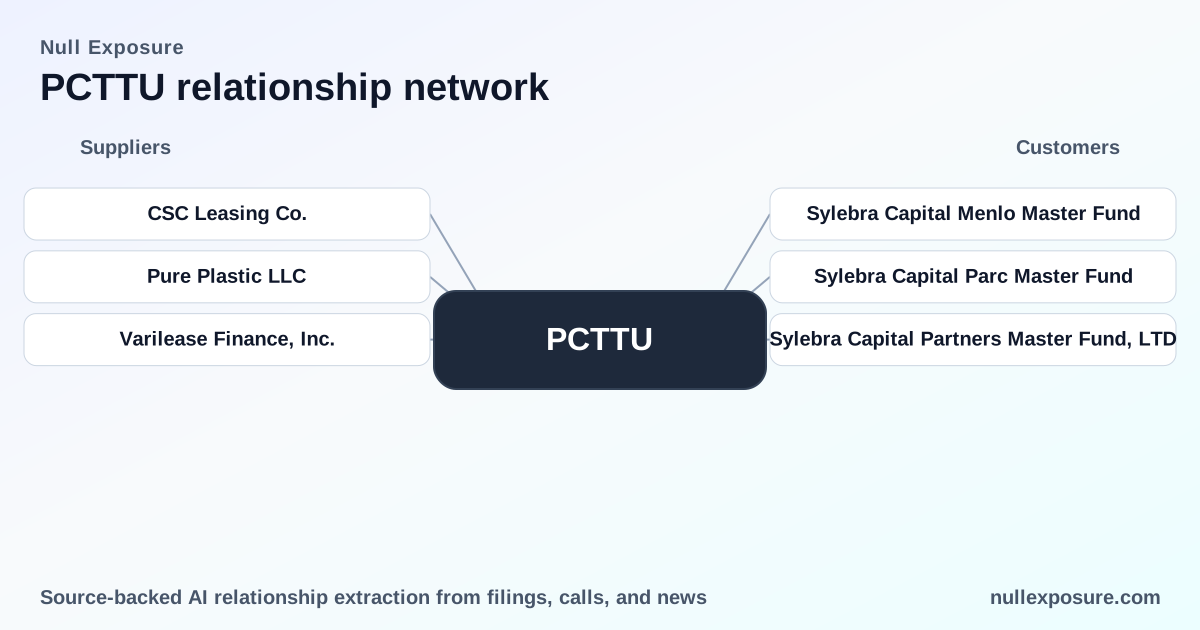
PureCycle (PCTTU): Capital relationships accelerate commercialization of PureFive™ resin
PureCycle Technologies operates a manufacturing and commercialization business that converts post‑use polypropylene into PureFive™ recycled polypropylene (PP) and monetizes through resin sales, long‑dated offtake commitments, and structured financing. The company depends on ramping production at its purification plants to convert pilot sales and prepayments into recurring revenue, while capital relationships such as a $150 million revolving credit facility provide working capital to bridge commercialization milestones. For a concise summary of PureCycle coverage and relationship signals, visit https://nullexposure.com/.
One credit facility, three named counterparties — what the filing actually records
PureCycle’s FY2024 Form 10‑K documents a single $150 million Revolving Credit Facility executed on March 15, 2023, under a Credit Agreement that names multiple Sylebra entities as parties. The structure is plainly a lender syndicate arrangement: the filing lists the three Sylebra funds as counterparties to that facility and records the facility as a material financing instrument supporting operations and growth initiatives. According to PureCycle’s 2024 Form 10‑K, the company entered into the $150 million facility on March 15, 2023 (FY2024 filing).
Sylebra Capital Menlo Master Fund
PureCycle identifies Sylebra Capital Menlo Master Fund as a party to the March 15, 2023 $150 million Revolving Credit Facility; this fund is named directly in the company’s FY2024 Form 10‑K as a counterparty under the Credit Agreement. (Source: PureCycle 2024 Form 10‑K.)
Sylebra Capital Parc Master Fund
Sylebra Capital Parc Master Fund is listed alongside the other Sylebra entities under the same $150 million Revolving Credit Facility executed in March 2023, indicating participation in the credit arrangement documented in the FY2024 10‑K. (Source: PureCycle 2024 Form 10‑K.)
Sylebra Capital Partners Master Fund, LTD
Sylebra Capital Partners Master Fund, LTD is the third Sylebra entity named in the credit documents for the March 15, 2023 $150 million Revolving Credit Facility disclosed in PureCycle’s FY2024 Form 10‑K. (Source: PureCycle 2024 Form 10‑K.)
How the disclosed relationships relate to PureCycle’s commercial strategy
PureCycle’s public disclosures paint a consistent commercial profile: long‑dated customer commitments, staged commercialization, global expansion intentions, and financing to bridge operational scale‑up. These are company‑level operating signals drawn from the FY2024 disclosures rather than attributes of any single counterparty.
- Long‑term contracting posture: The company has executed or negotiated strategic partnership term sheets for offtake agreements with terms of 20 years for PureFive™ resin, indicating a business model built on long‑dated supply relationships and predictability of demand when plants reach steady state.
- Global roll‑out intent: PureCycle expresses intention to build purification facilities globally as project financing becomes available, making geographic expansion a deliberate part of the growth plan rather than an opportunistic add‑on.
- Off‑balance‑sheet immateriality: Management explicitly states it has no off‑balance sheet arrangements that are material to financial condition or liquidity; while offtake term sheets exist, the company classifies them as conditional and not requiring off‑balance‑sheet disclosure.
- Commercial role and cash collection mechanics: The filings record instances of prepayments recorded as deferred revenue (for example, a $5.0 million prepayment under a prior block and release agreement), which demonstrates PureCycle’s capacity to accept customer prepayments and the use of deferred revenue to finance operations during commercialization.
- Relationship staging: pilot to ramp: PureCycle is currently conducting customer sampling and qualification (pilot stage) while simultaneously performing operational enhancements and ramping commercialization at the Ironton facility — management frames this as a transition from sampling to commercial ramp expected to drive meaningful sales into 2025.
- Core product focus: The business is structured around PureFive™ resin as its core product line, covering multiple grades intended to substitute for virgin polypropylene across converters, compounders, and consumer goods manufacturers.
These signals together form the operating model: capital relationships (like the Sylebra facility) provide liquidity while PureCycle converts pilot customers, prepayments and long‑dated offtakes into recurring product revenue as production stabilizes.
Why the Sylebra facility matters to investors and operators
PureCycle reported $8.36 million in trailing twelve‑month revenue and a materially negative EBITDA in FY2024, reflecting the company’s pre‑commercial to early‑commercial profile. The $150 million revolving facility therefore functions as a strategic funding lever: it underwrites working capital, funds operational fixes at Ironton, and supports the build‑out of additional purification capacity that underpins long‑term offtake economics.
Key implications:
- Concentration and counterparty risk: A single structured facility with multiple affiliated Sylebra funds concentrates lender exposure and creates a financing dependency until alternative capital sources or sustained product sales reduce utilization.
- Milestone sensitivity: Value realization for equity holders requires execution on production fixes and customer qualification — lenders will monitor ramp metrics and covenant compliance closely.
- Commercial durability: The presence of 20‑year offtake frameworks and prepayment arrangements signals a market appetite for PureFive™ when production achieves specification targets, supporting the revenue multiple potential once volume and quality scale.
For operators, this means aligning production reliability, quality specs, and sales conversion timelines with covenant schedules and draw conditions on the credit facility. For investors, monitor utilization, covenant waivers (if any), and reported progress on Ironton remediation and commercialization ramp.
Actionable watchlist for the next 12 months
- Track quarterly updates on Ironton operational improvements and ramp metrics, since commercialization timing drives cash flow and covenant risk.
- Watch for drawdown activity and amendments to the March 2023 $150 million facility in public filings; changes will reveal lender confidence and liquidity runway.
- Monitor customer conversion from sampling to offtake, especially any fully executed offtake agreements (beyond term sheets) and the timing of revenue recognition from prepayments.
- Evaluate progress on global project financing for additional sites, which will indicate the company’s ability to scale and diversify geographic and customer concentration.
For a structured review of counterparty and customer signals relevant to underwriting and portfolio stress testing, see our platform at https://nullexposure.com/ — it provides consolidated relationship context and filing‑level evidence.
Bottom line
PureCycle’s FY2024 disclosures establish a clear commercial path: long‑dated customer economics anchored to PureFive™ resin, operational ramping at existing facilities, and a concentrated credit facility that supplies working capital during commercialization. Investors and operators must assess execution against ramp milestones and monitor the Sylebra credit relationship for signs of covenant tolerance or tightening, as both will materially influence the company’s trajectory from pilot sales to scaled revenue.