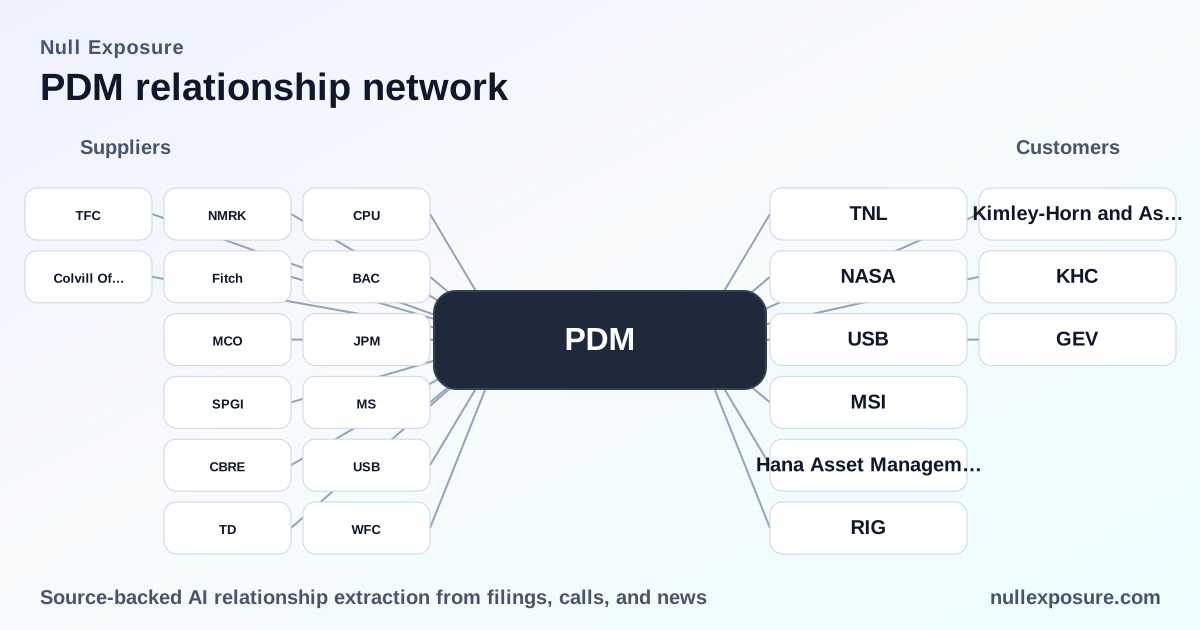
Piedmont Office Realty Trust (PDM): a tenant book that underwrites steady cash flow — if Sunbelt demand holds
Piedmont Office Realty Trust (NYSE: PDM) operates and monetizes a concentrated portfolio of Class A office properties across major U.S. Sunbelt markets. The firm generates principal revenue from long-term office leases and ancillary property-management fees, supplements value through selective asset sales and redevelopments, and leans on creditworthy corporate and governmental tenants to stabilize cash flow. For investors, the decision is driven by lease term durability, tenant credit quality, and regional concentration — all of which show up in the relationships summarized below. For a deeper, structured view of counterparties and commercial exposure visit https://nullexposure.com/.
What the operating model looks like in practice
Piedmont’s operating posture is contractual and long-term: company disclosures report an average lease size of ~14,000 square feet with an average remaining term of six years as of December 31, 2024, and rental income is the principal revenue source. The firm markets to investment-grade corporates and governmental agencies, producing a tenant mix that is both income-stable and skewed toward larger enterprises. The portfolio is concentrated in Sunbelt growth submarkets, which drives upside through leasing momentum but raises regional concentration risk. As of year-end 2024 Piedmont owned 30 in-service projects (≈15.3 million sq. ft.) that were 88.4% leased, signaling an active, cash-generating asset base with a modest near-term lease rollover (less than 9% of ALR scheduled to expire in the next 12 months). These are company-level signals drawn from Piedmont’s public disclosures.
Tenant and counterparty roll call: who pays Piedmont (and when)
Below are every counterpart named in public reporting collected for PDM’s customer relationships. Each entry is a concise, plain-English takeaway with the original reporting source.
SGN — strategic infrastructure supplier (FY2026)
SGN disclosed a strategic collaboration with Piedmont to supply transformers, switchgear and substations, tied to a planned 5–6 GW capacity pipeline referenced in the report. This represents a capital project and vendor relationship for Piedmont’s infrastructure needs. Source: TradingView news coverage (March 2026).
Travel + Leisure Co. (TNL) — full-building headquarters lease, downtown Orlando (FY2024)
Travel + Leisure signed a lease for the entire 182,000‑square‑foot, five‑story building through 2040 and will consolidate roughly 900 employees at the Piedmont-owned address, reflecting a long-term, single-tenant commitment. Source: Yahoo Finance and Orlando regional business reporting (reported March 2026, referring to the FY2024 lease).
Transocean (RIG) — large single-building tenant in Houston (FY2018)
Transocean leased the entire 300,000‑square‑foot Enclave Place building in the Energy Corridor, a transaction that converted a long-vacant asset into full occupancy and demonstrates Piedmont’s ability to secure large energy-sector tenants. Source: RealtyNewsReport and Houston Business Journal coverage (2018 reporting).
NASA — long-term government tenancy and an asset sale (FY2017)
A prior 15‑year NASA lease generated strong value creation for Piedmont, later culminating in sale activity tied to the asset, illustrating how government tenancy can underwrite value extraction. Source: Yahoo Finance coverage of the asset sale (2017).
Kimley‑Horn and Associates — long-term office lease in Orlando (FY2022)
Kimley‑Horn leased roughly 61,000 square feet at Piedmont’s 200 and 222 South Orange Avenue buildings through 2034, reinforcing the Orlando market’s role in Piedmont’s tenant base and the firm’s success in mid-sized professional-services leases. Source: CityBiz (2022).
Triumph Financial (TFINP) — asset sale counterparty (FY2025)
Piedmont sold a locally owned office building to Triumph for approximately $54 million after a decade of ownership, showing active portfolio recycling and capital redeployment as part of portfolio management. Source: Dallas News (December 2025).
Motorola Solutions, Inc. (MSI) — large-scale Chicago lease (FY2015)
Motorola signed a 150,345‑square‑foot, 12‑year lease through 2028 at Piedmont’s 500 West Monroe Street property in Chicago, an example of multi-year, high‑square‑footage commitments from technology/communications firms. Source: GrowthSpotter reporting (2015).
U.S. Bancorp (USB) — major headquarters renewal, Minneapolis (FY2023)
Newmark announced a 447,000‑square‑foot renewal by U.S. Bancorp at 800 Nicollet Mall on behalf of Piedmont, a marquee, large-enterprise renewal that materially supports Piedmont’s ALR and stability in that market. Source: PR Newswire (2023).
Hana Asset Management — institutional acquisition of a major asset (FY2017)
Piedmont sold Two Independence Square in Washington, D.C. to Hana Asset Management for roughly $360 million, demonstrating Piedmont’s willingness to monetize stabilized, large assets to institutional buyers. Source: Yahoo Finance (2017).
The Kraft Heinz Company (KHC) — large lease in Chicago (FY2015)
Kraft Heinz committed about 169,717 square feet through 2029 at Aon Center, signaling long-term occupancy by national consumer‑goods firms in Piedmont’s central business district holdings. Source: GrowthSpotter (2015).
GE Vernova (GEV) — strategic hub lease at Atlanta Galleria (FY2023)
GE Vernova signed a 77,000‑square‑foot lease through 2036 at Piedmont’s Atlanta Galleria, reflecting strategic relocations by industrial and energy-sector spinouts into suburban Sunbelt campuses. Source: FinancialContent / Markets coverage (October 2023).
What these relationships collectively tell investors
- Contracting posture is defensive and long‑dated. Piedmont structures leases to be multi‑year, reducing near-term cash flow volatility and supporting rent roll predictability. This is reinforced by company disclosures of average lease lengths and low near-term expirations.
- Tenant credit skews toward large corporates and government. The tenant list contains major national corporations and government agencies — a defensive mix that supports lower turnover and higher collection certainty.
- Regional concentration is both the growth lever and the principal risk. Sunbelt exposure concentrates upside where demand is expanding, but also creates geographic risk if local markets soften.
- Active portfolio management is central to returns. Piedmont monetizes stabilized assets to institutional buyers and repositions others through leasing wins, which is essential given negative EPS and margin dynamics in recent reporting (company financials show positive operating margin but negative net EPS on a TTM basis).
For a full, regularized assessment of counterparty exposure and lease expirations, see our issuer coverage at https://nullexposure.com/.
Bottom line for investors
Piedmont’s customer relationships are characterized by long-term leases, large enterprise and government tenants, and deliberate asset recycling, creating a cash-flow profile that is predictable if Sunbelt fundamentals continue to hold. The principal trade for equity investors is between lease durability and regional concentration — stability in rent roll versus exposure to localized office demand shifts.