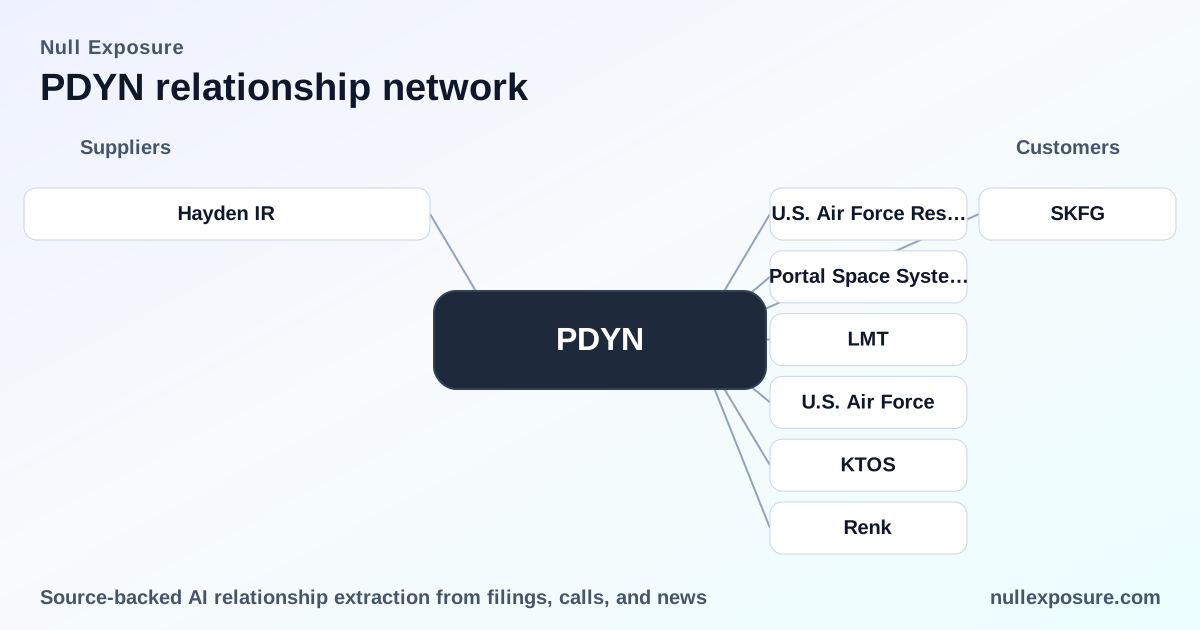
Palladyne AI (PDYN): Customer Map and Commercial Signals for Investors
Palladyne AI sells embodied neuro-symbolic AI software for autonomous vehicles and mission systems alongside associated compute hardware, monetizing primarily through term-based software licensing and product development contracts with U.S. government and defense primes. Its go-to-market is dominated by trial and pilot deployments in defense and aerospace, with revenue currently concentrated in North America and structured around recurring license economics plus one-off hardware or development fees. For a concise portfolio of customer intelligence on PDYN, visit https://nullexposure.com/.
How Palladyne’s operating model shows up in its customer list
Palladyne’s public signals indicate a licensing-first monetization posture: the company offers Palladyne IQ and Pilot under term-based licenses that create recurring revenue potential and can bundle or pass through hardware costs. Public disclosures and press coverage also show heavy reliance on U.S. government customers and defense primes, concentrated in North America and oriented around pilot-stage, mission-focused integrations. That combination implies a contracting posture that is project-oriented, government-heavy, and partner-dependent, where commercialization depends on converting pilots into stable license streams and prime-level integrations. Palladyne targets infrastructure, manufacturing, aerospace and defense applications while positioning its software as a seller-delivered product that often ships with hardware and integration services.
Full relationship walk‑through (every result, no omissions)
Below I cover every customer or partner mention in the public results; each entry includes a one-to-two sentence plain-English summary and a concise source reference.
U.S. Air Force Research Laboratory (AFRL)
Palladyne won an AFRL contract called HANGTIME to coordinate autonomous systems and improve cross-domain swarm operations, signaling direct federal research funding and operational trials. This was reported in March 2026 by StockTwits and reinforced in industry coverage the same period. (StockTwits, March 10, 2026; Tokenist, March 2026)
Draganfly Inc. (DPRO)
Palladyne integrated its SwarmOS platform with Draganfly’s mission-ready drone components and validated the integration through a flight simulation, demonstrating hardware-agnostic swarm software capability. (sUAS News, May 3, 2026)
RCAT (Red Cat)
Palladyne has an existing contract or memorandum of understanding with Red Cat to deliver drone software, indicating a channel/partner relationship with a specialized unmanned-systems vendor. (TradingView idea post, May 3, 2026)
U.S. Navy
A Palladyne subsidiary secured a contract from the U.S. Navy to develop near-hypersonic, air-launched missile technologies, expanding Palladyne’s defense development footprint beyond unmanned systems. (StockTwits report, May 3, 2026; Bitget, March 18, 2026)
Lockheed Martin (LMT)
Palladyne identifies Lockheed Martin as a prime customer or partner in its defense division narrative, indicating access to top-tier prime integrators and routes to scale in defense programs. (GovConWire profile, FY2025 coverage)
Mobilicom (MOB / MOBBW)
Palladyne and Mobilicom announced a partnership to bundle Palladyne AI software with Mobilicom’s OS3 cybersecurity solution, positioning their combined product for secure autonomous operations. (Yahoo Finance press release, March 10, 2026; Futunn, March 2026)
Portal Space Systems
Palladyne’s subsidiary GuideTech won a contract to support maneuverable spacecraft and next‑generation space logistics, signaling an extension of Palladyne’s software/embedded systems into space applications. (StockTwits, March 10, 2026; MarketBeat earnings commentary, March 20, 2026)
Kratos (KTOS)
Kratos is listed among the primes Palladyne currently works with, reinforcing a strategy of teaming with defense contractors that supply unmanned and aerospace systems. (GovConWire profile, FY2025)
United States Air Force (general references)
Palladyne references multiple Air Force engagements, including aircraft maintenance trials for its IQ product, showing repeated operational pilots and government trial activity. (MarketScreener and MarketBeat coverage, FY2026; Utah Business interview, FY2025)
MOBBW (Mobilicom B/W ticker reference)
A separate media mention reiterates the Mobilicom bundle—PalladyneAI’s software paired with OS3 cybersecurity—underscoring a repeated channel partnership message across outlets. (Futunn, March 2026)
DPRO (alternate Draganfly mention)
Industry reporting confirms Palladyne’s integration milestone with Draganfly hardware for autonomous drone swarms, restating the same integration success in specialized robotics media. (The Robot Report, May 2, 2026)
Draganfly (non‑ticker mention)
Company filings and earnings-comments note MOUs with Draganfly to expand capabilities via military development contracts, highlighting strategic collaboration and co-development posture. (MarketBeat earnings report, March 20, 2026)
Red Cat (RCAT duplicate reference)
Market commentary and company remarks reference an MOU with Red Cat alongside Draganfly as means to expand commercial and military capabilities. (MarketBeat, March 20, 2026)
Renk
Renk appears in Palladyne’s description of current prime relationships, indicating additional prime-tier industry contacts in defense systems supply chains. (GovConWire profile, FY2025)
SKFG (Stark/SKFG label)
SKFG appears in the GovConWire list as one of several primes Palladyne works with, implying a diversified set of prime collaborators in its defense pipeline. (GovConWire, FY2025)
Stark (alternate SKFG mention)
Stark is named within the same GovConWire prime roster, again signaling a multi-prime engagement strategy. (GovConWire, FY2025)
Note: multiple media items repeat the same underlying customer relationships (Air Force, Navy, Draganfly, Red Cat, Mobilicom) across different outlets and dates; the above entries preserve each reported item and source.
What these relationships tell investors about PDYN’s commercial runway
- Revenue mix and contracting posture: Public disclosures and press reports show Palladyne deriving revenue from U.S. government development contracts and MOUs with defense primes, while positioning a term-based licensing model for its commercialized products that creates recurring revenue potential.
- Concentration and criticality: The customer base is concentrated in the U.S. defense and aerospace ecosystem and routed through primes; success depends on converting pilots into long-term license agreements and winning prime bids where software is a component of larger systems.
- Stage and maturity: Multiple references to trials, simulations and MOUs indicate that many engagements remain at the pilot/integration stage, consistent with the company’s stated product testing and reliability improvement cycle.
- Geographic focus: The company’s revenue and sales efforts are North America‑centric, reducing near-term international diversification but aligning with defense budget tailwinds.
- Seller posture and product model: Palladyne operates as a seller of software bundled with compute hardware and integration services, with licensing as the primary monetization lever and development contracts providing upfront funding.
If you want a consolidated analytics brief for portfolio diligence, Null Exposure provides curated relationship intelligence and source-backed summaries — see https://nullexposure.com/ for more.
Investment implications and risks
- Upside drivers: Conversion of government pilots to term licenses and deeper adoption by primes would materially scale recurring revenue; partnerships with companies like Mobilicom and integration wins with Draganfly and Red Cat validate product fit across air, land and space platforms.
- Key risks: Customer concentration in government contracting, pilot-stage deployments, and reliance on prime partnerships introduce execution risk and potential revenue lumpiness until recurring licensing replaces one-off development fees. Regulatory and program-security requirements for defense programs also impose long sales cycles and integration costs.
- Operational signal: The company’s balance of development contracts and licensing positions it between an R&D contractor and a commercial SaaS-style vendor—execution on commercialization and license renewal rates will determine valuation expansion.
Bottom line: Palladyne is firmly embedded in the U.S. defense and aerospace procurement ecosystem, with clear product-market relevance for autonomous systems and early traction across primes and specialized vendors; the investment case hinges on scaling pilots into predictable licensing revenue and deepening prime integrations.