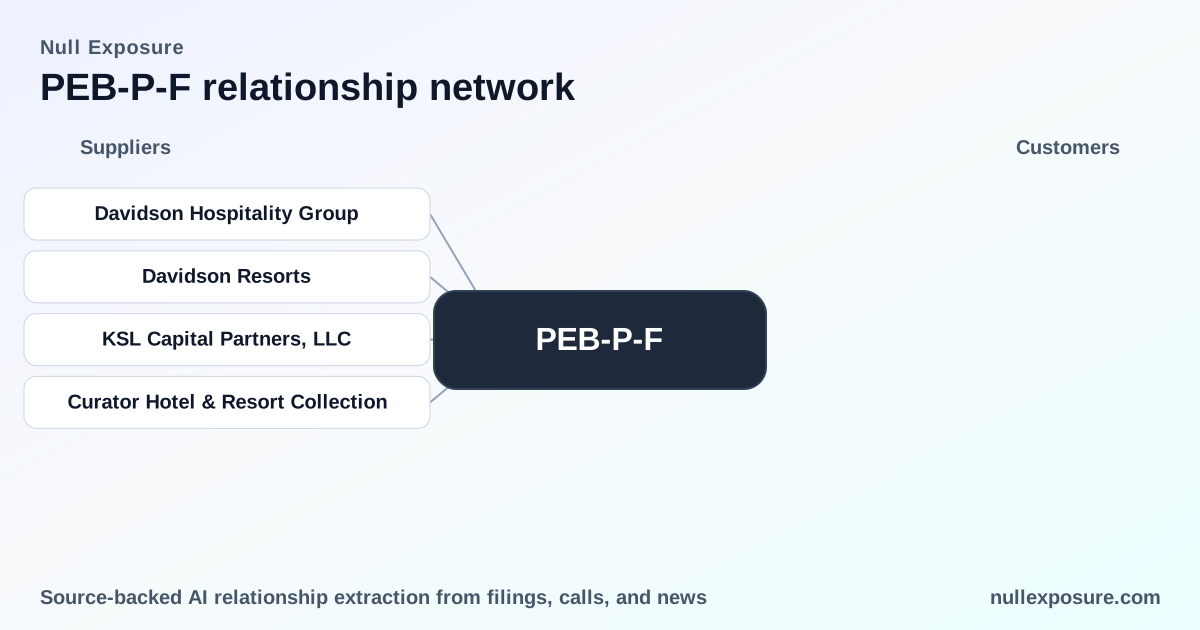
Pebblebrook’s Preferred: How PEB-P-F Ties to Event-Driven Demand
Pebblebrook Hotel Trust operates and monetizes as a focused hospitality REIT: it owns and manages upscale, full-service hotels in major urban and leisure markets and captures cash flow through room revenue, group and corporate event bookings, food & beverage and ancillary services, and selective asset-level enhancements and dispositions. The 6.30% perpetual preferred (PEB-P-F) is an income instrument that reflects the company’s asset-backed cash-generating profile and exposure to episodic group demand. For investors evaluating customer relationships, the primary signal here is how marquee groups and event organizers convert into near-term revenue inflections and cyclical occupancy patches. For an ongoing feed of relationship intelligence, see https://nullexposure.com/.
What a single customer mention tells investors about revenue drivers
Pebblebrook’s economics are straightforward: short-duration cash flows from transient guests plus higher-margin, concentrated cash flows from group and event business. A single media-captured relationship — a booking related to FIFA — illustrates how large, brand-name events translate into meaningful, time-bound revenue uplifts for urban and resort hotels. These bookings are not recurring subscriptions; they are transactional, high-intensity revenue events that can materially shift quarterly performance when they land.
- Contracting posture: Predominantly short-form agreements and block-room contracts with event organizers and sponsors rather than long-term take-or-pay contracts.
- Revenue concentration: Ongoing income is diversified across many properties and guests, but episodic relationships with major events create temporary concentration risk and upside.
- Criticality to operations: Large group contracts are critical to short-term margins, F&B spend, and occupancy mix at impacted hotels.
- Maturity of relationships: These are typically transactional and event-driven rather than long-duration partnerships.
The customer list: a single but illustrative mention
FIFA — event booking that lifts near-term bookings and F&B spend
Pebblebrook disclosed that it has booked group demand “from teams, sponsors, and FIFA,” indicating direct bookings tied to a major sports event that will drive concentrated occupancy and ancillary revenue for the affected hotels. According to an earnings call transcript reported by Investing.com in May 2026, management highlighted these FIFA-related bookings as part of the quarter’s demand drivers (Investing.com, May 2026 — earnings call transcript). (Source: https://ca.investing.com/news/stock-market-news/earnings-call-transcript-pebblebrook-hotel-trust-beats-q1-2026-forecasts-93CH-4595840)
This single-line disclosure is short but meaningful: the presence of FIFA as a booked counterparty signals high-margin, short-window revenue that disproportionately benefits urban full-service hotels with conference and banquet capacity.
Why this relationship matters for preferred stock investors
Preferred holders weight cash-hook reliability and priority of distributions over equity upside. Event-driven revenue like FIFA bookings improves near-term cash flow visibility, supporting dividend coverage and reducing short-term liquidity stress. However, because these bookings are episodic rather than contractual staples, investors must treat them as tailwinds rather than recurring guarantees.
- Positive: Event bookings accelerate cash receipts, increase F&B and ancillary margins, and can push occupancy through peak pricing.
- Cautionary: Reliance on episodic large events increases quarterly volatility; if events are rescheduled or attendance underwhelms, the revenue delta reverses quickly.
Constraints and company-level operating signals
The dataset provided no explicit contractual constraints, concentration disclosures, or maturity schedules tied to named customers. That absence is a company-level signal: no documented long-term customer contracts or exclusive relationships were identified in the available customer-scope data. Investors should therefore assume Pebblebrook’s customer posture is predominantly transactional and asset-centric rather than contract-heavy.
Operational and strategic characteristics for investors to note:
- Contracting posture: Short-term, event and block-room contracts; pricing leverage is seasonal and market-driven.
- Concentration: Portfolio-level diversification across properties moderates counterparty concentration, but major events create localized concentration risk.
- Criticality: Group and event bookings are operationally critical for property-level margins during event windows.
- Maturity: Customer relationships tend to be low-maturity, transaction-based bookings rather than multi-year supply contracts.
These characteristics reinforce that the preferred stock’s cash security is tied more to asset performance and balance-sheet management than to long-term customer contract protections.
Practical investor implications and risk framing
For research analysts and operators, the FIFA booking is an instructive micro-case: it validates management’s ability to capture premium group demand and to monetize sponsorship-driven traffic. From a portfolio perspective:
- Earnings sensitivity: Expect lumpy earnings around major events; model quarterly occupancy and F&B upside conservatively, and stress-test for event cancellations or muted attendance.
- Liquidity and coverage: Use event-driven cash flow as a buffer, not as a steady-state assumption for dividend coverage on the preferred.
- Operational leverage: Confirm which properties benefit from such bookings and whether capital allocation (renovations, labor scheduling) is aligned to capture incremental margin.
Bottom line and next steps
Pebblebrook’s mention of FIFA bookings demonstrates the REIT’s ability to monetize high-profile, short-duration events into measurable revenue outcomes. For preferred stock investors, these events are material near-term upside that support distribution coverage but do not replace the need for balance-sheet and asset-level diligence.
If you want continuous, relationship-level intelligence to refine cash-flow and counterparty risk models, explore more at https://nullexposure.com/.
Key takeaway: transactional, event-driven customer relationships amplify short-term cash flow but preserve structural volatility — treat episodic bookings as opportunistic cover rather than recurring revenue certainty.