Peoples Bancorp of North Carolina (PEBK): Customer Relationships and the NCDOT Episodic Gain
Peoples Bancorp of North Carolina is a regional, community-focused bank that monetizes primarily through net interest margin on commercial and consumer loans, fee income from deposit services, and local business banking relationships across a concentrated North Carolina footprint. The bank’s operating model is branch-centric and deposit-funded, with a portfolio skewed to individuals and small-to-medium businesses within a roughly 50-mile radius of its Newton headquarters; earnings volatility can therefore be driven by local credit cycles and a small number of large deposit relationships. For research access and relationship discovery, visit the firm overview at Null Exposure: https://nullexposure.com/.
The headline relationship: a $3 million one-time gain from the North Carolina DOT
Peoples disclosed a $3.0 million net gain tied to the North Carolina Department of Transportation’s eminent domain acquisition of the bank’s former Mooresville branch property; management flagged that gain as a notable factor influencing the quarter’s results in FY2026. This was a transaction-driven, non-recurring credit to the period rather than an operating revenue stream. (Reporting and company press coverage: The Globe and Mail, March 2026; Yahoo Finance, May 2026.)
- According to press coverage and the company’s Q4 commentary, the North Carolina Department of Transportation completed an eminent domain acquisition of the former Mooresville branch site, producing the $3 million net gain recorded in the quarter (The Globe and Mail, March 10, 2026; Yahoo Finance, May 3, 2026).
Why that single relationship matters to investors
The North Carolina DOT interaction is important for quarterly EPS dynamics but not for recurring margin. The $3 million boost is reported as a one-off realized gain tied to property disposition, so investors should treat it as an earnings timing event rather than evidence of sustainable revenue growth. The bank’s base business—deposit gathering and loan origination to local consumers and small businesses—remains the primary value driver.
Key takeaways:
- Earnings quality: The DOT gain inflates near-term profitability metrics without altering core credit or deposit franchise economics.
- Valuation context: With a trailing P/E around 11 and a modest market cap (~$210 million), one-off gains can materially influence short-term multiples for a small regional bank.
All reported customer relationships (full coverage)
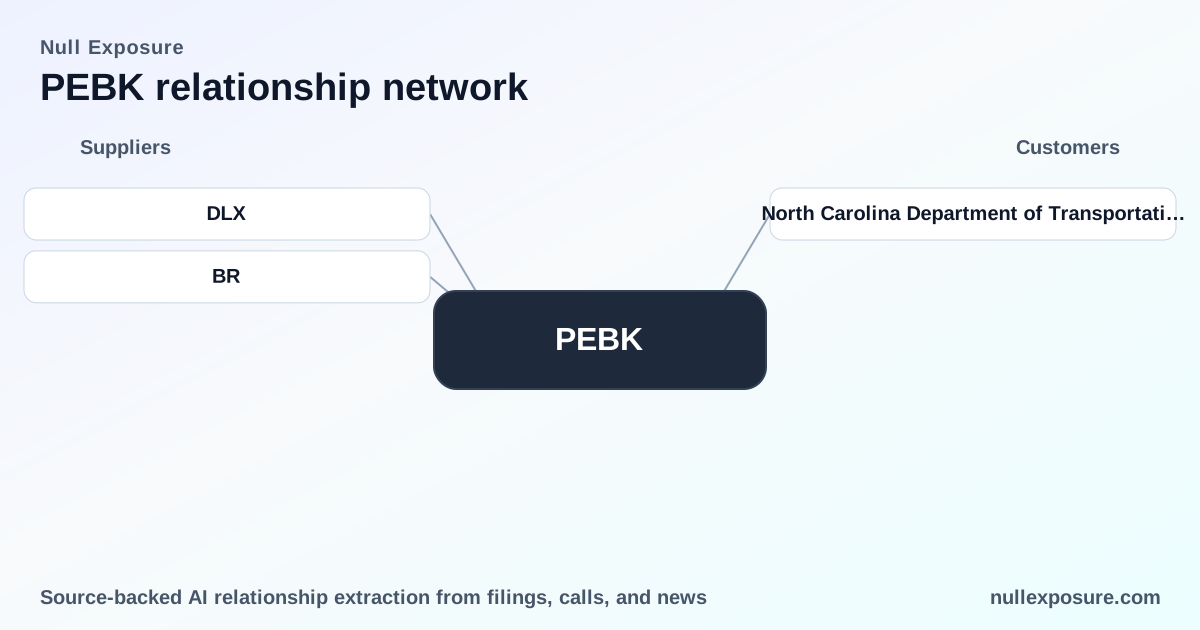
North Carolina Department of Transportation — The state agency acquired the bank’s former Mooresville branch property through eminent domain, and Peoples recognized a $3.0 million net gain in FY2026 that materially influenced the quarter’s reported results. (Press reports and Q4 commentary: The Globe and Mail, March 10, 2026; Yahoo Finance, May 3, 2026.)
Operating and business-model constraints that shape counterparty dynamics
The publicly available relationship constraints provide a clear portrait of how Peoples sources and serves its customers and where concentration and operational risk live:
- Counterparty mix: The bank serves primarily individuals, small businesses, and mid-market customers concentrated inside its local market. That client mix drives product focus toward consumer and commercial lending, deposit products, and localized service delivery rather than national corporate banking relationships.
- Geographic concentration: The bank’s primary market is an approximately 50-mile radius around Newton, North Carolina, implying local economic cyclicality and correlated credit exposure across its borrower base.
- Funding concentration: The bank notes that a small number of large deposit relationships provide a significant level of funding, which introduces counterparty concentration risk and a sensitivity to the decisions of a few key depositors.
- Role and segment posture: As a buyer/provider of banking services to local customers, Peoples operates in the services segment as a community commercial bank with 16 offices serving the Catawba Valley and neighboring markets.
- Contracting posture and maturity signals: The bank’s longstanding community presence (founded 1912) and branch footprint indicate mature local customer relationships, but contracting terms will typically reflect retail/small business norms—standard deposit agreements, loan covenants for commercial borrowers, and limited centralized bargaining power.
Presenting these constraints together yields a clear operating profile: localized, relationship-driven origination; funding dependent on a small number of materially large deposit relationships; and earnings that can be meaningfully affected by discrete non-operational events (property dispositions, legal actions, or large deposit movements).
Risk-reward implications for investors and operators
For investors:
- Upside: Stable local deposit base, healthy profitability metrics (ROE ~13.4% TTM), and modest valuation multiples create a defensive small-cap bank story in a low-beta profile.
- Risks: Concentration risk—both geographic and depositor—represents the primary downside, and one-off accounting gains (such as the DOT transaction) can obscure underlying trendline performance.
For operators:
- Strategic priority is diversification of funding sources and preservation of core deposit relationships to reduce the impact of a few large accounts.
- Real estate and property management policies deserve attention; branch disposition and property exposure can create material P&L volatility when resolved through eminent domain or sale.
Bottom line and practical next steps
Peoples Bancorp of North Carolina is a classic community bank whose earnings profile is dominated by local lending margins and a concentrated funding base; the North Carolina DOT eminent domain settlement delivered a meaningful but non-recurring boost in FY2026. Investors should focus on core-credit trends, deposit stickiness among the bank’s largest accounts, and management’s capital deployment strategy after one-off gains.
If you want a transactional view of customer relationships and to track similar counterparties across regional banks, explore our platform for coverage and analytics: https://nullexposure.com/.
For a deeper read on how one-off property events influence regional bank valuations and to see relationship-level disclosures extracted from filings and news, visit Null Exposure’s research hub: https://nullexposure.com/.