Phillips Edison & Company: Grocery-anchored cash flow with active leasing and JV scale
Phillips Edison & Company (PECO) operates and monetizes as a grocery‑anchored retail REIT—owning, operating and developing neighborhood shopping centers while collecting lease revenues from long‑running operating leases and generating ancillary fee income through third‑party investment management of joint ventures. The company’s cash flow is driven by necessity‑based anchors (roughly 70% of ABR) plus a high portfolio occupancy profile and active asset rotation and redevelopment programs that extract rent growth through re‑tenanting and parcel repurposing. For investors evaluating customer exposure, the mix of national grocers, regional banners and local service tenants frames both resilience and concentrated anchor risk.
If you want direct access to the underlying relationship intelligence and reporting we used for this note, visit https://nullexposure.com/ for full coverage and downloadable reference material.
Why the customer book matters to PECO’s valuation
PECO’s contracting posture is principally as a lessor: the firm records the majority of its revenue from operating leases with grocery anchors and necessity‑based Neighbors. Public disclosures enumerate operating lease structures and more than 600 lease expirations in a single year, which institutional investors should treat as an active maturity book that creates both rollover risk and re‑pricing opportunities. The portfolio is concentrated in the United States, with management explicitly stating there are no foreign operations, so geographic risk is domestic and tied to U.S. retail fundamentals.
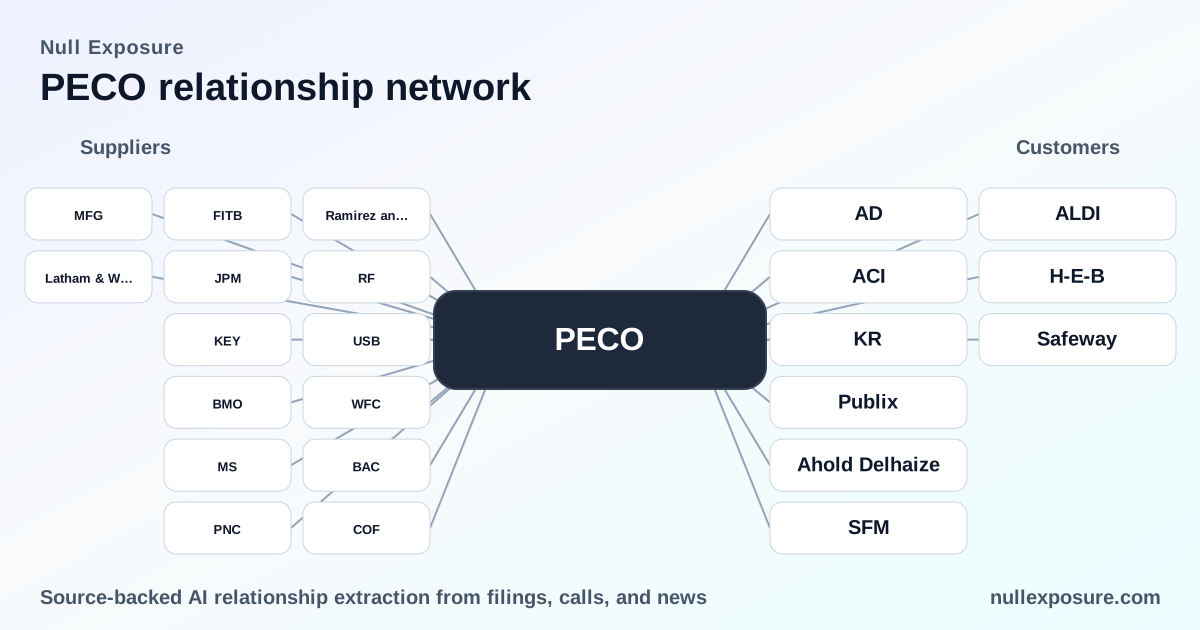
- Criticality and concentration: Grocery anchors (Kroger, Publix, Albertsons, Ahold Delhaize, H‑E‑B, Sprouts, ALDI and Safeway) supply steady traffic and therefore stabilize rent collections and occupancy; management reports that necessity‑based Neighbors generate about 70% of ABR, a material revenue signal for a retail REIT.
- Contract tenor and maturity: Company disclosures treat leases as operating leases and identify a concentrated set of expirations—this creates a defined event horizon for re‑tenanting, capex and leasing spreads.
- Business model layers: Beyond lease cash flow, PECO operates a third‑party investment management business that services several unconsolidated JVs (Grocery Retail Partners I LLC; Necessity Retail Venture LLC; Necessity Retail Partners) which adds fee income and aligns capital deployment with institutional partners.
For an investor view of these dynamics and the primary relationship files, visit https://nullexposure.com/.
Relationship roll call — every customer and partner cited by PECO in recent public filings and press
Below is a concise, plain‑English summary for each relationship mentioned in PECO’s FY2026 disclosures and related press, with source context.
- Ahold Delhaize — Ahold Delhaize is listed among PECO’s top grocery anchors; management repeatedly cites the banner when describing anchor diversity in FY2026 press releases. Source: GlobeNewswire and FY2026 investor communications (Feb–Apr 2026).
- Kroger (KR) — Kroger and its banners (including King Soopers) are identified as primary anchors across PECO centers, contributing anchor traffic and base rent. Source: GlobeNewswire Q1 2026 releases and related newswire coverage (Feb–Apr 2026).
- KR (ticker reference) — The KR ticker appears in multiple filings as the symbol for Kroger‑anchored relationships, reinforcing Kroger’s prominence in PECO’s tenant base. Source: FY2026 press citations (Mar–May 2026).
- Publix — Publix is named repeatedly as a top grocery anchor and referenced specifically in earnings call excerpts describing high‑performing, fully leased Publix‑anchored centers. Source: GlobeNewswire Q1 2026 release and earnings call transcript (Apr–May 2026).
- Albertsons — Albertsons is cited as a top anchor and appears in property examples and acquisition disclosures, highlighting its role as a foot‑traffic generator. Source: GlobeNewswire and ManilaTimes syndication of PECO results (Feb–Apr 2026).
- Bank of America — Bank of America is a non‑grocery tenant at recently acquired Shops at Plaza West Covina and represents the mix of service tenants that contribute to center occupancy. Source: ShoppingCenterBusiness coverage of the West Covina acquisition (May 2026).
- H‑E‑B — H‑E‑B anchors select PECO properties (e.g., Creekside Park Village in the Houston area) and strengthens regional resilience in Texas markets. Source: PECO Q1 2026 results release (Apr 2026).
- Sprouts (SFM) — Sprouts anchors certain acquired assets (The Village at Indian Wells), supporting specialty‑produce catchment and rent stability. Source: GlobeNewswire Q1 2026 release (Apr 2026).
- ALDI — ALDI is noted as an anchor for a recently acquired Springs Plaza property in Florida through an unconsolidated venture. Source: FY2026 results reporting (Feb 2026).
- Safeway — Safeway anchors properties in Pacific Northwest suburbs (e.g., Renton Highlands), contributing to regional ABR. Source: PECO Q4/FY2025 and Q1 2026 disclosures (Feb–Apr 2026).
- Lunds & Byerlys — Lunds & Byerlys anchors a suburban Minneapolis center (Prairieview Center), representing higher‑income regional markets. Source: PECO Q1 2026 results press (Apr 2026).
- King Soopers — King Soopers, a Kroger banner, is cited as an anchor at specific Colorado assets, reflecting Kroger’s multi‑brand presence in PECO centers. Source: GlobeNewswire Q1 2026 release (Apr 2026).
- Jamba Urbane Café — Jamba appears among non‑grocery tenants in the Shops at Plaza West Covina acquisition, illustrating PECO’s tenant mix beyond anchors. Source: ShoppingCenterBusiness acquisition article (May 2026).
- Gen Korean BBQ House — A food‑service tenant included in the West Covina roster, representative of experiential and F&B demand. Source: ShoppingCenterBusiness (May 2026).
- California Fish Grill — Another F&B tenant noted in the West Covina acquisition, supporting day‑part and evening traffic. Source: ShoppingCenterBusiness (May 2026).
- SchoolsFirst Federal Credit Union — Listed as a leased tenant at West Covina, showing non‑retail service tenancy in PECO properties. Source: ShoppingCenterBusiness (May 2026).
- Grocery Retail Partners I LLC — One of three unconsolidated institutional joint ventures that PECO manages and partially owns, the JV supplies fee revenue and co‑investment scale. Source: MarketScreener and PECO investor disclosures (Q1 2026).
- Necessity Retail Venture LLC — A second unconsolidated JV identified in PECO’s investment management platform and cited in acquisition activity. Source: MarketScreener and FY2026 press (May 2026).
- Necessity Retail Partners — The third named unconsolidated JV in PECO’s management business, reinforcing institutional partnership strategy. Source: MarketScreener and PECO filings (May 2026).
- JOANN — JOANN is referenced among previously bankrupt retailers whose vacated spaces have been largely backfilled, a metric management uses to quantify re‑tenanting progress. Source: Investing.com earnings previews and PECO commentary (May 2026).
- Big Lots — Big Lots is cited similarly as a bankrupt tenant where backfilling has been materially underway; management quantifies recovery progress for affected spaces. Source: Investing.com and earnings commentary (May 2026).
- Party City — Party City is listed with other distressed tenants in management disclosures about backfill rates and expected re‑occupancy timelines. Source: Investing.com and Q1 2026 commentary (May 2026).
- Starbucks — Management discussed repurposing small bank parcels into Starbucks as an example of value‑creating in‑fill leasing and redevelopment. Source: Q1 2026 earnings call transcript as reported by InsiderMonkey (May 2026).
- Chipotle — Chipotle is listed alongside Starbucks as a target for repurposed parcels, illustrating PECO’s leasing strategy for high‑demand national concepts. Source: InsiderMonkey transcript coverage (May 2026).
- Swig — Swig is identified as an example of a local/viral concept PECO targets for repurposed pads and bank conversions. Source: InsiderMonkey (May 2026).
Investment implications — signals that matter to the balance sheet
PECO’s customer profile sets a clear valuation framework: high occupancy, grocery‑anchored tenancy and JV fee income create predictable cash flow, while a concentrated anchor base and concentrated lease expiries produce discrete re‑letting and capital cycles investors should monitor. Company‑level signals from filings show U.S.‑only operations, operating leases as the revenue model, materiality of necessity‑based ABR (~70%), and an active but manageable lease maturity schedule (668 expirations, ~2.7 million sq ft cited in disclosures).
Key takeaways for investors:
- Strength: Anchor concentration in necessity retail lowers volatility in same‑store rent collection and supports high occupancy.
- Watch: Lease expiration waves and localized tenant bankruptcies have created a short‑to‑medium term re‑tenanting agenda—management reports ~70% backfill of former bankruptcy vacancies, leaving remaining volatility to be resolved through late‑2026 and 2027 leasing.
- Optionality: Parcel repurposing (Starbucks/Chipotle examples) and JV partnerships provide multiple levers to drive FFO and NOI growth.
For a downloadable checklist of these relationships and the underlying public references, visit https://nullexposure.com/.
Conclusion: PECO’s customer mix underpins a stability‑first REIT model with clear growth levers via re‑tenanting, redevelopment and JV scale; investors should balance the reliable cash flows against the calendar of lease expiries and the degree of anchor concentration when sizing exposure.