PSEG customer relationships: what investors should price now
Public Service Enterprise Group (PSEG) operates as a regulated utility and diversified energy company that monetizes through a mix of regulated transmission & distribution tariffs, merchant and contracted generation sales, and service contracts for franchise utilities. Its core earnings drivers are stable, regulated cash flows from PSE&G and contracted T&D services (notably PSEG Long Island), complemented by opportunistic merchant activity and asset dispositions that reshape its generation footprint. For a concise briefing on relationship-level exposures and their investment implications, visit https://nullexposure.com/.
The operating model behind the relationships — read this first
PSEG’s customer posture is defined by regulated franchise economics and contract-backed services. The firm functions as a seller of commodity and generation services, a distributor and operator of transmission & distribution (T&D) infrastructure, and a service provider that delivers management and operational services to regulated counterparties. These roles produce different margins and credit profiles: regulated tariffed distribution tends to deliver predictable revenue and lower margin volatility, while merchant or wholesale sales carry more price and counterparty exposure.
Company-level signals drawn from recent filings and disclosures reinforce these characteristics:
- Long-term contracting posture: regulatory approvals and extended service contracts create multiyear revenue visibility, which supports stability in cash flow modeling. Evidence includes regulatory extensions of long-term supply and service contracts through the late 2020s.
- Geographic concentration: operations and customer exposure are heavily concentrated in North America, with the bulk of retail and distribution revenue tied to New Jersey and adjacent service territories.
- Counterparty mix skews toward individual retail customers (residential/commercial) under tariffed service and institutional counterparties for wholesale activity.
- Materiality signal: PSEG’s public disclosures register immaterial contract balances for major segments, which indicates the company typically recognizes consideration contemporaneously with service performance rather than building large deferred receivables.
- Role diversity: PSEG functions as seller, distributor, and service provider across its business lines — a dynamic that limits single-mode dependency but introduces regulatory and operational complexity.
These signals frame how to value customer relationships: prioritize stability and regulatory clarity for tariffed revenues, and treat merchant/contracted counterparties as optional upside or liability depending on market cycles.
Relationship-by-relationship view (each mention in the recent feed)
ArcLight Energy Partners Fund VII, L.P.
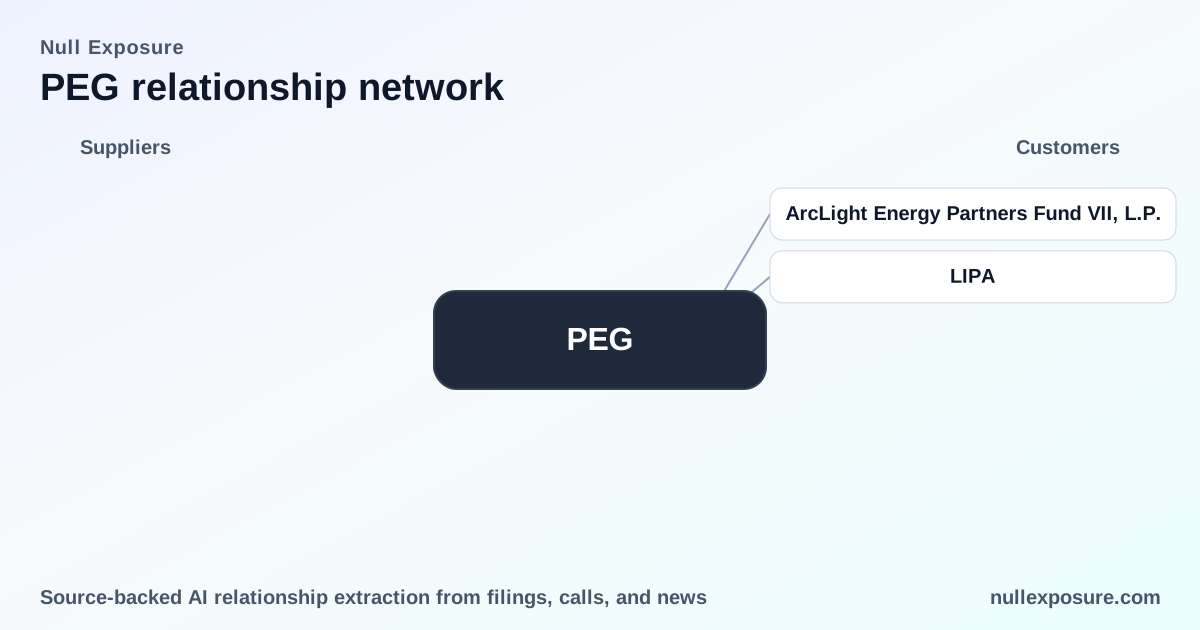
PSEG completed the sale of PSEG Fossil’s generating assets in New Jersey and Maryland to a subsidiary of ArcLight Energy Partners Fund VII, L.P., transferring ownership of certain fossil plants as part of a strategic shift away from merchant fossil generation. According to a CSRWire press release dated March 2026, the transaction closes a chapter on PSEG’s ownership of those specific fossil assets and shifts related operational and market exposure to the ArcLight vehicle.
Long Island Power Authority — report on energy-efficiency impact (Intellectia)
PSEG Long Island operates under a long-term contract with the Long Island Power Authority (LIPA) to deliver transmission and distribution services, providing continuity of service and program delivery on Long Island. An Intellectia article from May 2026 described PSEG Long Island’s role in energy-efficiency programs and reiterated the long-term contractual relationship with LIPA that underpins those initiatives.
LIPA — contract extension reported in earnings (InsiderMonkey)
PSEG Long Island was awarded a five-year contract extension to continue as the T&D operator on Long Island and the Rockaways through 2030, a development highlighted during PSEG’s Q4 2025 earnings call and captured in an March 2026 earnings transcript on InsiderMonkey. That extension cements near-term operational continuity and revenue visibility for the PSEG Long Island franchise.
Long Island Power Authority — grid resiliency upgrades (DailyEnergyInsider)
PSEG Long Island implemented major summer upgrades to bolster grid resiliency while operating LIPA’s transmission and distribution system under its long-term contract, demonstrating active capital deployment within the franchise. DailyEnergyInsider reported in May 2026 that these upgrades reflect the operator role and ongoing investment obligations PSEG undertakes under the LIPA contract.
What these relationships mean for valuation and risk
- Regulatory-backed revenue stability: The LIPA contract extension is a material operational stabilizer for the T&D franchise, supporting cash-flow modeling with explicit contract duration through 2030. For valuation, treat PSEG Long Island as quasi-regulated, with upside limited by contract terms and regulatory oversight.
- Asset-lighting of fossil generation: The ArcLight sale reduces PSEG’s merchant fossil exposure and trims generation capex and fuel-market sensitivity from the corporate profile. This transaction decomposes merchant volatility from the regulated earnings base, improving predictability.
- Low contract receivable risk: Public disclosures that contract balances are immaterial indicate PSEG converts services to cash rapidly, which reduces working-capital drag and supports leverage assumptions in credit models.
- Concentration risk remains: Heavy exposure to New Jersey and nearby territories means regulatory outcomes in those states and local infrastructure events can swing earnings more than an industrially diversified peer.
- Role-driven margin profile: Where PSEG functions as a supplier of last resort or delivers BPU-mandated services, pricing is often a pass-through with limited margin, constraining profitability even while ensuring steady volumes.
Investment implications and action checklist
- For income investors: PSEG’s regulated cash flows and predictable dividends justify a conservative allocation if regulatory risk is priced in; dividend yield and payout history remain core supports for total return expectations.
- For credit investors: contract duration and immaterial receivable balances reduce cash-flow volatility, but monitor regulatory rate cases and state-level policy shifts that could alter allowed returns.
- For growth-oriented investors: asset dispositions like the ArcLight sale free capital for lower-carbon investments, but incremental growth depends on successful redeployment into regulated or higher-return segments.
- For operational diligence: watch negotiated terms in municipal/franchise contracts (e.g., scope of capital obligations and service-level penalties) since these dictate future investment cadence and potential cost recovery.
Consider a targeted refresh of your exposure analysis at each regulatory filing and franchise contract renewal cycle, and revisit cash-flow assumptions if PSEG pursues further generation exits or contract restructurings. For a clearer picture of how these relationship signals map to credit and market scenarios, see more structured briefings at https://nullexposure.com/.
Bottom line
PSEG’s customer landscape is dominated by regulated, contract-backed revenue streams with selective merchant exposure that the company is actively reducing through asset sales. The LIPA contract extension and T&D investments lock in multi-year operational cash flows, while the ArcLight transaction repositions the company away from certain fossil-generation market risks. Investors should price the stock and credit with regulatory stability and contract tenure as primary anchors, and treat further asset redeployments as the principal catalyst for rerating.