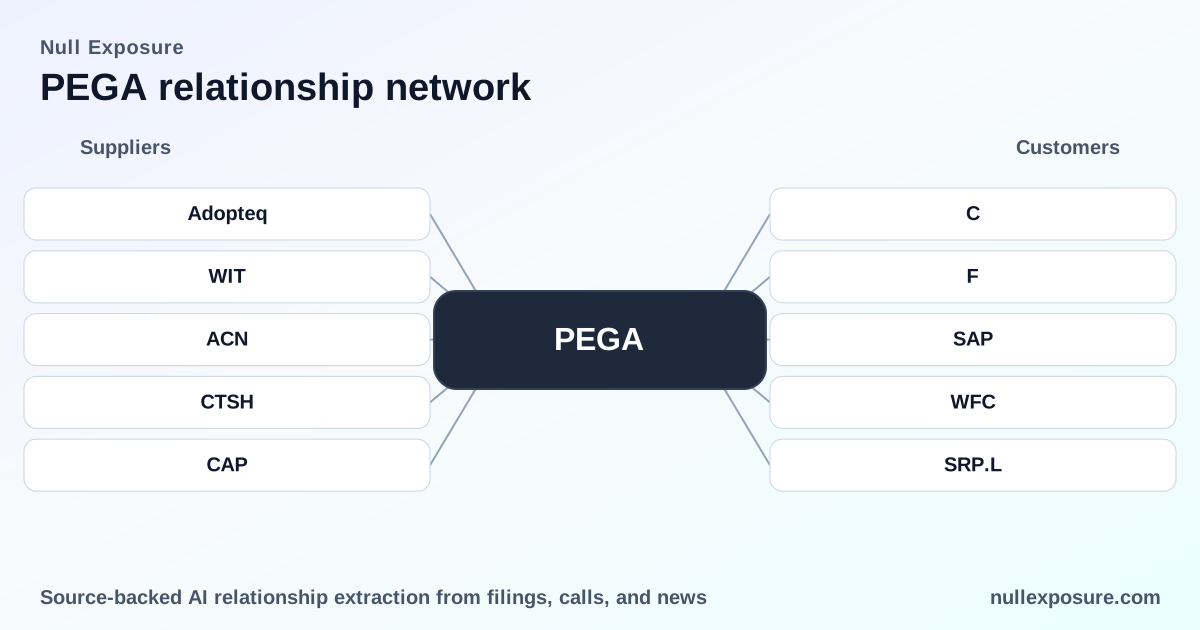
Pegasystems (PEGA): Customer Map, Contracting Signals, and What Investors Should Price In
Pegasystems sells enterprise decisioning and workflow software to large corporations and government agencies, monetizing through subscription services (Pega Cloud and maintenance), term and perpetual licensing, and professional services. The business generates scale revenue—roughly $1.70 billion in trailing twelve‑month revenue—with a subscription-first billing profile, an active backlog of future contracted revenue, and growing channel distribution via partners such as AWS, Cognizant, and Accenture. For relationship-level intelligence and sourcing context on the clients below, see https://nullexposure.com/.
Why the client list matters for valuation
Pegasystems’ clients are large enterprises and government agencies whose processes and compliance requirements make vendor switching costly and slow. The client roster cited repeatedly in company calls and analyst coverage — banks, telcos, manufacturers, global consumer goods firms, and government contractors — points to high contract criticality and concentration by enterprise class, not by a fragmented SMB base. That combination supports durable revenue, predictable renewals, and above‑average customer lifetime value relative to many application software peers.
How Pegasystems contracts and where it sells
Pegasystems operates a hybrid contracting model with clear operational implications:
- Subscription-first contracting posture. Management reports that most revenue derives from subscription services (Pega Cloud and maintenance) and that clients “largely prefer subscription-based offerings,” requiring scalable delivery and recurring revenue management.
- Licensing remains part of the mix. The firm continues to recognize term and perpetual licenses, delivered separately from maintenance and services, which preserves a capitalized revenue component for certain enterprise deals.
- Services and support are complementary but material. Consulting, training, hosting and implementation services drive initial deployments and help scale usage across global enterprises.
- Global footprint and geographic diversification. In 2025 Pegasystems reported revenue by geography: U.S. $956,296 (54%), Other Americas $115,266 (7%), U.K. $189,993 (11%), Europe/EMEA $270,627 (16%), Asia‑Pacific $213,630 (12%), total $1,745,812—an explicit signal of multinational exposure and implementation complexity.
- Backlog supports visibility. Management disclosed remaining performance obligations as of December 31, 2025 in a range that implies future contracted revenue roughly between $1.54 billion and $2.07 billion, indicating a meaningful pipeline of recurring and term commitments.
These company-level signals imply renewal economics and implementation cadence that are favorable to steady cash conversion, while also requiring continued investment in cloud operations, partner enablement, and professional services to capture upsell.
Clients and relationships cited in calls and coverage
Below are every client or partner referenced in the collected materials, with a concise plain‑English summary and source.
-
Rabobank — Rabobank is highlighted as a customer using Pega to empower employees to serve customers while keeping criminals outside the financial system, reflecting Pega’s deployment in financial crime and customer service workflows. Source: Pegasystems Q1 2025 earnings transcript summarized on Fool.com (April 2026).
-
Verizon (VZ) — Verizon is mentioned as a use case for combining generative AI, intelligent case management, and hyper‑personalization on the Pega platform, illustrating telecom‑scale personalization and automation. Source: Pegasystems Q1 2025 earnings transcript on Fool.com (April 2026).
-
Ford (F) — Ford was listed among major enterprise clients during the company’s Q4 2024 earnings call, indicating adoption in manufacturing or mobility operations where process orchestration matters. Source: Pegasystems Q4 2024 earnings call (company transcript).
-
SAP (SAP) — SAP is referenced in the context of clients recognizing Blueprint’s power, suggesting integration or complementary use with enterprise ERP and process modeling tools. Source: Pegasystems Q4 2024 earnings call (company transcript).
-
Wells Fargo (WFC) — Wells Fargo appears in company commentary as a client describing how it uses Pega solutions — a sign of Pega’s penetration in large banking workflows. Source: Pegasystems Q4 2024 earnings call (company transcript).
-
C (inferred symbol C) — The label “C” was cited alongside other major financial institutions during the Q4 2024 call, reflecting Pega’s engagement with large banking entities. Source: Pegasystems Q4 2024 earnings call (company transcript).
-
Citibank (C) — Citibank was explicitly named as a client in the same Q4 2024 call, confirming multiple top‑tier banking relationships in Pega’s customer base. Source: Pegasystems Q4 2024 earnings call (company transcript).
-
Unilever (UL) — Unilever was discussed as a client that transformed distributor onboarding and unlocked efficiency gains with Pega, demonstrating Pega’s application in global supply chain and channel management. Source: Pegasystems Q1 2025 earnings transcript summarized on Fool.com (April 2026).
-
Cognizant (CTSH) — Cognizant is identified as a channel partner generating incremental ACV through autonomous partner selling alongside Blueprint‑driven new logo work, indicating systems integrator‑led go‑to‑market expansion. Source: Tikr analysis (May 2026).
-
Serco (SRP.L) — Management noted a consortium led by Serco as a partner in a public sector engagement, showing Pega’s role in government and outsourced service provider projects. Source: Pegasystems Q4 2024 earnings call (company transcript).
-
Amazon Web Services (AWS) — AWS is cited as a channel and cloud partner in analyst coverage, where autonomous partner selling with AWS is presented as an upside to management guidance and new logo acceleration. Source: Tikr analysis (May 2026).
-
SRP.L — The dataset also lists SRP.L (the London ticker for Serco) separately; it was referenced in the same Q4 2024 call as leading or participating in a public-sector consortium. Source: Pegasystems Q4 2024 earnings call (company transcript).
-
Accenture (ACN) — Accenture appears with AWS and Cognizant as an autonomous partner that can produce incremental ACV outside management’s conservative guide, representing strategic SI leverage for rapid enterprise adoption. Source: Tikr analysis (May 2026).
What these relationships imply for investors
- Concentration in large enterprises and regulated industries (financial services, telecom, manufacturing, consumer goods, government) increases contract stickiness and macro‑resilience. The client list supports durable revenue but also makes go‑to‑market execution and compliance critical.
- Channel partners are a material upside vector. AWS, Cognizant, and Accenture are explicitly called out as engines for incremental annual contract value growth that the company considers upside to conservative guidance.
- Subscription economics with a sizable backlog create predictable cash flows, but realization depends on successful implementation and partner execution across geographies.
- Operational risk centers on delivery and partner execution. Large implementations and public‑sector procurements (e.g., Serco) imply longer sales cycles and higher professional services intensity.
Key near‑term watch items:
- Renewal rates and expansion within the largest banking and telecom customers.
- Execution of autonomous partner selling and measurable ACV contribution from AWS/Cognizant/Accenture channels.
- Backlog conversion cadence against the disclosed $1.54B–$2.07B remaining performance obligations.
For a deeper read on relationship-level signals and how they affect revenue durability, visit https://nullexposure.com/.
Bottom line
Pegasystems combines subscription recurring revenue, retained licensing economics, and professional services to serve high‑value enterprise and government clients. The customer list and cited partners point to high contract criticality, global scale, and a channel-driven growth runway that investors must weigh against execution risk in complex, large‑scale implementations.