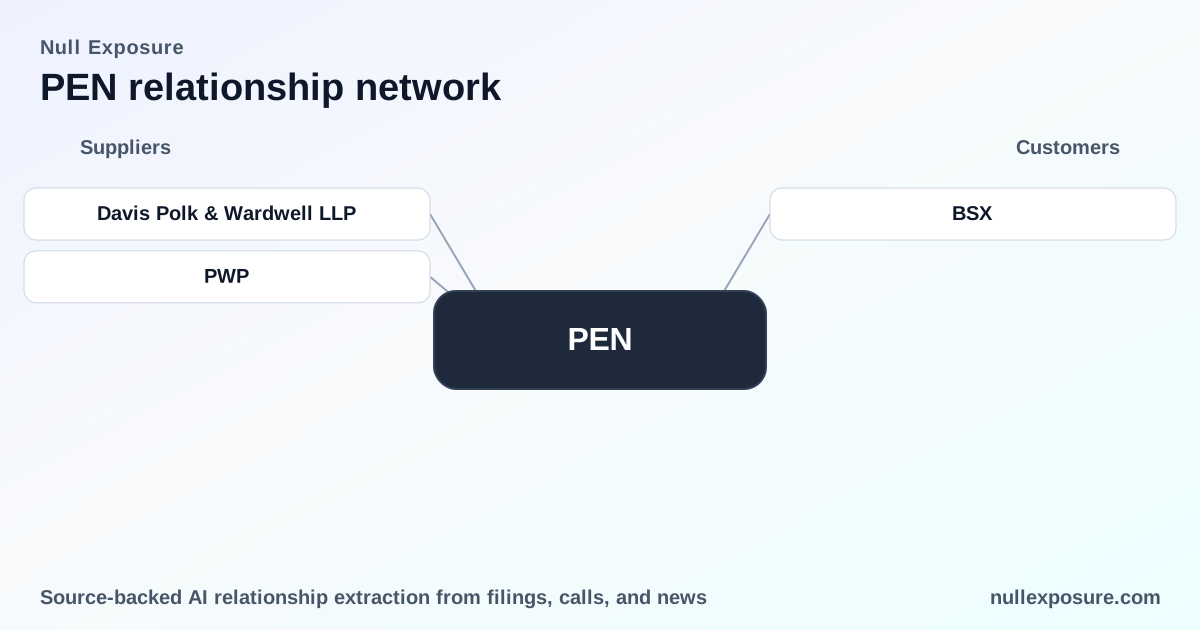
Penumbra (PEN): Customer relationships under the microscope as acquisition reshapes the landscape
Penumbra sells and distributes specialty medical devices—chiefly thrombectomy and related vascular products—primarily through a direct U.S. sales force and selected international distributors. The company monetizes by selling devices to healthcare providers and distributors on a purchase-order basis, driving recurring consumable sales around core procedural platforms. Investor thesis: Penumbra’s value is concentrated in a high-growth, procedure-driven franchise with strong U.S. revenue concentration, distribution-led international expansion, and an acquisition premium being priced into the stock.
Visit https://nullexposure.com/ for more company relationship intelligence.
How Penumbra operates and what that means for customers
Penumbra operates a classic medical-device commercial model: direct sales domestically, complemented by distributors internationally, with short-term purchase orders rather than long-term customer contracts. That contracting posture creates predictable transactional revenue tied to procedure volumes rather than multi-year committed spend, increasing exposure to procedural cycles and hospital purchasing behavior. The company reports heavy U.S. concentration—roughly 75.5% of revenue from the United States—which makes domestic payor and hospital adoption the most critical driver of revenue and cash flow. Penumbra’s core portfolio is focused on thrombectomy technologies for stroke, pulmonary embolism, and acute limb ischemia, which underpins pricing power and recurrent consumable demand.
Operationally, investors should weigh four practical characteristics:
- Contracting posture: short-term, purchase-order driven sales increases revenue volatility tied to procedure volumes.
- Concentration: material U.S. exposure (75.5%) creates single-market sensitivity but benefits from a direct sales engine.
- Role mix: Penumbra is primarily a seller to healthcare providers and uses distributors overseas—distributors are strategic for market reach but dilute direct commercial control.
- Portfolio criticality: core thrombectomy products are mission-critical in acute care, supporting stickiness despite short-term orders.
If you want to compare Penumbra’s relationship map to peers or track changes from the acquisition process, see https://nullexposure.com/.
The relationship map: what the sources show (complete list)
Below are every customer-related mention in the collected results, each distilled into a short, investor-ready reading with the original source noted.
-
OSRH / OSR Holdings — SpaceInsider reported that OSR’s RMC subsidiary distributes medical devices from clients including Penumbra, indicating a distributor linkage in FY2023. Source: SpaceInsider, March 10, 2026.
Penumbra products flow through regional distributors such as OSR’s RMC, underscoring the company’s reliance on third-party channels for certain markets. -
Boston Scientific — An ad-hoc news release on March 10, 2026, stated that Boston Scientific will pay $374 per share for Penumbra under a definitive agreement. Source: ad-hoc-news.de, March 10, 2026.
The proposed cash-and-stock deal at $374 per share represents an immediate re-pricing of Penumbra’s customer-facing business into a larger acquirer’s commercial network. -
BSX (Boston Scientific symbol) — The same ad-hoc release reiterated the $374 per-share consideration under the definitive agreement, reflecting market messaging around FY2026 deal terms. Source: ad-hoc-news.de, March 10, 2026.
Multiple communications of identical deal terms confirm the acquisition headline and frame near-term commercial integration risk and opportunity. -
Boston Scientific Corporation — A GlobeNewswire release highlighted investor and legal attention, noting that plaintiffs and firms are investigating Penumbra in connection with its sale to Boston Scientific. Source: GlobeNewswire, January 22, 2026.
The sale process has attracted shareholder scrutiny; legal actions could affect timing and integration certainty for customer-facing operations. -
BSX (follow-on mention) — GlobeNewswire’s investigator notice reiterated the connection between Penumbra’s sale and Boston Scientific as the counterparty, underlining the potential governance and process risk around the transaction. Source: GlobeNewswire, January 22, 2026.
Repeated regulatory and litigation signals increase execution risk for post-deal commercial continuity. -
Boston Scientific Corporation (investigative alert) — A FinancialContent/BusinessWire-style investor alert (April 8, 2026) flagged a separate firm investigating the adequacy of price and process in the proposed sale of Penumbra to Boston Scientific. Source: FinancialContent/BizWire, April 8, 2026.
Active investor litigation challenges heighten the probability of deal delays or renegotiation, with downstream implications for customers who face integration of supply chains and product portfolios. -
Boston Scientific — SahmCapital reported Penumbra is set to be acquired by Boston Scientific in a roughly US$14.5 billion transaction following strong quarterly results. Source: SahmCapital, February 8, 2026.
Framing the transaction as a strategic consolidation, independent commentary positions the deal as a recast of Penumbra’s growth story within Boston Scientific’s scale platform. -
BSX (duplicate reporting) — SahmCapital’s later commentary reiterated the cash consideration and conversion ratios for shareholders, referencing the same FY2026 deal terms. Source: SahmCapital, April 10, 2026.
Multiple analyst and independent pieces reinforce market consensus on the deal structure and the strategic rationale. -
Boston Scientific Corporation — A final mention from SahmCapital described the consideration as $374 in cash or 3.8721 Boston Scientific shares, confirming the alternative consideration mechanics. Source: SahmCapital, April 10, 2026.
The cash-or-stock election embedded in the transaction will influence how Penumbra customers experience integration—cash-accretive outcomes differ from stock rollovers in transitional support and retention incentives.
Key implications for investors and operators
- Distribution dependency is explicit. Third-party distributors such as OSR’s RMC play a material role outside the U.S., which accelerates international reach but reduces direct control over pricing and customer relationships.
- Transaction risk is front and center. The proposed Boston Scientific acquisition at $374 per share—and the active shareholder investigations—represent both a value realization event and an execution risk that can affect short-term customer continuity and pricing negotiations.
- Commercial model drives sensitivity to procedure volumes. Short-term purchase orders and a heavily U.S.-weighted revenue base mean Penumbra’s top-line is tied tightly to domestic procedure growth and hospital purchasing dynamics.
- Core product stickiness protects long-term cash flows. Despite transactional contracts, thrombectomy devices are procedure-critical and support recurring consumable revenue once clinical adoption is established.
Bottom line
Penumbra’s customer footprint is clear: a direct-sell, U.S.-centric core supplemented by distributors internationally, with short-term purchase-order sales and a high strategic value proposition that attracted Boston Scientific’s acquisition bid. The transaction creates a near-term valuation event and integration risk; distributors such as OSR will be key to how international customers experience any change. For a deeper view of counterparties, contractual posture, and concentration signals, explore more at https://nullexposure.com/.
Bold investors will weigh acquisition upside against integration and litigation risk; commercial operators should focus on continuity of supply, key distributor relationships, and how Boston Scientific’s platform will change channel economics for Penumbra’s critical thrombectomy franchise.