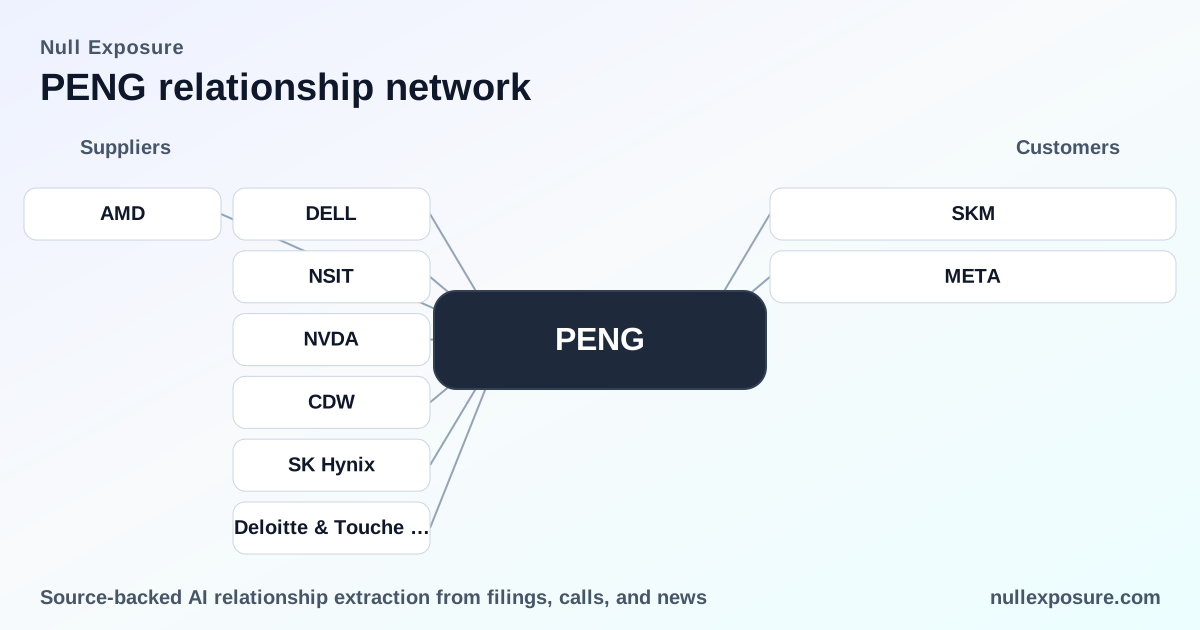
Penguin Solutions (PENG) — Customer Relationship Map and Investor Thesis
Penguin Solutions is an enterprise-focused AI infrastructure builder that monetizes by selling custom high-performance computing hardware, integration services, and subscription-based managed HPC environments to large enterprises, government customers and hyperscalers. The company’s revenue mix blends one-time, build-to-order hardware transactions with recurring service and subscription revenue from installation, extended warranty and managed AI infrastructure — a model that produces episodic large deals alongside growing higher-margin services. For investors, the commercial story is simple: scale deployments with hyperscalers and strategic partners drive outsized Advanced Computing growth while concentrated customer exposure and short-term contracting present execution and renewal risk.
For more detail on engagement-level signals and contract exposure, see the company relationship map at https://nullexposure.com/.
How Penguin actually operates in the market — the commercial constraints that matter
Penguin sells bespoke compute platforms and then often continues as the operator or integrator for customers’ AI clusters. The evidence shows a dual operating posture: large, build-to-order hardware contracts completed through customer purchase orders, and subscription/service revenue tied to managed HPC and installation services. Company disclosures state that sales are generally not based on long-term supply agreements and are often fulfilled against purchase orders; at the same time, service revenue explicitly includes subscriptions to the company’s HPC environment.
Company-level signals that drive commercial risk and opportunity:
- Contracting posture: build-to-order, short-term purchase orders for hardware combined with subscription and managed services for operating clusters.
- Concentration: sales to the top ten customers represented 66% of net sales in 2025, indicating meaningful revenue dependency on a small number of large customers.
- Global footprint: Penguin reports roughly 43% of sales outside the U.S.; the business competes in North America, APAC and EMEA.
- Counterparties: customer base spans large enterprises and government buyers; government and OEM verticals are explicit go-to-market channels.
- Material deal sizes and stage: the firm recorded a $50.7 million total transaction amount for AI hardware solutions and installation services in FY2025 (with $32.4 million recognized and $18.3 million as contract liability), implying a typical spend band in the $10–100 million range for material engagements.
- Roles: Penguin operates as both manufacturer/integrator and reseller/distributor through third-party channels and also acts as a service provider for selected strategic partners.
These characteristics make Penguin a highly scalable integrator when it wins hyperscaler or strategic partner business, but they also create concentration and renewal exposure given the short-term, purchase-order driven nature of much of the hardware demand.
Customer relationships: who matters and what they mean for revenue
Below I list every identified customer relationship in the coverage set and provide a concise, sourced assessment.
SK Telecom / SKM
Penguin has a strategic relationship with SK Telecom that goes beyond a simple customer sale: SKT (via Astra AI Infra) has taken a meaningful ownership stake and Penguin entered an agreement to support SKT’s AI data center initiatives, positioning Penguin as a potential primary builder for SK’s Asia expansion. Source: Penguin 2025 Q4 earnings call (2025Q4) and company disclosures noting SKT’s ownership and a May 2025 agreement with SKT; further coverage on this investment and strategic implication appeared in March 2026 commentaries. (Earnings call 2025Q4; Insidermonkey/Finviz March 2026)
Deepgram
Penguin was selected by Deepgram to design and deploy production-ready inference infrastructure for enterprise voice AI, reflecting Penguin’s role as an optimizer of GPU and inference stacks for commercial AI customers. Source: Automation.com/Business Wire coverage of the Deepgram collaboration (FY2026, May 2026).
Meta (META)
Meta is a headline hyperscale client: Penguin architected and deployed large-scale AI clusters for Meta’s RSC program, and company disclosures exclude Meta contributions when reporting Advanced Computing growth. Meta represents hyperscaler-level validation of Penguin’s cluster engineering capabilities and a meaningful revenue contributor historically. Source: CIO and multiple market write-ups noting Penguin’s selection by Meta and the company’s reported Advanced Computing growth (FY2026, March–May 2026).
MHI Group / MHI
Penguin deployed its Stratus ztC Edge platform for MHI Group to tackle logistics automation, supporting on-premise edge compute use cases that address labor shortages and operational stability. This illustrates Penguin’s ability to move down-market to edge/HPC hybrid plays outside hyperscale data centers. Source: TradersUnion and related coverage describing Stratus ztC Edge deployments for MHI (FY2026, May 2026).
OriginAI
Penguin committed pre-validated cluster architectures for OriginAI featuring NVIDIA DGX B300 and RTX PRO 6000 GPUs, signaling Penguin’s role in providing validated, SKU-level cluster solutions to AI software providers. OriginAI’s engagement underscores Penguin’s go-to-market with smaller AI-first software players requiring turnkey clusters. Source: Business Wire notice reported on Finviz (FY2026, May 2026).
What these relationships mean for the P&L and risk profile
- Revenue growth lever: Hyperscaler and strategic partner wins (Meta, SKT, Deepgram) drive high incremental margin for Advanced Computing revenue — the segment is up materially year-over-year when adjusted for non-recurring items. Coverage shows Advanced Computing revenue rose sharply in FY2026 (reported growth of +52% ex-hyperscale contributions in some analyst notes). Source: Finviz/analyst commentary (March 2026).
- Concentration and renewal risk: With the top ten customers accounting for two-thirds of sales in 2025, loss or non-renewal of a single major account would materially impact near-term results. The company’s build-to-order customer purchase order model amplifies this concentration risk. (Company disclosures, FY2025).
- Contract economics: Material deals sit in the $10–100M band with partial upfront cash recognition and contract liabilities for remaining performance; services and subscriptions provide a path to recurring margin, but overall cash flow is lumpy. (FY2025 transaction disclosure).
- Geographic diversification and expansion: SKT’s investment and APAC engagements create a growth vector in Asia, while Penguin’s EMEA and NA deployments diversify demand channels across hyperscalers, enterprises and government buyers.
Bottom line for investors
Penguin offers a clear investment proposition: a specialized integrator capturing high-value AI infrastructure projects with the ability to convert large one-off hardware deals into recurring service relationships. That upside is balanced by concentration risk, short-term contracting for hardware, and execution sensitivity tied to a handful of large customers. Investors should value Penguin on a revenue multiple that reflects both the scalability potential of Advanced Computing wins and the downside of renewal concentration.
For a deeper engagement map and to track customer-level signals as they evolve, visit https://nullexposure.com/.
Bold takeaways:
- Hyperscalers and strategic partners are the primary growth engine.
- Top-ten concentration is a material credit and revenue risk.
- The mix of one-off hardware and recurring services creates lumpy but improving margin profiles.
If you want a tailored digest of specific counterparty exposure or scenario modeling for PENG, start with the relationship coverage at https://nullexposure.com/.