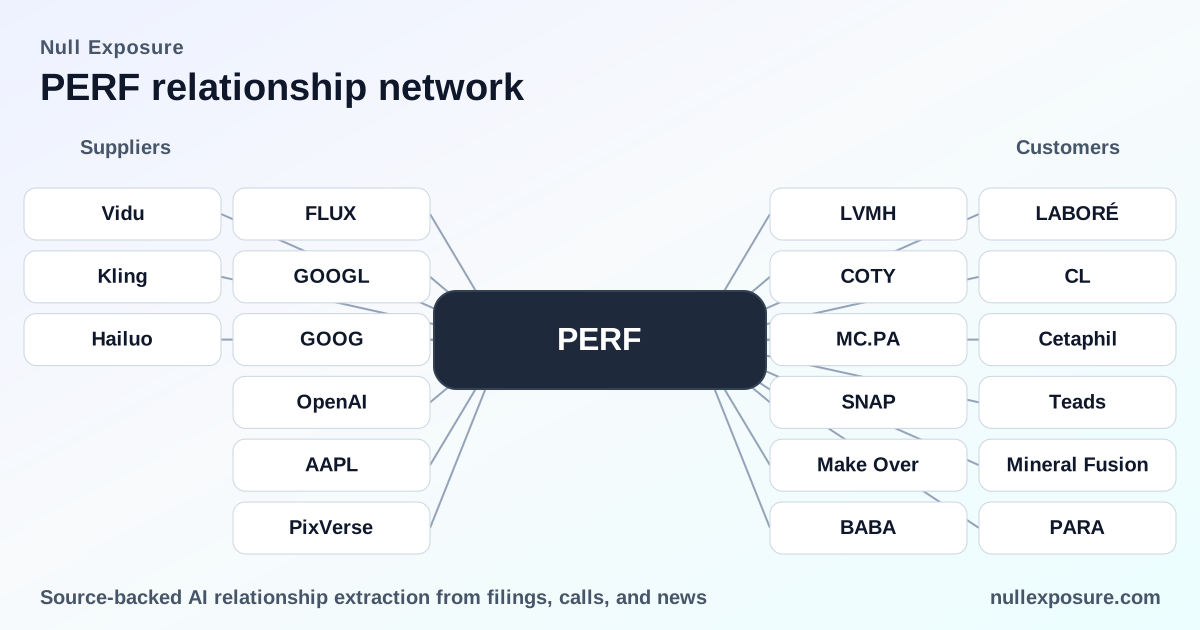
Perfect Corp. (PERF) — customer relationships that define the commercial runway
Perfect Corp. sells AI- and AR-driven beauty and fashion technology to brands, retailers and platforms, monetizing primarily through enterprise licensing, white‑label integrations and API-based product features that sit inside clients’ commerce and marketing channels; that revenue model produces recurring, contract‑style income tied to adoption by major beauty and consumer brands. Investors should value PERF as a software‑driven services business with high gross margins (Revenue TTM $69.2M; Gross Profit TTM $53.5M) and an emphasis on strategic brand wins that validate product fit and expand addressable market. Explore the company at https://nullexposure.com/ for a deeper commercial map and benchmarking data.
What the customer base tells investors about the business
Perfect’s customer list is concentrated in beauty and consumer brands but spans entertainment and large internet platforms, signaling a deliberate go‑to‑market that targets marquee partners to accelerate adoption and credibility. These relationships function as distribution and marketing channels: brand integrations create visible consumer touchpoints while platform partnerships provide scale. The relationship set supports a SaaS/licensing contracting posture with expected multi‑year commercial terms and implementation services. No relationship‑level contractual constraints were provided in the source material; at the company level, that absence is a neutral signal rather than evidence of weak governance or concentration.
Relationship rundown: every cited partner and what it means
LVMH — group-level luxury partnership
Perfect Corp. collaborated with LVMH to support Maison‑level AR/AI experiences tied to the launch of Louis Vuitton’s full makeup collection, demonstrating enterprise traction with top‑tier luxury houses. According to SiliconCanals (March 10, 2026) — https://siliconcanals.com/perfect-corp-partners-with-louis-vuitton-to-power-innovative-virtual-try-on-for-new-makeup-line/
Louis Vuitton — brand collaboration for La Beauté Louis Vuitton
The company powered virtual try‑on features for Louis Vuitton’s first full makeup line, underscoring Perfect’s role in luxury product launches and brand‑level digital merchandising. SiliconCanals (March 10, 2026) — https://siliconcanals.com/perfect-corp-partners-with-louis-vuitton-to-power-innovative-virtual-try-on-for-new-makeup-line/
COTY — multi‑channel beauty tech agreement (FY2021)
Coty signed a multi‑channel agreement to deploy Perfect Corp.’s beauty tech, a commercial validation with a major global beauty conglomerate that helps convert technology into recurring revenue. GlobalCosmeticsNews (FY2021) — https://www.globalcosmeticsnews.com/coty-expands-beauty-tech-offering-in-new-perfect-corp-partnership/
COTY — additional reporting of the same multi‑channel deal
Additional coverage reiterates Coty’s multi‑channel agreement with Perfect, reinforcing the deal’s breadth across Coty’s retail and digital channels. GlobalCosmeticsNews (FY2021) — https://www.globalcosmeticsnews.com/coty-expands-beauty-tech-offering-in-new-perfect-corp-partnership/
CL (Colgate‑Palmolive ticker) — tooth‑whitening AR feature
Perfect provided the tooth‑whitening algorithm and AR visualization used by Colgate’s Optic White product, showing the company’s capability to extend beyond cosmetics into CPG personal care. ConsumerGoods (FY2022) — https://consumergoods.com/colgate-marches-ai-infused-product-innovation
Colgate‑Palmolive — consumer care use case (same engagement)
Colgate‑Palmolive partnered with Perfect to give consumers a smartphone AR visualization of post‑treatment whitening results, demonstrating cross‑category applicability of Perfect’s tech. ConsumerGoods (FY2022) — https://consumergoods.com/colgate-marches-ai-infused-product-innovation
Louis Vuitton (Yahoo Finance coverage) — mainstream press amplification
Yahoo Finance covered the Louis Vuitton collaboration, providing broader exposure and marketing value that accompanies enterprise client announcements. Yahoo Finance (March 10, 2026) — https://finance.yahoo.com/news/perfect-corp-partners-louis-vuitton-110000913.html
MC.PA (LVMH ticker) — alternative market reference to the same partnership
Press referencing the LVMH ticker underscores that the Louis Vuitton work is group‑level and visible to capital markets following the March announcement. Yahoo Finance (March 10, 2026) — https://finance.yahoo.com/news/perfect-corp-partners-louis-vuitton-110000913.html
Alibaba — platform integrations for Taobao and Tmall Beauty
Perfect’s technology is integrated with Alibaba’s Taobao and Tmall Beauty, giving direct access to China’s e‑commerce scale and local marketplace distribution. HAPPI (FY2022) — https://www.happi.com/breaking-news/augmented-reality-beauty-industry-leader-perfect-corp-to-merge-with-provident/
SNAP / Snap Inc. — Snapchat platform partnership
Perfect partners with Snap to bring AR experiences to Snapchat, extending Perfect’s reach into social commerce and user‑facing engagement that drives adoption. HAPPI (FY2022) — https://www.happi.com/breaking-news/augmented-reality-beauty-industry-leader-perfect-corp-to-merge-with-provident/
Snap Inc. — platform detail (duplicate coverage)
Secondary entries reiterate the Snapchat integration and its role as an amplification channel for brand AR experiences. HAPPI (FY2022) — https://www.happi.com/breaking-news/augmented-reality-beauty-industry-leader-perfect-corp-to-merge-with-provident/
LABORÉ / LABORE — ParagonCorp brand API adoption
ParagonCorp’s LABORÉ brand adopted Perfect’s AI skin analysis API to enhance digital skincare services, signaling uptake among regional beauty groups and OEM brand partners. MarketScreener (FY2026 / May 3, 2026) — https://www.marketscreener.com/news/perfect-corp-partners-with-make-over-at-paragoncorpa-s-beauty-science-tech-2026-to-deliver-ai-powe-ce7e5adad98af023
Make Over — ParagonCorp professional makeup brand engagement
Perfect partnered with Make Over (ParagonCorp) at BST 2026 in Jakarta to showcase next‑generation beauty tech, illustrating regional expansion and event‑driven sales motion. MarketScreener (FY2026) — https://www.marketscreener.com/news/perfect-corp-partners-with-make-over-at-paragoncorpa-s-beauty-science-tech-2026-to-deliver-ai-powe-ce7e5adad98af023
LABORE — repeat reporting of the LABORÉ API adoption
A separate MarketScreener entry repeats that LABORE implemented Perfect’s AI skin analysis, confirming rollout with ParagonCorp brands. MarketScreener (May 3, 2026) — https://www.marketscreener.com/news/perfect-corp-partners-with-make-over-at-paragoncorp-s-beauty-science-tech-2026-to-deliver-ai-powere-ce7e5adad980f123
Make Over — additional coverage of Jakarta partnership
Another MarketScreener item reaffirms the Make Over activation in Jakarta, reinforcing regional go‑to‑market momentum. MarketScreener (May 3, 2026) — https://www.marketscreener.com/news/perfect-corp-partners-with-make-over-at-paragoncorp-s-beauty-science-tech-2026-to-deliver-ai-powere-ce7e5adad980f123
True Beauty Lashes — LashLovr virtual try‑on rollout
Perfect launched LashLovr with True Beauty Lashes, a personalized lash recommendation and virtual try‑on experience that monetizes through API and integration fees. MarketScreener (April 28, 2026) — https://www.marketscreener.com/news/perfect-corp-to-announce-financial-results-for-first-quarter-of-2026-on-april-28-2026-ce7e50dfd88af626
Keensight — 3D medical beauty consulting enhancement
Perfect enhanced Keensight’s 3D medical beauty consulting offering using AI skin analysis APIs, illustrating enterprise use beyond retail cosmetics into medical beauty services. MarketScreener (FY2025 / reported May 3, 2026) — https://www.marketscreener.com/news/perfect-corp-to-announce-financial-results-the-three-months-ended-september-30-2025-and-the-nine-m-ce7d5ad9df89f024
True Beauty Lashes — repeated listing of LashLovr rollout
A second entry reiterates the LashLovr launch, indicating continued promotion and client activation across Perfect’s go‑to‑market channels. MarketScreener (FY2025) — https://www.marketscreener.com/news/perfect-corp-to-announce-financial-results-the-three-months-ended-september-30-2025-and-the-nine-m-ce7d5ad9df89f024
Cetaphil — Galderma brand AI skin analysis deployment
Cetaphil implemented Perfect’s AI skin analysis tool to deliver personalized skin assessments and product recommendations, showing adoption by dermatologist‑oriented brands. CosmeticsBusiness (FY2022) — https://cosmeticsbusiness.com/buzz-cut-or-bob-perfect-corp-launches-virtual-tech-so-consumers-can-try-on-new-hairstyles-204287
COTY — additional mention in consumer goods coverage (FY2022)
ConsumerGoods notes Coty among brands using Perfect’s AR try‑on, reflecting multi‑brand penetration within beauty conglomerates. ConsumerGoods (FY2022) — https://consumergoods.com/colgate-marches-ai-infused-product-innovation
COTY — repeat mention confirming brand list inclusion
A duplicate mention reinforces Coty’s place among Perfect’s brand clients for AR cosmetics experiences. ConsumerGoods (FY2022) — https://consumergoods.com/colgate-marches-ai-infused-product-innovation
Keensight — second item on AI skin analysis integration
Keensight’s enhancement via Perfect’s APIs appears again in market disclosures, indicating a multi‑period client relationship or sustained project activity. MarketScreener (May 3, 2026) — https://www.marketscreener.com/news/perfect-corp-to-announce-financial-results-for-first-quarter-of-2026-on-april-28-2026-ce7e50dfd88af626
Teads — creative consortium partner for ad experiences
Teads listed Perfect Corp. among best‑in‑class partners for delivering personalised ad creative and interactive experiences, highlighting an adjacent advertising use case for Perfect’s tech. ExchangeWire (June 14, 2024) — https://www.exchangewire.com/blog/2024/06/14/teads-unveils-creative-consortium-built-to-incubate-innovation-to-bolster-results-for-advertisers/
Ibon — YouCam Perfect collaboration for seasonal campaign
YouCam Perfect and Ibon launched personalized AI red envelopes for Lunar New Year, an example of Perfect’s consumer‑facing app activations and seasonal marketing integrations. MarketScreener (May 3, 2026) — https://www.marketscreener.com/news/perfect-corp-to-announce-financial-results-for-first-quarter-of-2026-on-april-28-2026-ce7e50dfd88af626
PARAMOUNT / Paramount — entertainment AR tie‑ins
Perfect worked with Paramount to create interactive movie experiences, demonstrating cross‑industry IP licensing and experiential marketing revenue streams. TheIndustry.Fashion (FY2022) — https://www.theindustry.fashion/perfect-corp-brings-new-top-gun-maverick-movie-to-life-through-ar-try-on-experience/
Mineral Fusion — beauty brand AR try‑on inclusion
Market coverage lists Mineral Fusion among brands using Perfect’s AR try‑on, confirming penetration into indie and niche beauty labels in addition to conglomerates. ConsumerGoods (FY2022) — https://consumergoods.com/colgate-marches-ai-infused-product-innovation
What the relationship set implies for operations and risk
- Contracting posture: The mix of luxury houses, global conglomerates and platforms points to enterprise‑led, negotiated contracts with implementation services and ongoing license/usage fees rather than pure transactional sales.
- Concentration and criticality: Relationships with LVMH/Louis Vuitton, Alibaba and Snap are commercially strategic — they are high‑impact clients that drive visibility and scale; dependence on any single partner is a potential risk but current customer breadth reduces single‑counterparty concentration.
- Maturity and go‑to‑market: The roster combines marquee global brands and regional beauty groups, which is consistent with a go‑to‑market that validated core product features and is now scaling through platform and brand integrations.
- Revenue model characteristics: Expect recurring revenue elements (API licenses, platform integrations) plus professional services for rollouts; that supports predictability but requires continued product investment.
No relationship‑level contractual constraints were included in the source material; that absence should be treated as a neutral data gap rather than evidence for or against contract strength.
Bottom line for investors and operators
Perfect Corp. has built a commercial engine anchored in marquee brand partnerships and platform integrations that convert its AI/AR capability into visible consumer experiences and recurring revenue streams. The customer list spans luxury, mass beauty, CPG and platforms — a profile that supports both premium pricing and broad market access, while creating operational complexity in client service and product localization. For a concise commercial map and to benchmark these relationships against peers, visit https://nullexposure.com/.
Bold takeaway: PERF’s growth trajectory will track client renewals and deeper platform integrations more than one‑off announcements — watch renewal rates and channel revenue mix next.