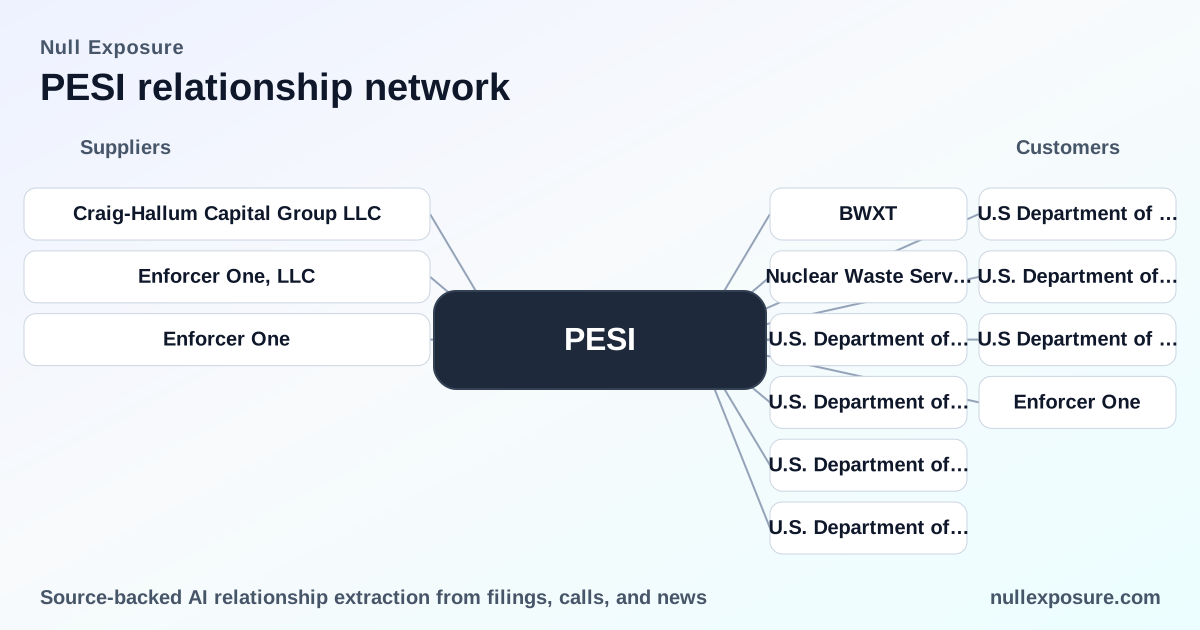
Perma‑Fix (PESI): Customer Map and What It Means for Revenue Stability
Perma‑Fix Environmental Services monetizes specialized nuclear and hazardous waste management through a mix of short‑term treatment contracts and multi‑year service agreements with government and commercial clients. The company's revenue base is dominated by federal work—both prime and subcontract roles—while proprietary treatment technologies (PFAS destruction, radioactive and mixed‑waste processing) and licensed facilities underpin recurring billings and program awards. For investors, the key construct is a government‑facing services business with sizable, repeatable contract flows and measurable concentration risk. Read a concise vendor‑level view at NullExposure.
How Perma‑Fix wins work and where the cash comes from
Perma‑Fix operates three licensed radioactive‑waste treatment facilities and sells technical services and on‑site waste management across North America and Europe. The business mixes short, transactional treatment engagements with long‑term and framework contracts that deliver higher visibility and equipment/permit‑driven capacity leverage. The company's public disclosures show government customers account for the majority of revenue—approximately $40.55M or 68.6% of total revenue in 2024—which makes federal spending cycles a principal driver of performance (company filings, 2024–2025).
- Contract posture: Evidence of both long‑term (multi‑year European Commission partnership) and framework arrangements exists alongside treatment contracts that are typically one year or less, producing a hybrid revenue profile.
- Concentration & materiality: Government clients are material to results; the firm warns that loss of federal contracts or funding reductions would have a material adverse impact (Form 10‑K excerpts, FY2024–FY2025).
- Geography and scale: Operations are primarily North American with expanding international work; typical customer spend bands cluster in the $10M–$100M range for large program awards.
- If you want a full technical breakdown, visit NullExposure for our vendor relationship analytics.
Relationship roll call — every customer cited in recent public sources
Below are the customer and partner names that appear in Perma‑Fix public materials and news coverage, with a short plain‑English summary and source reference for each.
-
BWXT — Perma‑Fix referenced an active collaboration with BWXT on the DOE’s West Valley end‑state contract, where Perma‑Fix’s waste‑management scope contributes to long‑term site remediation. (Perma‑Fix Q3 2025 earnings call, transcript dated 2026‑03‑07.)
-
Lawrence Livermore National Security, LLC (LLNS) — Perma‑Fix announced a two‑year master task agreement valued at approximately $24 million with LLNS for demolition and disposal services at LLNL in California. (Company press release reported by Sahm Capital and Yahoo Finance, March–May 2026.)
-
Four Rivers Nuclear Partnership (FRNP) — Perma‑Fix completed a PFAS destruction project for Four Rivers, the DOE contractor managing cleanup at the Paducah site, using Perma‑Fix’s proprietary Perma‑FAS technology. (GlobeNewswire and SAHM Capital press releases, April 2026.)
-
Nuclear Waste Services (NWS) — Perma‑Fix is one of three suppliers awarded a framework contract by NWS, the UK Nuclear Decommissioning Authority vehicle focused on long‑term nuclear waste management. (Finance.yahoo coverage of the NWS framework award, reported in company releases referencing FY2022 arrangements.)
-
U.S. Department of Energy (DOE) — The DOE is a repeated prime or indirect counterparty across Perma‑Fix’s treatment and services segments; DOE engagements span radioactive and mixed waste management and remediation projects. (Company business‑update releases and multiple press announcements, FY2022–FY2026.)
-
U.S. Department of Defense (DOD) / Department of Defense — Perma‑Fix lists the Department of Defense among its institutional customers for radioactive and mixed waste processing across licensed facilities and services. (Industry reporting and Perma‑Fix corporate releases citing FY2022–FY2026.)
-
U.S. Department of War (DOW) — Multiple Perma‑Fix press materials use the phrase “U.S. Department of War” (DOW) when describing federal customers; these references are included in company releases describing federal client categories. (GlobeNewswire and Sahm Capital press coverage, FY2026.)
-
Department of Energy (generic references) — Corporate materials reiterate that the company supplies nuclear and mixed waste management services to DOE programs, reinforcing DOE as a cornerstone client. (Trading releases and investor presentations compiled in 2026 announcements.)
-
Department of Defense (generic references) — Press and sector reporting reaffirm DOD as an end market for radioactive/mixed waste treatment services. (Waste‑Management‑World and related industry coverage, FY2022 reporting cited in 2026 summaries.)
-
Enforcer One — Perma‑Fix entered a joint distribution agreement with Enforcer One to deliver end‑to‑end PFAS foam transition solutions, positioning Perma‑Fix as a distribution and technology partner in fire‑suppression chemical remediation. (TradingView/Reuters distribution announcement, FY2025.)
-
ASIX (Advansix) — ASIX referenced a $26.0M settlement tied to a 2019 PES supplier shutdown claim in its Q4 2025 earnings commentary, noting that Perma‑Fix was involved in that supplier issue; the mention affects contextual cash flows for the parties involved. (ASIX Q4 2025 earnings call transcript and related earnings coverage, early 2026.)
What the customer map implies for investors
-
High government exposure is strategic but concentrated. With roughly 68.6% of revenue tied to federal clients in 2024, Perma‑Fix operates in a funding‑sensitive segment where contract renewals and appropriations dictate near‑term topline momentum (10‑K disclosures, FY2024–FY2025). This elevates revenue visibility when contracts are multi‑year but increases cyclicality when work is short‑term treatment work.
-
Contract mix reduces margin volatility but increases program risk. The presence of framework and long‑term fixed‑price projects supports stable utilization of licensed facility capacity; the company also runs short‑term treatment engagements that provide volume flexibility. This hybrid model improves utilization while leaving Perma‑Fix exposed to program award cycles and permit/operational continuity.
-
Contracts are material and meaningful in size. Company evidence places large contract spend bands in the $10M–$100M range and cites multi‑year awards (European Commission partnership through Campoverde and other framework contracts), so single awards can move revenue materially in a fiscal year.
-
Geography is North America‑centric with growing international frameworks. The Treatment segment works primarily in North America but has active framework ties in Europe that support diversification of large program risk.
-
Operational posture: Perma‑Fix functions primarily as a service provider and contractor with active engagements across DOE/DOD programs, prime and subcontract roles, and technology partnerships for PFAS remediation. These roles make Perma‑Fix a critical mid‑tier operator for federal cleanup programs.
Final take
Perma‑Fix’s customer base is concentrated, government‑heavy, and structured around a mix of short‑term treatment revenue and larger framework/long‑term contracts that drive visibility. Investors should value the company on its contracted backlog quality, permit‑driven capacity utilization, and the stability of federal funding flows. For a deeper vendor and counterparty breakdown tied to investment signals, see our coverage at NullExposure.