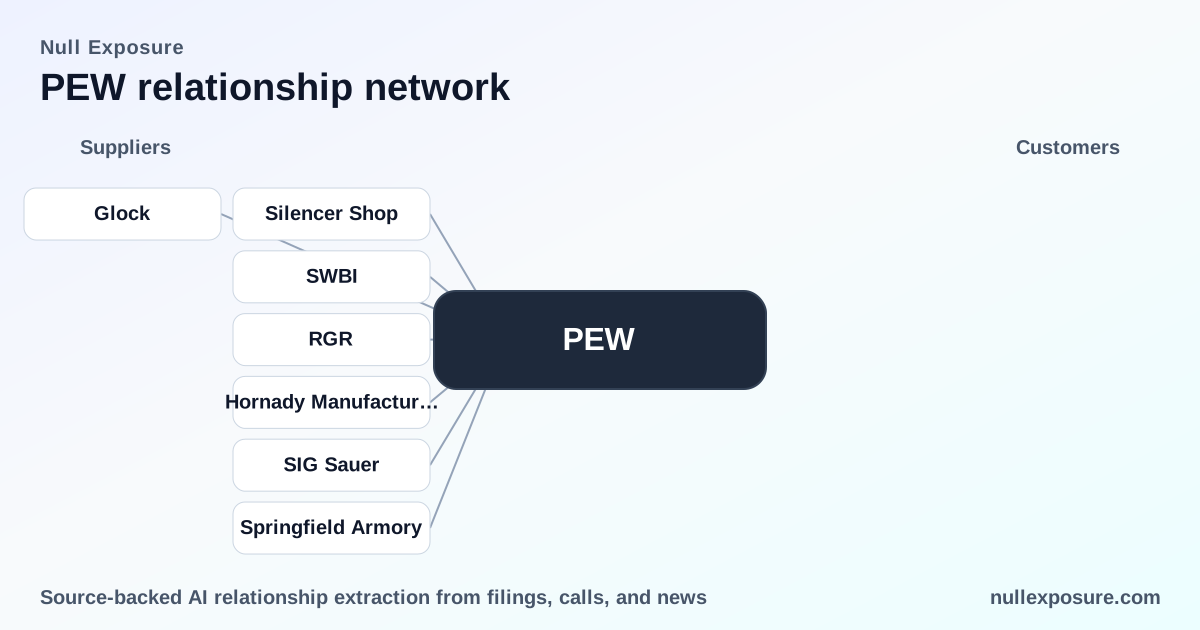
PEW (GrabAGun) — Platformizing firearms retail: an investor thesis
GrabAGun Digital Holdings (PEW) operates an e-commerce-first firearms and outdoor retail business and has begun monetizing logistics and direct-to-consumer (DTC) fulfillment for manufacturers through its recently launched PEW Logistics platform. The company captures retail margin on consumer sales while selling logistics and order-fulfillment services to firearm manufacturers, creating a two-sided revenue mix that converts platform scale into recurring service fees. Investors should weigh rapid platform adoption and low current customer count against negative margins and early-stage execution risk.
Learn more: https://nullexposure.com/
Why PEW’s business model matters now
GrabAGun’s core retail business generated roughly $96.4 million in trailing revenue with $11.3 million gross profit and negative operating cashflow (EBITDA: -$4.35 million), indicating current retail economics are thin. The strategic pivot is to leverage Fulfillment-as-a-Service for manufacturers — branded PEW Logistics — to increase unit economics via third-party service revenue and to deepen customer stickiness by operating manufacturers’ DTC channels. If PEW converts platform partnerships into predictable volume and margin-accretive service fees, the company can shift the revenue mix away from low-margin retail to higher-return services.
PEW Logistics in plain language
PEW positions the logistics product as a turnkey channel solution for firearm manufacturers that want a direct consumer presence without building DTC infrastructure. Contracting is service-provider oriented (GrabAGun provides operations and fulfillment), the initiative is very early stage (platform launched January 2026), and current customer concentration is high, with only a handful of manufacturers on the platform so far. That combination yields outsized upside if the roll-out scales, and outsized revenue risk if new customer wins stall.
Customer relationships on the platform
Derya Arms — the second manufacturer adoption
GrabAGun announced a strategic collaboration with Derya Arms, marking the second firearms manufacturer to adopt PEW Logistics since the platform launched in January 2026. This relationship underscores that PEW is actively signing external manufacturers to its fulfillment and DTC services (press release via The Outdoor Wire, May 3, 2026: https://www.theoutdoorwire.com/releases/2026/03/grabagun-expands-pew-logistics-platform-with-addition-of-derya-arms).
KelTec — the inaugural implementation and reference customer
KelTec served as the first implementation of PEW Logistics, a 35-year American manufacturer that selected the platform to power its direct consumer channel. KelTec functions as the reference launch customer, signaling product-market fit for legacy manufacturers seeking a turnkey DTC solution (Q4 2025 earnings call transcript coverage via Investing.com, May 2026: https://m.investing.com/news/transcripts/earnings-call-transcript-grabagun-digital-holdings-q4-2025-misses-eps-forecast-93CH-4558637?ampMode=1).
What the customer list signals about operating posture and risk
Because the constraints record is empty for PEW’s customer relationships, treat the following as company-level signals rather than relationship-specific constraints:
- Contracting posture: PEW is acting as a third-party service provider to manufacturers, executing logistics and consumer fulfillment rather than reseller-only arrangements. That posture increases potential revenue per unit and creates operational obligations around compliance and FFL handling.
- Concentration: With two announced manufacturer partners at launch, customer concentration is high, so each new win materially affects platform revenue and sentiment.
- Criticality: For manufacturers that outsource their DTC channel, PEW becomes a mission-critical partner; that raises the likelihood of multi-year contracts and stickiness if execution is reliable.
- Maturity and execution risk: The logistics platform launched in January 2026; maturity is low and operational execution will determine whether early customer wins convert to scale.
- Commercial path: The company’s go-to-market relies on converting legacy manufacturers and leveraging retail order flow; expansion requires both sales execution and on-the-ground fulfillment reliability.
Learn more about how we track these commercial signals at Null Exposure: https://nullexposure.com/
Financial and governance implications for investors
PEW’s public metrics present a mixed picture. Revenue of $96.4M and gross profit of $11.3M demonstrate commercial traction in retail, but operating margins and EBITDA are negative, reflecting either elevated operating costs or investment in the platform launch. Market capitalization (~$87.3M) against trailing revenue yields a price-to-sales of ~0.9, which prices modest growth expectations into the equity. Insider ownership is substantial at ~36%, with institutional holdings near 16.7%, creating concentrated voting control and visibility into management incentives.
Investors should focus on:
- The pace of manufacturer on-boarding to PEW Logistics and whether those contracts are recurring multi-year arrangements.
- Unit economics of the logistics service: contribution margins on orders fulfilled for third parties versus internal retail margins.
- Operating cashflow trajectory as fulfillment volume grows and fixed costs are amortized.
Operational implications and near-term catalysts
The platform approach imposes operational complexity: compliance with federal and state firearms shipping rules, FFL transfers, returns management, and inventory control across manufacturers. Successful scale reduces per-order fulfillment costs and improves margin, but failure to maintain reliable compliance and fast fulfillment will undercut manufacturer adoption. Near-term catalysts for valuation re-rating include:
- Public disclosure of additional manufacturer customers beyond the two announced.
- Quantified contribution of PEW Logistics to total orders and revenue.
- Sequential improvement in gross margin and EBITDA as platform volume scales.
Bottom line: concentrated upside conditional on execution
PEW has converted a retail footprint into a platform offering that leverages existing fulfillment capabilities into B2B revenue. The platform is early, customer concentration is high, and financials show negative operating profitability; this creates concentrated upside if PEW demonstrates scale with several manufacturer wins, and concentrated downside if the platform does not ramp quickly. For investors, the critical readouts over the next two quarters are customer additions, contractual terms for those relationships, and margin trajectory as fulfillment volumes expand.