Pinnacle Food Group (PFAI) — Customer Landscape and What Investors Should Price In
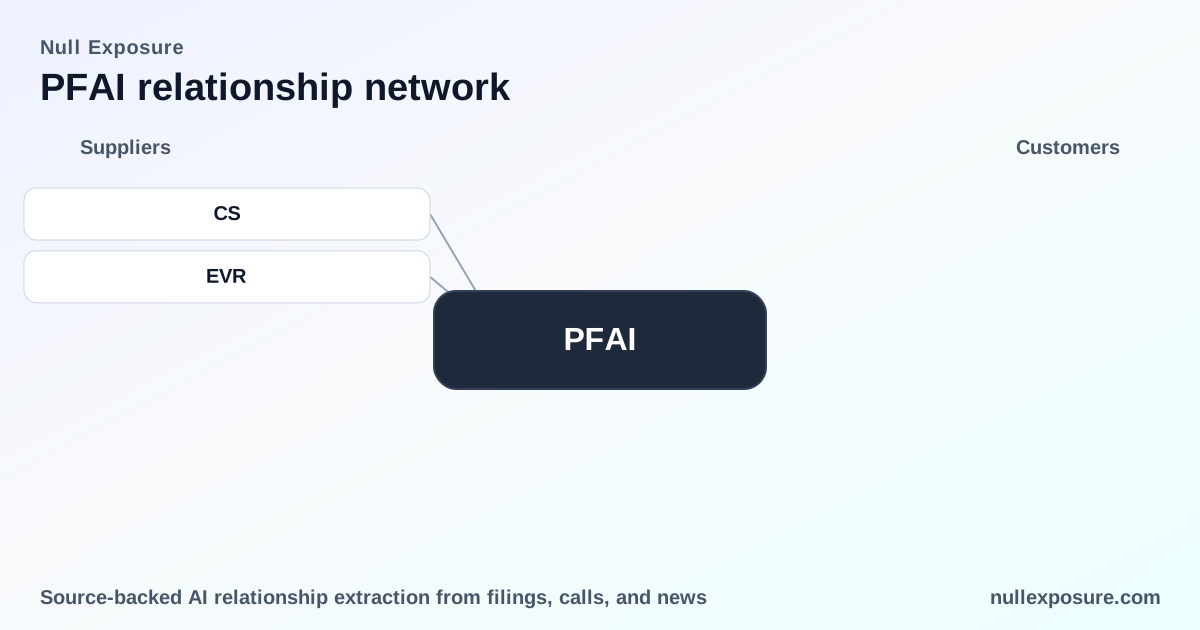
Pinnacle Food Group Limited operates as a provider of smart farming solutions for vertical and hydroponic farms, monetizing through the sale of integrated hardware, software and service offerings to commercial growers and controlled-environment agriculture operators. For investors and operators evaluating counterparty risk and commercial traction, the public record offers very limited customer evidence, forcing conclusions to rest on financial scale, ownership concentration and a single historical media match.
If you want a concise, curated view of PFAI relationships and commercial signals, visit https://nullexposure.com/ for the consolidated profile.
What the numbers say about commercial scale and go-to-market posture
PFAI is a micro-cap, early commercial-stage company. Market capitalization is about US$44.8 million with trailing revenue of roughly US$3.5 million and negative operating margins. Profitability metrics are weak — diluted EPS is negative and operating margin TTM is reported at -103% — signaling that the business is still investing ahead of establishing consistent gross-to-operating profitability.
Ownership and coverage are thin: institutional ownership is under 1% while insiders hold roughly 11.8%, and there is virtually no analyst coverage reported. Those facts translate into a high concentration and liquidity risk profile for counterparties and investors. The company’s price-to-sales and price-to-book ratios are elevated relative to the revenue base, underscoring an expectation of future growth that current financials do not yet support.
Customer relationships: the public record, item by item
Public-match search returns a single customer-related result. Below is the full extracted relationship and its plain-English interpretation.
- Conagra Brands — Media record: Conagra Brands announced it was buying Pinnacle Foods for about US$10.9 billion in cash and stock. According to a Food Dive report covering the FY2018 transaction, Conagra executed a strategic acquisition of the branded food company Pinnacle Foods for approximately US$10.9 billion (reporting dated to the FY2018 transaction). Source: https://www.fooddive.com/news/conagra-buying-pinnacle-foods-for-109b-in-cash-and-stock/526575/
This single match is a historical media event referencing the Pinnacle Foods consumer-packaged-goods acquisition. It is the only customer-facing match surfaced in the relationship search results.
How to interpret that single match for valuation and commercial risk
The literature match to Conagra is not evidence of a current enterprise customer base for PFAI; it is a historical transaction headline tied to the Pinnacle Foods consumer brand transaction in FY2018. Investors should treat public customer validation as minimal: outside of the one historical media reference, there are no documented enterprise customer agreements, marquee logos, or recurring revenue contracts visible in the public record for PFAI.
Because public evidence of customers is sparse, the company’s commercial credibility in the market must be assessed through financial signals (revenue trajectory, gross profit, margin trends), direct management disclosure, or verified customer references rather than media matches alone.
Operational signals: contracting posture, concentration, criticality and maturity
-
Contracting posture: Company-level signal — the revenue scale and lack of enterprise references indicate PFAI currently operates with shorter, transactional contracts or early-stage pilot agreements rather than large, multi-year enterprise contracts. The financial footprint does not support a portfolio heavy with long-duration, high-dollar fixed contracts unless undisclosed.
-
Concentration: Company-level signal — modest TTM revenue (≈US$3.5M) and small float imply the customer base is likely concentrated; any loss of a single mid-sized account would have material impact on top-line growth and margins.
-
Criticality: Company-level signal — the product set (smart farming for vertical/hydroponic farms) targets customers in specialized agriculture niches where systems can be operationally important. However, public confirmation of mission-critical deployments for PFAI is not available; therefore criticality should be validated via direct customer references.
-
Maturity: Company-level signal — negative operating margins, low institutional ownership, limited analyst coverage and small market cap indicate early commercial maturity. The company is in a scaling phase rather than a steady-state revenue business.
Key risk checklist for investors and operators
- Limited public customer validation. The search returns a single historical media match that does not constitute a verifiable current customer relationship for PFAI.
- High concentration and small revenue base. Modest TTM revenue magnifies counterparty risk from any one customer.
- Early-stage financial profile. Negative margins and thin institutional support increase execution and funding risk.
- Brand/name confusion risk. Public matches reference similarly named companies in the food sector; investors must verify entity identity when assessing counterparties and contracts.
Investment implications and next steps
For investors, the absence of verifiable enterprise customers in public sources elevates execution risk and places more weight on management disclosures, pipeline evidence, and upcoming revenue milestones. Catalysts that would change the risk-reward profile include: confirmed multi-year contracts with commercial growers, disclosed recurring revenue streams, or institutional investor participation.
If you need a consolidated diligence package or ongoing tracking of PFAI’s public relationships and filings, see https://nullexposure.com/ for monitoring and integrated relationship intelligence.
Bottom line: evidence-based position
PFAI provides targeted smart-farming solutions but currently shows limited public proof of commercial traction. The single relationship match in public media is a historical acquisition headline tied to the Pinnacle Foods brand, not a current verified customer engagement for Pinnacle Food Group Limited. Investors should rely on direct verification of customer contracts and management disclosures before assigning material revenue assumptions to the company’s valuation.