Pfizer (PFE) — commercial footprint and customer network investors should price in
Pfizer is a global pharmaceutical manufacturer that monetizes through product sales to large wholesalers, government procurement, and commercial licensing/collaborations that include supply, milestone and royalty streams. Its financial profile is driven by a concentrated U.S. wholesale channel and an active program of clinical collaborations and asset transfers that convert R&D assets into near‑term commercial or partnering value. For a concise view of partner exposures, see https://nullexposure.com/.
Wholesale concentration: where the revenue rotates
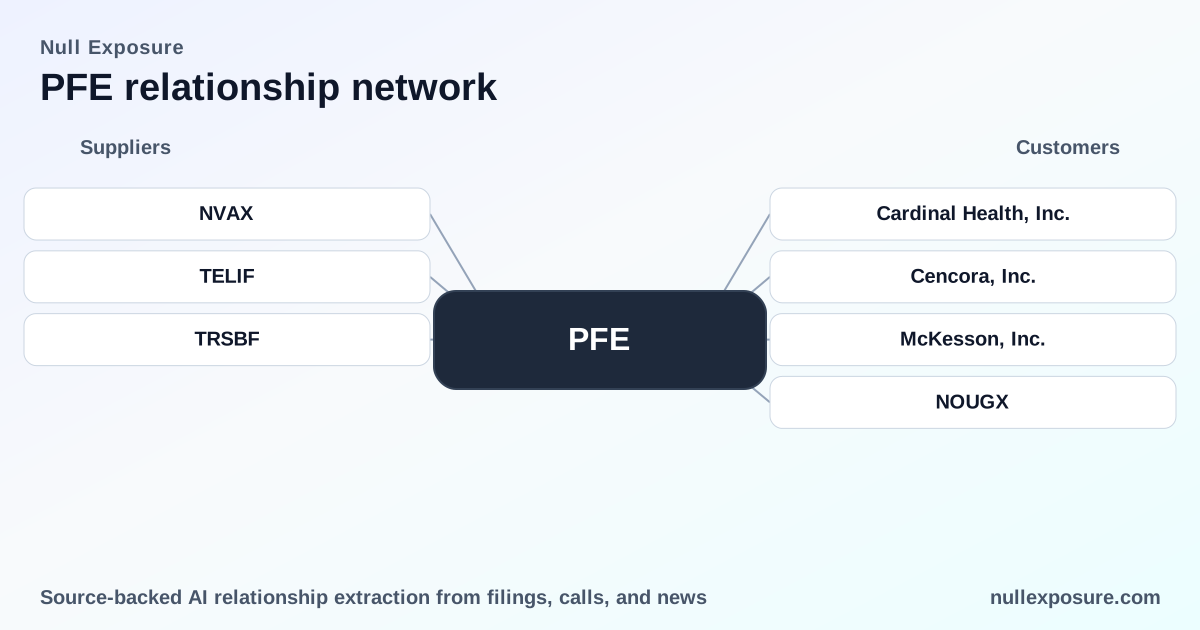
Pfizer reports that its top three U.S. wholesalers and the U.S. government are material revenue drivers. McKesson, Cencora and Cardinal Health together represent a meaningful share of revenues and trade receivables, underscoring dependence on a few distribution counters.
- McKesson, Inc. — McKesson accounted for 23% of total revenues in FY2024 (up from 16% in 2023), making it Pfizer’s largest U.S. wholesaler customer in FY2024; this is documented in Pfizer’s FY2024 10‑K.
- Cencora, Inc. — Cencora represented 17% of total revenues in FY2024, reflecting the firm’s central role as an aggregator between manufacturers and pharmacies (FY2024 10‑K).
- Cardinal Health, Inc. — Cardinal Health drove 14% of total revenues in FY2024, completing the trio of wholesalers that together account for a large share of channel volume (FY2024 10‑K).
- U.S. government (NOUGX reference in filings) — Government sales compressed to 6% of total revenues in 2024 after the transition of COVID products to the commercial market; Pfizer’s FY2024 10‑K documents the shift away from pandemic procurement.
Key takeaway: Pfizer’s receivables and negotiating leverage are concentrated among a few large wholesalers and governmental buyers, which increases both cashflow visibility and counterparty risk (FY2024 10‑K).
Clinical supply and collaboration pipeline: active partner list
Pfizer routinely supplies clinical‑grade molecules, licenses assets and invests cash to accelerate external development. The following relationships were identified in public filings and press coverage; each entry below summarizes the partnership in plain language with a source reference.
- C4 Therapeutics (CCCC) — Pfizer entered a clinical trial collaboration and supply agreement to provide elranatamab (ELREXFIO) free of charge for a Phase 1b trial combining it with C4T’s cemsidomide; documented across multiple press releases in late 2025 and investor communications in 2026 (GlobeNewswire; Investing News; Marketscreener).
- Allogene Therapeutics (ALLO) — Allogene acquired assets from Pfizer under an April 2018 Asset Contribution Agreement that included research collaborations and IP related to CAR‑T technologies (Allogene definitive proxy filing, FY2026 disclosure).
- Heritage Global Partners (HGBL) — HGP was re‑selected as Pfizer’s global vendor for asset disposition services relating to laboratory equipment under a vendor contract announced in 2022 (Business Wire / FinancialContent, 2022).
- Madrigal Pharmaceuticals (MDGL) — Madrigal licensed a MASH candidate (ervogastat) from Pfizer, with press reports noting a January transaction for exclusive global rights (Finviz / Pharmaphorum coverage, 2026).
- Relay Therapeutics (RLAY) — Pfizer agreed to supply atirmociclib for Relay’s experimental arm and palbociclib for a control arm in a planned breast cancer study (Relay press/GlobeNewswire, 2026).
- Agomab (AGMB) — Pfizer agreed to provide development expertise in support of Agomab’s lead compound for fibrostenotic Crohn’s disease while Agomab retained rights (Pharma/press coverage, noted in FY2022 reporting).
- Pyxis Oncology (PYXS) — Pyxis’s ADC program uses linker/payload technology and chemistries previously obtained from Pfizer, reflecting historical licensing of conjugation tooling (FierceBiotech / GlobeNewswire, 2023–2026).
- Zentalis Pharmaceuticals (ZNTL) — Pfizer made a $25 million equity investment and agreed to jointly advance a synthetic lethality candidate through clinical development (GlobeNewswire, 2022; FierceBiotech coverage).
- eFFECTOR Therapeutics (EFTR) — eFFECTOR has a global collaboration with Pfizer (and Merck KGaA) to develop eFT508 combinations and carry forward a Phase 2 program (press release coverage, historical filings).
- Iterum Therapeutics (ITRM) — Iterum’s cost of sales and milestone disclosures reflect royalty and milestone obligations under a license agreement with Pfizer following regulatory approval events (company 2025 filings and investor releases).
- Cardiff Oncology (CRDF) — Pfizer provided clinical execution support for CRDF‑004 and Pfizer Ignite’s development infrastructure has run trials for onvansertib (analyst coverage and SEC‑filed press items, 2023–2025).
- Celcuity (CELC) — Celcuity disclosed development milestone payments and clinical support activity under a license agreement with Pfizer, reflected within FY2025–FY2026 corporate updates (company news releases, 2026).
- Olema Pharmaceuticals (OLMA) — Olema’s palazestrant program is a collaboration developed with Pfizer and Novartis and remains in late‑stage trials (investor commentary and company releases, 2025–2026).
- Arvinas (ARVN) — Arvinas and Pfizer agreed to jointly out‑license vepdegestrant, with a regulatory milestone (PDUFA) referenced in 2026 analyst notes (investment news, 2026).
- ZLab (ZLAB) — ZLAB’s 2024 10‑K states the company sources TIVDAK from Pfizer, indicating a buyer/supplier relationship for the product.
- Spero Therapeutics (SPRO) — Spero cited securing licensing and investment arrangements with Pfizer as part of its strategic financing track record (citybiz report, historical corporate biography).
- SpringWorks (SWTX) — SpringWorks developed therapies spun out of Pfizer R&D, reflecting Pfizer’s practice of in‑licensing or spinning assets into smaller developers (BioSpace / Pharmaphorum historical coverage).
- Valneva / Valor (VALN) — Press releases in 2026 referenced Pfizer as a development partner on a Lyme vaccine (PF‑07307405) in topline Phase 3 results announced with Valor/Valneva (AccessNewswire, 2026).
- Cencora (COR) — Independent media coverage has described Cencora’s positioning between drug makers like Pfizer and downstream pharmacies/providers, reinforcing its distributor role in the channel (Ad‑Hoc‑News, 2026).
Each of these relationships is documented in public filings or press releases cited above; the balance is a mix of supply agreements, licensing/milestones, clinical execution support and vendor services.
You can explore Pfizer’s partner network and the underlying sources at https://nullexposure.com/.
What contracting and counterparty signals tell investors
Pfizer’s disclosures generate several company‑level operating signals that investors should incorporate into valuation and risk models:
- Contracting posture: The firm uses both long‑term supply agreements (for vaccines and major commercial programs) and short‑term/credit sales for routine product shipments; both contract types coexist and shape revenue visibility (FY2024 10‑K).
- Counterparty mix: Significant exposures to governments and very large enterprise wholesalers increase payment reliability but also concentrate negotiating leverage in the hands of a few buyers (FY2024 filings).
- Geography: Operations are global, but the U.S. market contributes the majority of revenue, making domestic healthcare policy and managed‑care dynamics particularly consequential (FY2024 10‑K).
- Materiality: Some government receivables are described as not material to consolidated statements, yet the three wholesalers collectively represent a material share of trade receivables, creating a concentrated credit posture.
- Relationship roles: Pfizer serves as seller, supplier, clinical execution partner and licensor across its network, which diversifies revenue types but links earnings to trial outcomes and milestone timing.
Investment implications and risks to price in
- Upside: Collaborations that supply clinical‑grade molecules or transfer assets accelerate revenue conversion and crystallize R&D value without carrying full development cost.
- Downside: Concentration with three wholesalers and meaningful government exposure creates counterparty, pricing and policy risk; pipeline supply commitments (free‑of‑charge supply, milestone timing) can depress near‑term cash receipts while supporting long‑term strategic positions.
For deal‑level detail, the sources cited above are taken from Pfizer’s FY2024 10‑K and public corporate press releases and filings covering 2017–2026. If you want a structured export of each partner mention and original source, visit https://nullexposure.com/ for full provenance and investor‑grade feeds.