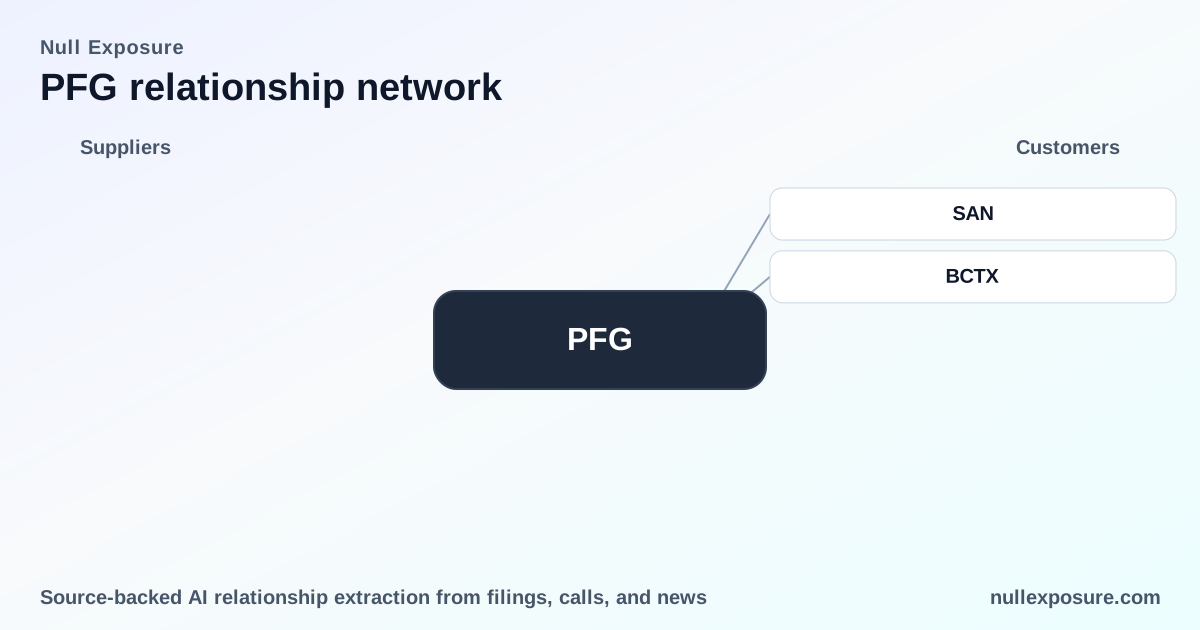
Principal Financial Group (PFG): Customer ties that shape regional exposure and fee durability
Principal Financial Group operates and monetizes across three core pillars — retirement and income solutions, principal asset management, and benefits & protection — generating revenues from insurance premiums, investment management fees, and workplace benefit services. The company captures recurring cash flow through long-duration annuity and pension obligations, asset-based fees on large pools of client capital, and employer-sponsored benefits contracts; these relationships drive both fee stability and liability duration that investors must price into valuation and capital plans. For a concise map of corporate customer signals, visit https://nullexposure.com/.
Why these customer links matter for investors today
PFG’s customer relationships reveal an operating profile that blends long-duration contractual economics with geographic concentration pockets and selective divestitures that reshape future revenue mix. Recent disclosures and press coverage show management executing portfolio simplification in Latin America while simultaneously unwinding specific local operational roles in Asia—moves that materially affect local earnings volatility, capital allocation, and recurring fee streams.
Operating-model constraints that drive investment risk and opportunity
The public record and company filings surface several company-level operating signals investors should treat as structural, not incidental:
- Contracting posture: long-duration bias. PFG underwrites long-duration insurance and annuity liabilities and operates pension products with multi-decade cash flows, implying funding and interest-rate sensitivity is central to economics.
- Counterparty mix: broad but with scale concentration. The firm serves individuals, small/mid-sized businesses and large institutional clients; that breadth reduces single-bucket concentration risk but leaves meaningful exposure to institutional mandates and employer-sponsored plan cycles.
- Geographic concentration: meaningful Latin America and Asia exposure. PFG runs material pension, mortgage and annuity operations in Chile and Asia, creating currency, regulatory and political vectors for earnings variance.
- Relationship maturity and criticality: many active, deeply embedded contracts. The company reports tens of thousands of defined contribution plans and billions in assets under administration, indicating high switching costs and long economic life for many relationships.
- Spend/signature scale: mid-to-large transactional footprint. Multiple references to average loan sizes and option exercise proceeds imply counterparties and transactions often fall in the $10–100 million band, which has implications for operational counterparty diligence and capital deployment.
These characteristics create durable fee streams but also concentration and duration risks that investors must overlay with interest-rate, currency and regulatory scenarios.
Relationship-level read: what the public evidence records
Below I summarize every relationship captured in the available results, with a plain-English takeaway and a concise source reference.
Hyzon Motors (HYZN)
Principal is reported as a recipient of hydrogen fuel supplied by Hyzon Motors, indicating a tactical procurement or pilot-scale adoption of hydrogen fuel infrastructure for relevant vehicle fleets. The mention suggests operational decarbonization activity rather than core revenue linkage. Source: TheBuzzEVNews coverage, March 10, 2026.
Banco Santander, S.A. — TradingView SEC 10-K summary
PFG announced a deal to sell its Chile annuities business to Banco Santander, with closing targeted in the third quarter of 2026, signaling a deliberate exit from certain local insurer liabilities and a move to refocus on core markets. Source: TradingView summary of PFG SEC 10‑K, March 10, 2026.
SAN (duplicate TradingView entry)
The TradingView notice repeats that the Chile annuities sale is expected to close in Q3 2026 and is framed as part of strategic streamlining to concentrate on core businesses—reinforcing management’s intention to reduce operational footprint in Chile. Source: TradingView SEC 10‑K summary, March 10, 2026.
BSAC (Banco Santander via LexLatin)
LexLatin reports that Banco Santander acquired Principal Compañía de Seguros de Vida Chile’s annuities business for an undisclosed amount and that Principal Asset Management will retain a non-discretionary mandate to manage the private assets backing the annuities, preserving some fee continuity despite the sale. Source: LexLatin, May 2, 2026.
BCT / BCTX (Hong Kong MPF sponsor/trustee transfer)
PFG is exiting sponsor and trustee roles in Hong Kong for MPF schemes with those roles transferring to BCT (BCTX), a transaction expected to close in 2026; this reduces PFG’s local operating responsibilities while transferring fiduciary duties and potential costs. Source: TradingView summary of PFG SEC 10‑K, March 10, 2026.
BCTX (duplicate)
The duplicate TradingView record reiterates the MPF sponsor/trustee transfer to BCT, confirming the planned operational exit from those Hong Kong roles and the likely reduction in recurring administration responsibilities. Source: TradingView SEC 10‑K summary, March 10, 2026.
The Shyft Group (SHYF)
A PR Newswire release referenced a product — a Royal Crane Body with PALFINGER Crane — in the context of a work-truck solutions showcase; the linkage to PFG is tangential in the public excerpt and suggests a vendor or equipment relationship rather than a material customer contract. Source: PR Newswire release reprinted, first seen March 10, 2026 (PR Newswire original FY2025).
What investors should extract from these relationship moves
- Divestiture plus mandate retention in Chile is strategically significant. Selling the annuities business to Banco Santander reduces PFG’s direct insurance liability footprint in Chile while retaining an asset management mandate preserves a route to recurring fees—this is a capital-light way to monetize local technical expertise while shrinking statutory insurance capital needs (LexLatin, May 2026).
- Operational de-risking in Asia. Transferring MPF sponsor and trustee roles to BCT reduces legacy operational exposure in Hong Kong and lowers the complexity of direct fiduciary responsibilities (TradingView, March 2026).
- Decarbonization and vendor relationships are peripheral to core economics. The Hyzon and Shyft mentions reflect operational procurement and equipment choices that are immaterial to principal revenue drivers, but useful as indicators of corporate operating expenditures and ESG-linked initiatives (TheBuzzEVNews; PR Newswire).
- Revenue durability is rooted in contract duration and client breadth. The company-level evidence points to long-term annuity and pension contracts, a diversified counterparty mix (individuals to institutions), and significant assets under management—factors that support fee resilience but embed duration and regional concentration risk.
Investment implications and risk checklist
- Positive: The Chile sale and asset-management mandate retention suggest better capital efficiency and retained fee exposure to closed blocks of business. This is a constructive reallocation away from insurance-carrier balance sheet intensity to fee-based services.
- Negative: Latin American and Asian operations continue to inject currency and regulatory volatility; exiting some roles reduces risk but does not eliminate regional economic exposure.
- Watchlist: closing timelines (Q3 2026 for Chile sale), the terms of the non-discretionary mandate with Santander, and the operational handover in Hong Kong for potential transitional service costs.
For a practitioner-ready synthesis of PFG’s customer signals and how they map to balance sheet and cash-flow risks, explore the compiled signals at https://nullexposure.com/.
Bolded takeaways: PFG is de-risking local insurance balance sheets while preserving fee channels, contract duration and geographic exposure remain the primary drivers of valuation risk and recent transactions materially alter local capital and operational footprints without fully severing fee relationships.