Performance Food Group (PFGC): customer relationships that scale convenience distribution
Performance Food Group (PFGC) operates as a high-volume food distributor across North America, monetizing through volume-driven wholesale margins, proprietary “Performance Brands,” and logistics-enabled distribution services to convenience stores, multi-unit restaurants, government accounts, and foodservice operators. PFGC leverages a national footprint of distribution centers to convert scale into market share gains in the convenience segment while selling largely on purchase-order terms rather than long-term supply contracts. For a compact view of PFGC’s customer exposures and how recent onboardings move the revenue needle, see NullExposure. https://nullexposure.com/
What the customer mix tells investors: posture, scale and leverage
PFGC’s customer relationships display a predictable set of commercial characteristics that shape both upside and risk:
- Contracting posture is transactional. Company disclosures state many customers buy via individual purchase orders and the business often does not enter long-term agreements, signaling flexible but non-locked-in revenue streams.
- Customer concentration is low. PFGC reports no single customer exceeded 10% of consolidated net sales for fiscal 2025, 2024, or 2023, which reduces counterparty concentration risk but increases dependence on broad customer retention.
- Counterparty heterogeneity spans government and large chains. Disclosures list U.S. federal, state and local government entities as customers alongside multi-unit restaurant chains and national convenience brands, indicating a mix of public-sector reliability and commercial volume accounts.
- Geographic footprint is North America-centric. The company distributes to over 300,000 customer locations from about 155 distribution centers, positioning PFGC as a continental-scale logistics operator rather than a regional player.
- Role is distributor/seller, not manufacturer-contractor. PFGC’s model centers on distribution of national brands, customer brands, and proprietary Performance Brands, reinforcing margin exposure to procurement and logistics rather than IP or licensing.
These characteristics create high operational scale with margin sensitivity to freight, commodity and labor dynamics and customer retention risk driven by spot purchasing behavior. Company filings for fiscal periods through FY2025 document these features.
Recent customer wins that matter
PFGC has been active expanding its convenience footprint with notable onboardings in FY2026 that directly contributed to Convenience segment growth.
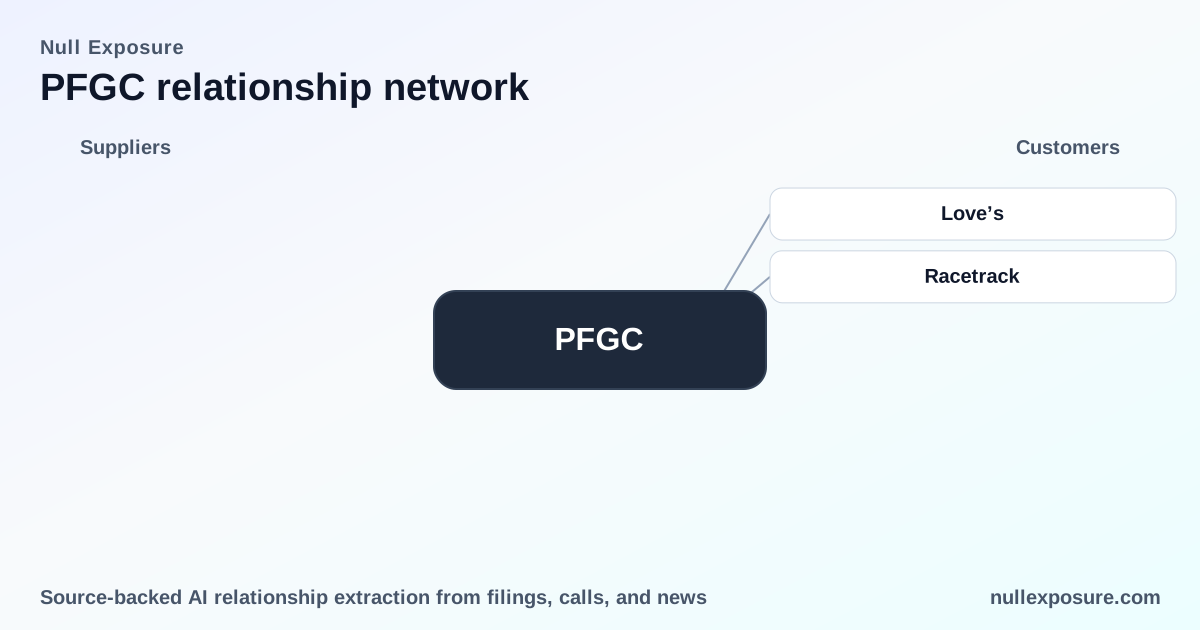
Love’s: 500+ locations onboarded
PFGC reported onboarding over 500 Love’s locations in September as part of the Convenience segment expansion, which contributed to a 6.1% net sales increase in that segment for the period. This is a clear example of accelerating scale through rollouts with national convenience chains. Source: company earnings remarks published via The Globe and Mail, March 2026.
Racetrack: 600 store rollout in December
The company also onboarded approximately 600 Racetrack stores in December, further expanding its convenience channel reach and reinforcing market share gains in that segment. The combined Love’s and Racetrack activations are cited as drivers of Convenience segment net sales growth in FY2026. Source: company earnings remarks published via The Globe and Mail, March 2026.
How these relationships drive the income statement
Onboarding hundreds of convenience-store locations converts directly to higher throughput across PFGC’s distribution network. The economics are straightforward:
- Top-line lift from volume: Large chain rollouts increase revenue per distribution center without proportionate increases in fixed overhead, improving gross throughput.
- Margin pressure remains a watchpoint: While volume dilutes fixed costs, PFGC’s operating margin is thin relative to retailers (Operating Margin TTM ~1.16%), so incremental revenue must offset freight, labor, and commodity cost swings to move operating profit meaningfully.
- Short contract duration increases churn risk: Because many relationships are governed by purchase orders rather than long-term contracts, the company needs continuous onboarding and strong service economics to retain share and protect margins.
These dynamics make recent Love’s and Racetrack additions strategically important: they increase penetration in a higher-margin convenience channel while testing PFGC’s ability to convert spot transactions into repeat business.
Operational constraints and company-level signals
Company disclosures and management commentary present a set of operating constraints that investors should incorporate into models:
- Spot-heavy contracting (company-level signal): A meaningful portion of revenue comes from purchase orders, which reduces long-term revenue visibility but increases pricing flexibility.
- Government accounts as a stable revenue tail (company-level signal): Federal, state and local government customers introduce episodic but generally reliable order flows that soften cyclicality in commercial channels.
- Low customer concentration (company-level signal): No individual customer exceeded 10% of sales in recent fiscal years, implying diversified counterparty risk.
- Distribution-centric segmentation (company-level signal): PFGC’s core competency is distribution logistics across North America, supported by proprietary brands and broad product assortment that drive competitive positioning.
These signals collectively indicate a mature, scale-dependent distribution model with concentrated operational risk around logistics costs and customer retention rather than credit concentration.
Key takeaways for investors
- Scale is the chief asset. PFGC’s ability to onboard hundreds of convenience locations at a time turns its distribution network into a leverage point for revenue growth.
- Contracts are short; retention is essential. The prevalence of purchase-order-based relationships increases the importance of service economics and margin maintenance.
- Concentration risk is low, but margin sensitivity is high. Diversified customers reduce single-counterparty risk but do not insulate the company from industry-wide margin compression.
- Recent onboardings validate go-to-market in convenience. Love’s and Racetrack integrations in FY2026 materially contributed to Convenience segment growth and demonstrate the company’s capacity to secure national rollouts.
Explore these customer relationships and risk signals in more depth at NullExposure. https://nullexposure.com/
Bottom line
PFGC is a logistics-first food distributor that converts national rollouts into incremental revenue, but its reliance on transactional contracting and thin operating margins makes retention and operational efficiency the central drivers of sustained shareholder value. Investors should weigh the growth potential from large convenience chain onboardings against the structural margin volatility inherent to distribution when positioning around PFGC.