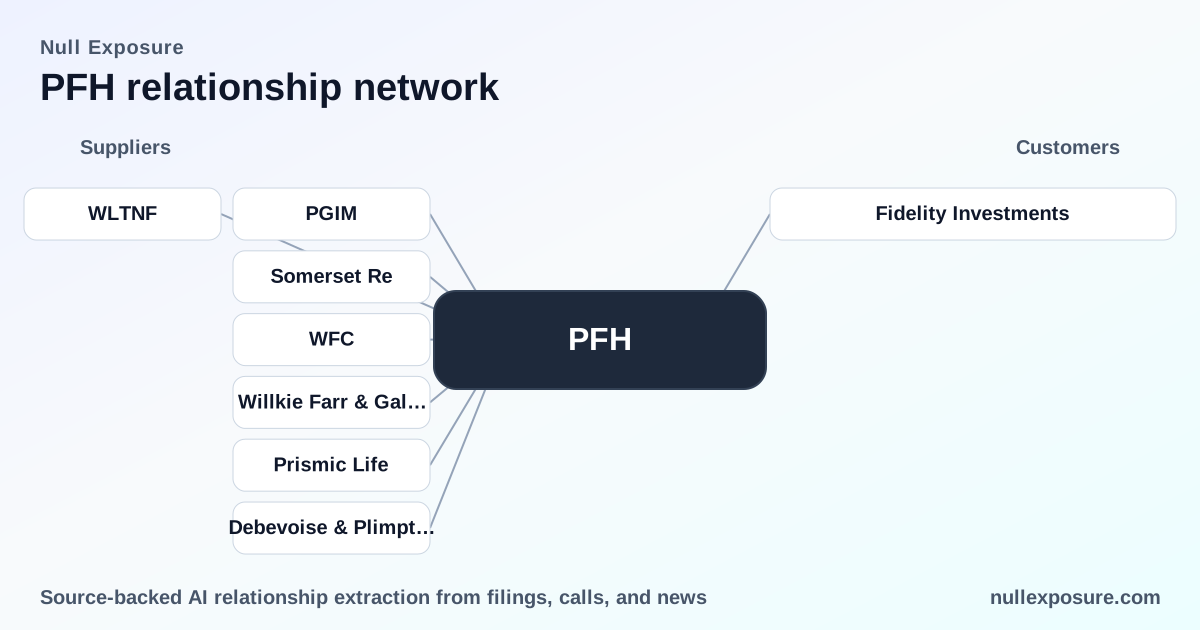
PFH (Prudential) Customer Relationships: Distribution, Durability, and the Fidelity Channel
Prudential Financial monetizes through three durable engines: insurance and annuity premiums, investment management fees, and investment income from a large asset base. The company sells guaranteed retirement and life products through both proprietary and third‑party distribution networks, and it increasingly places guaranteed income solutions into employer-sponsored plans via strategic partners. This dynamic — product manufacture plus third‑party distribution — defines how customer relationships convert into cash flow for holders of Prudential-issued securities such as PFH. For a concise view of our coverage and model signals, see NullExposure for relationship analytics: https://nullexposure.com/
Why a Fidelity tie-up matters for bond and credit investors
The one explicitly surfaced customer relationship in the record is a distribution collaboration with Fidelity Investments to offer a single‑premium immediate annuity (SPIA) within employer‑based retirement plans administered by Fidelity. According to InvestmentNews, Prudential and Fidelity collaborated on this decumulation option (March 10, 2026). This is not a product novelty in isolation — it is a distribution leverage event: linking Prudential’s guarantee product to Fidelity’s plan administration scale accelerates access to defined‑contribution savers who historically received fragmented retirement income options.
Strategically, this kind of relationship influences three credit drivers:
- Revenue stickiness: annuities sold into retirement plans create long‑dated premium flows and lower lapse sensitivity relative to retail channel sales.
- Asset/liability matching: large SPIA issuances change the profile of liabilities and the need for duration and credit in the investment portfolio.
- Counterparty concentration and counterparty quality: large recordkeepers like Fidelity drive volume, but concentrated distribution can create economic dependence if agreements are exclusive or preferential.
The Fidelity link — succinct and source‑backed
Prudential has partnered with Fidelity Investments to make a new single‑premium immediate annuity available through employer‑based DC plans administered by Fidelity, expanding decumulation options for plan participants. This collaboration was reported by InvestmentNews on March 10, 2026. (InvestmentNews, March 10, 2026)
All customer relationships surfaced in the record
- Fidelity Investments — Prudential collaborated with Fidelity to offer a single‑premium immediate annuity through employer retirement plans administered by Fidelity, deepening its presence in the DC decumulation market. (InvestmentNews, March 10, 2026)
This record contains one active, news‑level relationship. The Fidelity collaboration exemplifies Prudential’s broader distribution strategy of placing guaranteed products through large third‑party plan administrators.
Company‑level operating constraints and what they signal
The extracted constraints in the record give a clear picture of Prudential’s operating posture and risk architecture:
-
Long‑term contracting posture is embedded. The company explicitly uses long‑term insurance and reinsurance constructs (e.g., pension risk transfers and long‑term care assumptions) that convert up‑front premiums into predictable, long‑dated obligations. This creates revenue durability but also reserves and regulatory sensitivity when assumptions change.
-
Counterparty mix is broad and skewed toward large counterparties. The business serves very large enterprises, mid‑market, governments, non‑profits, and individuals, implying both scale and diversification in counterparty exposure. Large institutional ties drive volume; retail and individual channels diversify earnings volatility.
-
Global footprint and regional concentration coexist. Prudential reports global operations with meaningful concentration in the United States and significant APAC exposure (notably Japan). The FY2025 filings reference approximately $1.609 trillion AUM (Dec 31, 2025) and U.S. revenue (~$36.8bn) alongside sizable Japan revenue, signaling that currency and regional regulatory regimes materially affect earnings.
-
Dual role as seller and service provider. The company acts both as product seller (insurance and annuities) and as service provider (investment management via PGIM and contract servicing), creating multiple, distinct revenue and operational lines that can offset cyclical swings in one channel with fee income from another.
-
Services segment orientation. Repeated references to PGIM and investment management indicate ongoing reliance on fee‑based, asset management economics to complement underwriting results.
These constraints are company‑level signals about the maturity and structure of Prudential’s customer relationships: long contracts, diversified counterparty types, cross‑border scale, and a mixed seller/service provider role.
Investment implications and the risk checklist
For investors evaluating PFH and Prudential credit, the Fidelity relationship and the company‑level constraints imply clear opportunities and risks.
Key investment positives:
- Distribution leverage: partnerships with recordkeepers accelerate annuity take‑up and reduce customer acquisition cost for guaranteed income products.
- Durable premium streams: long‑term contracts and pension risk transfers convert lump sums into long‑dated liabilities, supporting predictable cash flows when priced correctly.
- Diversified revenue mix: investment management fees provide a smoothing counterweight to underwriting volatility.
Key risk vectors:
- Reserve and actuarial risk: long‑term guarantee businesses require accurate mortality, morbidity, and lapse assumptions; misestimation forces reserve strengthening and can compress capital.
- Interest‑rate and asset‑liability mismatch: annuity guarantees become more expensive in prolonged low‑rate environments and require disciplined asset allocation to defend capital.
- Distribution concentration: reliance on a few large partners for volume can transfer negotiating leverage to recordkeepers.
- Regulatory and cross‑border exposures: large APAC operations and global distribution expose earnings to currency swings and varying regulatory regimes.
Bottom line: the Fidelity collaboration is a constructive distribution outcome that strengthens Prudential’s annuity franchise, but it increases the importance of disciplined ALM, reserving, and capital planning.
How to act on this read
For credit and relative‑value investors, prioritize monitoring: SPIA issuance volumes through large recordkeepers, changes in reserving disclosures in subsequent filings, and asset allocation shifts within PGIM portfolios tied to liability hedging. For operational stakeholders and potential partners, the Fidelity tie illustrates the commercial value of recordkeeper distribution and the importance of integrating product, technology, and service processes to scale decumulation solutions.
Explore our relationship dashboards and get deeper signal‑level context at NullExposure: https://nullexposure.com/
By focusing on distribution partners, long‑term contract dynamics, and PGIM’s role as a fee provider, investors can form a clear, evidence‑based view of Prudential’s customer franchise and how it translates into cash flow and credit resilience for PFH stakeholders.