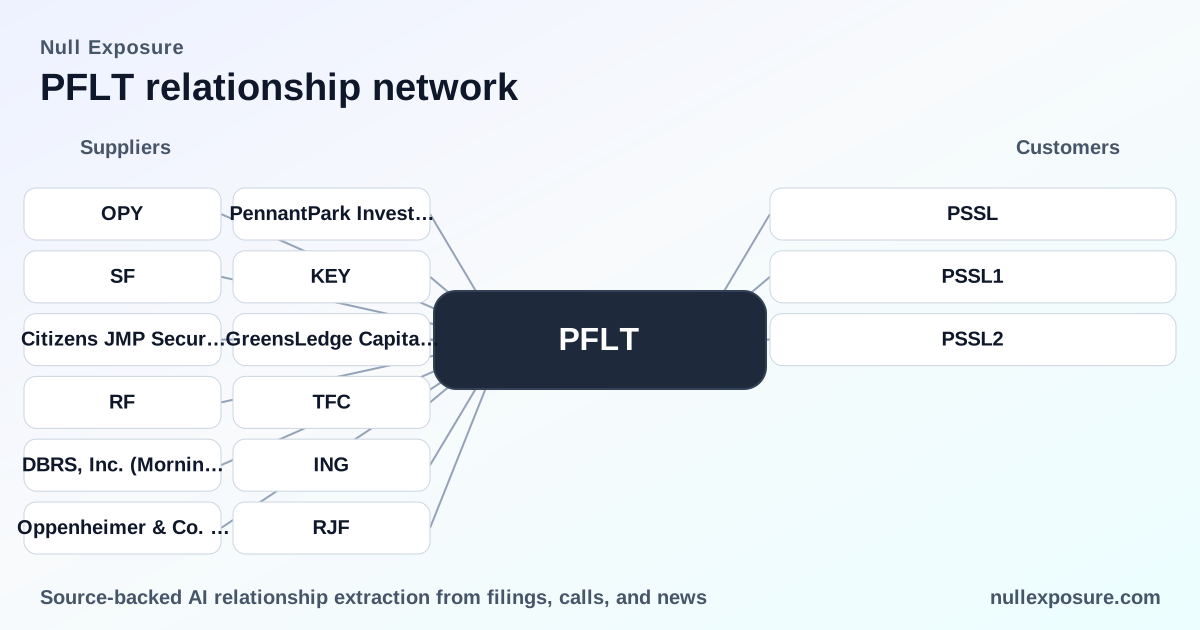
PFLT: How PennantPark Floats Liquidity Through JV Sales and Middle‑Market Loans
PennantPark Floating Rate Capital Ltd (PFLT) operates as a publicly traded business development company that originates and holds floating‑rate debt to middle‑market U.S. companies and monetizes those assets through interest income, dividend distribution, and opportunistic asset sales. The firm preserves capital primarily by diversifying across ~164 portfolio companies, using joint‑venture and funding vehicles to crystallize value or manage liquidity when needed. For counterparty intelligence and deeper relationship mapping visit https://nullexposure.com/.
Asset rotations are the operational lever investors should watch
PFLT’s most material customer‑facing activity in the recent reporting cycle is not a new lending program but the sale of loan and debt assets into affiliated joint ventures and funding vehicles. Those transactions are a repeatable mechanism for the company to convert loan positions into cash, manage net asset exposure, and align regulatory or tax-efficient funding structures. According to the FY2025 Form 10‑K, the company executed a significant post‑period sale, and the subsequent quarter disclosures in early 2026 show additional sales into named PSSL joint‑venture vehicles. These sales are large enough to move portfolio and liquidity metrics, and they bear directly on dividend coverage and leverage management.
The counterparties named in filings and calls — what each relationship represents
PSSL
PennantPark reported in its FY2025 Form 10‑K that it sold $118 million of assets to an entity called PSSL subsequent to September 30, 2025. This transaction is recorded in the official filing and reflects PFLT’s use of a special‑purpose purchasing vehicle to offload loans or debt instruments. According to the FY2025 Form 10‑K filed for the period ending September 30, 2025, the sale was a discrete, post‑period event reported by management.
PSSL1
In the company’s first‑quarter FY2026 commentary, management stated that $27 million of assets were sold to a joint venture labeled PSSL1. The disclosure appears in an earnings call transcript published in March 2026 and indicates active partitioning of portfolio positions into multiple JV tranches for either funding flexibility or credit segregation. The source is the March 2026 earnings call transcript reported by InsiderMonkey.
PSSL2
The same March 2026 earnings call transcript records that $133 million of assets were sold to a second joint venture called PSSL2, underscoring that the larger portion of the most recent post‑quarter activity was allocated to this second vehicle. The magnitude of the PSSL2 sale suggests a deliberate structuring choice to concentrate certain assets under a single JV sleeve for financing or risk‑management purposes. Source: March 2026 earnings call transcript (InsiderMonkey).
What these relationships imply about PFLT’s business model and constraints
PFLT’s public disclosures and the constraint signals pulled from its filings outline a consistent operating posture:
-
Long‑term contract posture. The company’s debt investments typically carry maturities of three to ten years, so while PFLT can sell assets to manage near‑term liquidity, the underlying exposures are structurally medium‑to‑long duration. This creates an emphasis on interest rate resets and credit monitoring over multi‑year cycles.
-
Focused on U.S. middle‑market borrowers. PFLT’s mandate centers on U.S. middle‑market companies (defined in filings as firms with annual revenues between $50 million and $1 billion). Geographic concentration to North America is explicit: as of September 30, 2025 all investments were in U.S. companies, representing the large majority of net assets.
-
Service provider role to portfolio companies. The firm is required by the 1940 Act to make managerial assistance available to qualifying portfolio companies, and its investment adviser functions as a collateral manager under certain credit facilities. PFLT therefore operates not only as a lender but as an active manager of portfolio company outcomes, which increases operational touchpoints but also creates potential execution risk dependent on management bandwidth.
-
Spend and ticket size in the $10m–$100m band. The company’s portfolio statistics disclose an average investment size of roughly $16.9 million across 164 companies, which positions most exposures squarely in the $10m–$100m commitment band and shapes counterparty credit and monitoring resource needs.
All of these are company‑level signals drawn directly from PFLT’s filings and investor communications; they are structural features of the BDC model PFLT executes.
Key metrics that frame investor decisions
- Market capitalization: $910.8 million (latest available).
- Dividend yield: 13.6% on the reported dividend per share of $1.23 and current pricing dynamics, a figure that places dividend sustainability at the center of investor scrutiny.
- Price/Book: 0.865, indicating the market values the company at a modest discount to book.
- Concentration and exposure: 164 portfolio companies with an average ticket of ~$16.9 million; all U.S. based as of FY2025.
These numbers underline two central tradeoffs for investors: attractive current yield supported by active portfolio monetization, and concentration risk created by reliance on U.S. middle‑market credit performance and repeat sales into JV structures.
Investment implications and risk checklist
-
Liquidity management via JV sales is a core tactic. PFLT uses PSSL, PSSL1, and PSSL2 to move assets off the balance sheet or into funded vehicles — this supports dividend distributions and leverage targets but increases counterparty and structural complexity. Investors must track timing and economics of each JV sale to assess whether realized gains or carried exposures are aligned with NAV objectives.
-
Credit exposure remains U.S. middle‑market centric. The single‑country bias lowers geopolitical diversification but concentrates expertise and information advantages; underwriting quality and managerial assistance matter intensely.
-
Maturity and rate sensitivity require monitoring. With floating‑rate instruments and multi‑year maturities, PFLT’s income stream benefits from higher short‑term rates but depends on portfolio repricing and default trajectories.
-
Governance and related‑party clarity are important. Repeated sales into closely named vehicles (PSSL family) demand clear disclosure on pricing, fair value mechanics, and potential conflicts — this is a governance and transparency lens investors should keep sharp.
For a closer counterparty and portfolio map, including transaction timing and materiality analysis, consult additional coverage at https://nullexposure.com/.
Bottom line
PFLT runs a classic BDC playbook: originate floating‑rate loans to U.S. middle‑market companies, collect interest, and use JV sales and funding vehicles as tactical levers to manage liquidity and balance‑sheet exposure. Recent activity — a $118 million post‑period sale reported in the FY2025 10‑K and subsequent Q1 FY2026 sales of $27 million and $133 million into PSSL1 and PSSL2 respectively — confirms that management is actively reshaping portfolio composition through structured counterparties. For investors, the key questions are whether JV sales are accretive to NAV and dividend sustainability, and whether disclosure and governance around those vehicles remain transparent and robust.