Provident Financial Services (PFS): How customer relationships translate into banking economics
Provident Financial Services operates a regional community bank model headquartered in Jersey City, New Jersey, monetizing through net interest income on loans and deposits, fee income from wealth management and insurance services, and community-focused deposit gathering. The company drives revenue from lending and deposit spreads while expanding fee-based services through its Beacon wealth management and Provident Protection Plus insurance units. For a concise view of relationship-level exposure and what it signals for investors, see https://nullexposure.com/.
Grants, community ties and why they matter to investors
Provident’s public activity in FY2026 included a targeted grants program that allocated small—but strategically relevant—amounts to local non-profits. These relationships are not commercial lending exposures; they are community engagement and reputational investments that tie the bank to its primary retail and municipal markets in New Jersey and the adjacent tri-state area. Such ties support deposit stability and local brand equity even though they do not produce material fee or interest income directly.
The four FY2026 community relationships — what happened and where it was reported
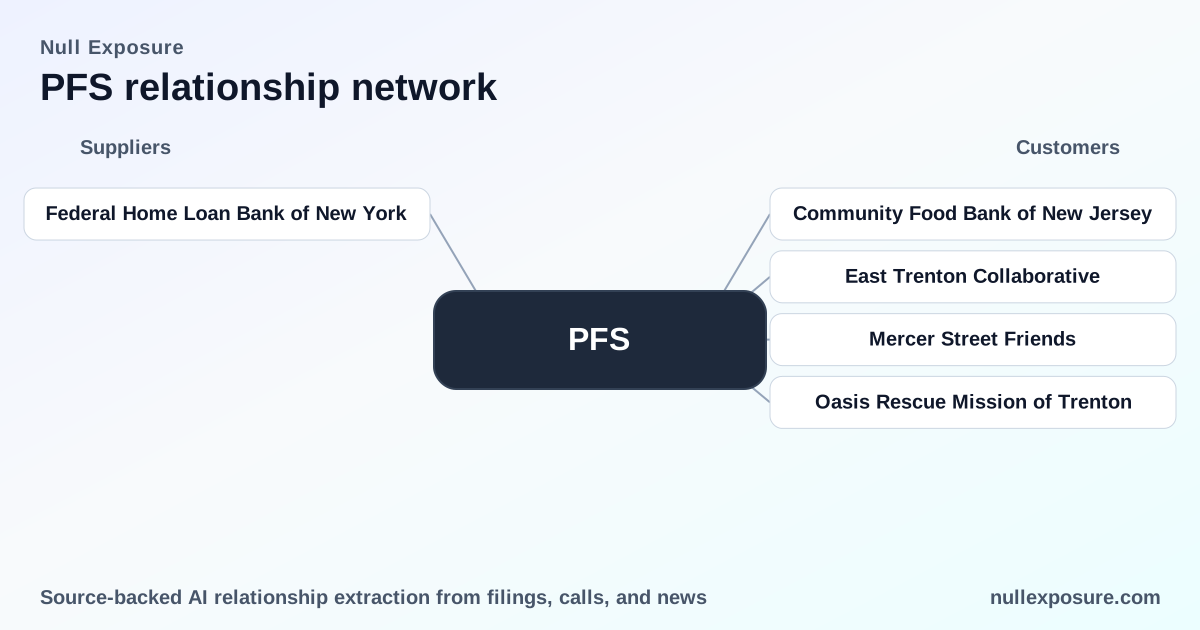
Provident announced an additional $50,000 in grants distributed across five non-profit recipients; four named beneficiaries in the public report are summarized below.
Community Food Bank of New Jersey
Provident provided a $10,000 grant to the Community Food Bank of New Jersey under the FHLBNY SBRG program as part of the March 2026 announcement. According to a Finviz news post dated March 10, 2026, this was a coordinated distribution of small grants to local social service organizations. (Source: Finviz, March 10, 2026 — https://finviz.com/news/288095/provident-bank-announces-an-additional-50000-in-grants-to-5-non-profit-organizations)
East Trenton Collaborative
The East Trenton Collaborative received a $10,000 FHLBNY SBRG grant in the same FY2026 program, reflecting Provident’s focus on neighborhoods within its New Jersey service footprint. The grant was documented in the bank’s public grant announcement reported by Finviz on March 10, 2026. (Source: Finviz, March 10, 2026 — https://finviz.com/news/288095/provident-bank-announces-an-additional-50000-in-grants-to-5-non-profit-organizations)
Mercer Street Friends
Mercer Street Friends was awarded $10,000 under the same program, signaling Provident’s continued engagement with local social service networks that intersect with the bank’s retail deposit and community outreach strategies. The distribution was reported on March 10, 2026 through Finviz. (Source: Finviz, March 10, 2026 — https://finviz.com/news/288095/provident-bank-announces-an-additional-50000-in-grants-to-5-non-profit-organizations)
Oasis Rescue Mission of Trenton
Oasis Rescue Mission of Trenton received the same-sized grant, completing the set of local partners explicitly named in the announcement; the allocation reinforces Provident’s community banking positioning within Mercer County and adjacent areas. The grant was part of the March 10, 2026 report on Finviz. (Source: Finviz, March 10, 2026 — https://finviz.com/news/288095/provident-bank-announces-an-additional-50000-in-grants-to-5-non-profit-organizations)
What these relationships collectively signal about Provident’s operating model
These community grants are not transactional customer relationships in the credit or deposit sense, but they provide tactical visibility into Provident’s customer-facing strategy and local market penetration. From the company-level evidence available, investors should read the following operational characteristics into Provident’s model:
- Contracting posture — short-term liquidity sensitivity: Public filings note certificate of deposit accounts maturing within one year totaled $3.05 billion as of December 31, 2024, indicating a meaningful pool of short-term retail liabilities that influence funding risk and interest rate management decisions.
- Counterparty profile — retail and individual focus: The bank’s operating narrative and branch footprint emphasize service to individuals, families and small businesses across New Jersey and nearby counties in New York and Pennsylvania, which drives product mix toward consumer deposits and residential real estate lending.
- Geographic concentration — regional franchise: Provident conducts business through 140 full-service branches concentrated in New Jersey and selected counties in Pennsylvania and New York, making its customer and deposit base regionally concentrated and sensitive to local economic cycles.
- Relationship roles — seller and service provider: Provident operates both as a principal seller of banking products and as a service provider via wealth and insurance subsidiaries (Beacon Trust, Beacon Investment Advisory Services, and Provident Protection Plus), positioning fee income as an explicit strategic lever.
- Lifecycle maturity — active, cross-sell oriented relationships: The bank emphasizes relationship banking and core deposits, indicating active management of customer accounts and cross-selling of wealth and insurance services to deepen lifetime value.
- Segment focus — services-driven expansion: The firm runs a single operating segment but is actively expanding fee-related services (wealth management and insurance brokerage) to diversify revenue away from pure net interest income.
These are company-level signals derived from filings and narrative disclosures; they frame how granular community engagements like the FY2026 grants fit into a broader business strategy.
Investment implications — key takeaways for allocators and operators
- Brand and deposit stability: Small, targeted community grants reinforce local brand equity and support deposit retention in a regionally concentrated market; this is a cost-effective underwriting of customer relationships that underpins low beta (0.795) relative to peers.
- Fee diversification reduces earnings cyclicality: Expansion of Beacon and the insurance subsidiary represents an intentional shift toward fee income, improving operating margin stability given Providence’s high operating margin (0.535 TTM).
- Funding sensitivity is real: The material volume of short-term CDs elevates rollover risk and exposes the bank to rate volatility; investors should monitor deposit repricing and retention metrics closely.
- Concentration risk: Heavy geographic concentration into New Jersey and nearby counties concentrates credit and deposit risk; portfolio stress scenarios should be regionally specific.
- Reputational capital is an asset but not earnings: Community grants support reputational capital and local market positioning, but each grant is immaterial to revenue—its value is in retention and cross-sell facilitation rather than direct EBITDA contribution.
For further analysis of customer relationships and exposure mapping, visit https://nullexposure.com/ for the complete company-level relationship view.
Final read: how to position on PFS customer signals
Provident’s FY2026 community grants confirm a classic community-bank playbook: deep local ties, a retail-heavy customer base, and incremental moves into fee-bearing services to lift ROE and reduce earnings cyclicality. Investors should value the brand benefits of community engagement while focusing due diligence on deposit durability, CD rollovers, and the trajectory of fee income from Beacon and the insurance unit. Operationally, the bank’s concentrated geography and short-term funding profile are the most material risk levers to monitor going forward.