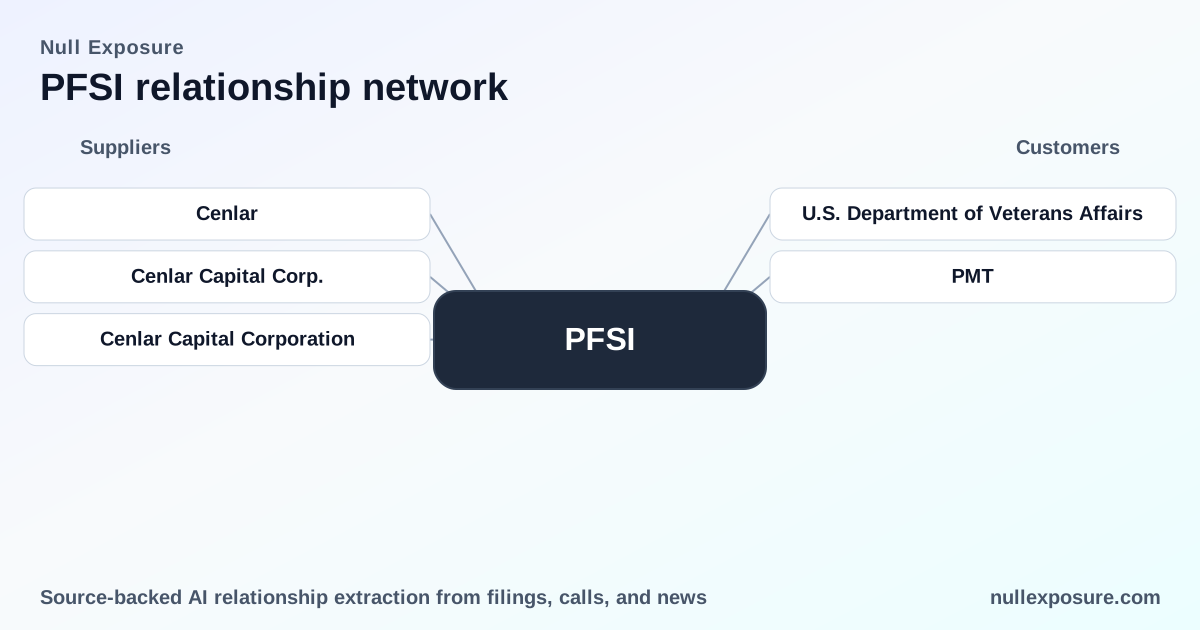
PennyMac Financial Services (PFSI): who pays the bills and why it matters
PennyMac Financial Services operates a two‑pronged mortgage platform: a production arm that originates and sells mortgage loans and a servicing arm that collects fees and ancillary income from servicing portfolios and third‑party trusts. The company monetizes through loan sales gains, servicing fees (including subservicing and fulfillment), management fees from externally managed REITs, and retained MSR economics, with a meaningful portion of revenue coming from related-party activity. For a deeper view of the relationship map and supporting filings, see https://nullexposure.com/.
How investors should read PFSI’s customer map
PennyMac’s customer relationships are not casual vendor ties — they are commercial channels and capital partners that generate recurring fee income and structurally influence balance‑sheet deployment. Long‑dated servicing arrangements, reliance on U.S. agencies and a concentrated, related‑party revenue stream are the dominant themes. Below I summarize each counterparty referenced in PFSI’s public record and contemporary reporting.
U.S. Department of Veterans Affairs (VA)
PennyMac acts as a servicer and subservicer for VA‑guaranteed loans, with a small but explicit subservicing balance disclosed in the FY2024 10‑K. This is direct government counterparty exposure that anchors PFSI’s Ginnie Mae/FHA/VA servicing footprint. According to PFSI’s FY2024 Form 10‑K, the company reported VA subservicing balances as part of total subservicing (FY2024 filing).
PennyMac Mortgage Investment Trust (PMT) / PMT (ticker)
PennyMac provides a suite of mortgage banking services to PMT — fulfillment fees, servicing/subservicing, loan disposition and management fees — and sells loans to the trust, which often obtains the related MSRs. PMT is a material revenue source: PMT‑related revenues accounted for roughly 10% of PFSI’s net revenues in 2024, making PMT a strategic and material client. This arrangement is described in PFSI’s FY2024 10‑K and reiterated in multiple market reports in early 2026.
PMT preferred series (PMT‑P‑B, PMT‑P‑A, PMTV, PMTW, PMTU)
These tickers are preferred or series securities issued by PennyMac Mortgage Investment Trust and all sit within the same sponsor/management relationship with PFSI. Each security references a trust that is externally managed by a PennyMac affiliate, which creates recurring management fee revenue streams and alignment across origination, servicing and capital markets activity. Press coverage and company disclosures in 2025–2026 note that PMT is externally managed by PNMAC Capital Management, LLC, a PennyMac subsidiary (news releases on Yahoo Finance, MarketBeat, and TradingView, early 2026).
- PMT‑P‑B: a preferred issue of PMT that benefits from PennyMac’s management and servicing platform (Yahoo Finance press release, 2026).
- PMT‑P‑A: market commentary highlighted PMT’s use of PennyMac’s origination and servicing scale when discussing preferred performance (MarketBeat, Jan 2026).
- PMTV / PMTW / PMTU: market reports describe these series in coverage of PMT’s yield profile and note the trust’s advantage from the PennyMac platform (TradingView, Ad‑Hoc‑News, TradersUnion, 2025–2026).
Annaly Capital Management (NLY) and NLY‑P‑F
In October 2025 PennyMac expanded a servicing relationship with Annaly that includes long‑term subservicing and an MSR purchase agreement. This is a commercial third‑party servicing partnership that broadens PFSI’s fee base and demonstrates PFSI’s role as an institutional servicer of scale. Trading‑and‑analysis reports in early 2026 document the October 2025 agreement and the expanded subservicing engagement (TradingView/Zacks, March 2026; Yahoo Finance investor commentary, March 2026).
Operational constraints that shape risk and upside
PennyMac’s relationship profile generates predictable fee streams but comes with structural constraints that investors must price into valuation and risk scenarios.
- Contracting posture — long‑dated but renewable: PFSI operates under multi‑year servicing agreements that extend to defined contract terms (examples cite expiration December 31, 2029 with automatic 18‑month renewals). This creates revenue durability but also raises renewal and termination considerations over the medium term (company disclosures cited in FY2024 materials).
- Government and GSE dependency: PLS (PennyMac Loan Services) is an approved seller/servicer for Fannie Mae, Freddie Mac and an issuer for Ginnie Mae, and is a lender/servicer for FHA, VA and USDA programs. Service standards, capital and liquidity requirements imposed by those agencies are a persistent operating constraint and counterparty risk (FY2024 10‑K). The VA is explicitly listed among the agencies PFSI services.
- Geographic concentration: U.S. centric: PFSI services and originates loans across all U.S. states and territories, which concentrates regulatory, credit and interest‑rate exposure to the U.S. mortgage ecosystem rather than diversifying by geography (FY2024 disclosure).
- Material related‑party concentration: PMT accounted for roughly 10% of total net revenues in 2024, indicating meaningful revenue concentration in a related‑party trust that is externally managed by a PennyMac affiliate (FY2024 10‑K).
- Role diversity and criticality: PFSI operates as borrower/ buyer (loan purchases for its accounts and for PMT), seller (loan sale counterparty), and service provider (servicing and subservicing across owned MSRs and third‑party portfolios). This vertically integrated posture drives margin capture but also concentrates operational risk in servicing platform performance (FY2024 10‑K).
- Maturity / stage: Many relationships are active and operational today; several contracts are multi‑year and tied to ongoing origination/disposition workflows and externally managed trust economics (FY2024 filings and 2025–2026 market reporting).
Investment implications and final takeaways
- Revenue diversification is partial, not complete: PFSI captures origination, servicing and management fees and benefits from adjacent REIT management, but PMT represents a single, material customer relationship that contributes predictable management and servicing income.
- Servicing scale is a competitive advantage: Long‑term servicing contracts and recent third‑party deals (e.g., Annaly) convert operational scale into fee income; this supports a valuation premised on recurring servicing economics.
- Agency dependency is a two‑edged sword: Access to GSE and agency programs secures product distribution and capital markets access but imposes regulatory and capital constraints on PFSI’s mortgage banking activities.
For a consolidated view of PFSI’s customer relationships and underlying source documents, visit https://nullexposure.com/ — the homepage has the full relationship trace and original filing links.
PennyMac’s earnings power springs from integrated origination and servicing channels and a suite of externally managed capital vehicles; investors must balance stable fee generation against concentration in related‑party trusts and agency‑linked regulatory exposure when building position size and scenario assumptions.