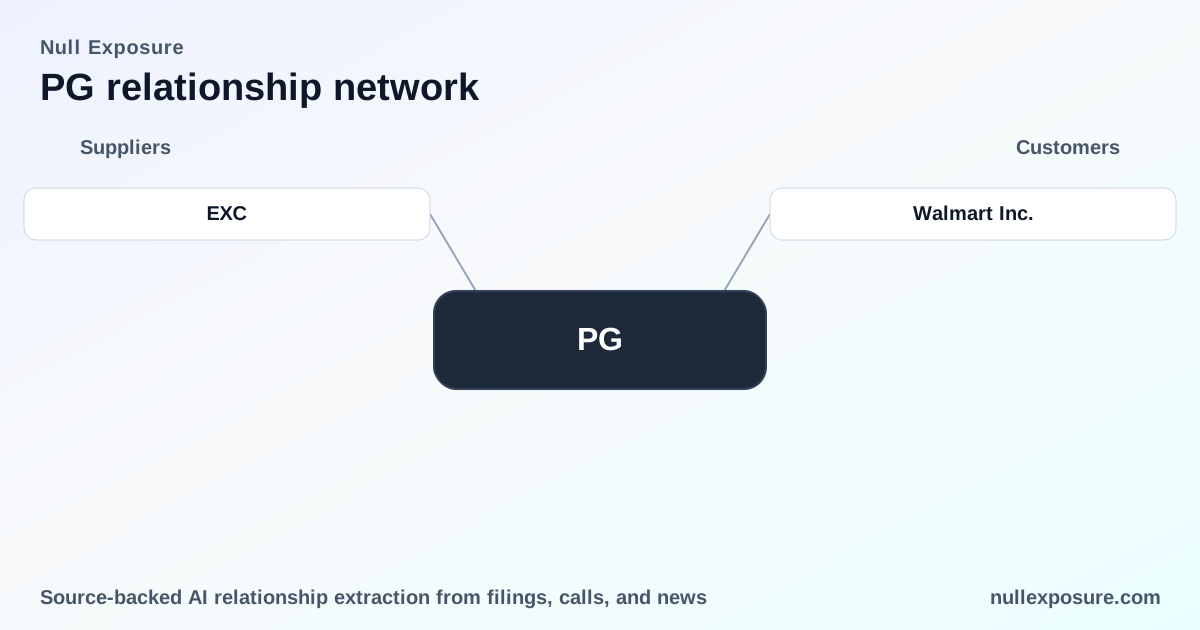
Procter & Gamble's Customer Footprint: Concentration, Channels, and Key Counterparties
Procter & Gamble sells global branded household and personal-care products into a wide range of retail and distribution channels and monetizes through sustained product sales, private-label avoidance, and selective channel partnerships that preserve brand pricing power. The company drives margin and cash flow by placing high-volume, high-frequency SKUs with mass merchandisers, membership clubs, grocery and drug chains, and increasingly through direct-to-consumer and e-commerce channels—while licensing select proprietary technologies where strategic. For a quick view of broader intelligence on counterparties and exposures, visit https://nullexposure.com/.
Why P&G’s customer map matters to investors P&G’s revenues flow through a structured mix of large retail anchors and many wholesale/distributor relationships. Several company-level characteristics shape the risk and opportunity profile for investors:
- Concentration and materiality: P&G discloses that its top ten customers accounted for 43% of total net sales in 2025, pointing to meaningful revenue concentration that elevates counterparty importance and negotiation leverage. (P&G FY2025 10‑K)
- Global reach and channel diversity: The company sells products in about 180 countries using mass merchandisers, e‑commerce, grocery stores, membership clubs, drug and department stores, distributors, wholesalers, specialty stores and direct-to-consumer channels—which supports resilience but creates varied contracting postures and localized execution risk. (P&G FY2025 10‑K)
- Dual role as seller and licensor: Beyond selling goods, P&G licenses proprietary technology (notably a polypropylene recycling process) to third parties, introducing a different counterparty dynamic that depends on milestone enforcement and intellectual property controls. (News coverage, 2025–2026)
- Contracting posture and maturity: Relationships with large retailers are long-standing and commercial in nature; distribution partners are treated as channels rather than strategic owners of P&G brands. The company’s scale and brand equity sustain favorable shelf placement and promotional economics.
- Direct-to-consumer presence: P&G sells directly to consumers in addition to third-party channels, providing a strategic outlet to capture data, margin and product bundling opportunities without intermediary dependence. (P&G FY2025 10‑K)
Relationship catalog: who P&G sells to and how each counterparty matters Below are the specific counterparties identified in public sources, each summarized in plain language with a citation.
Walmart Inc.
P&G reports that sales to Walmart and its affiliates represented approximately 16% of total sales in 2025 and 2024 (15% in 2023), making Walmart a material, high-volume retail anchor and a key customer for negotiating promotions, assortment and shelf space. (P&G FY2025 10‑K)
PureCycle Technologies (PCT)
PureCycle Technologies holds a global license to commercialize a proprietary polypropylene dissolution recycling technology developed by P&G; the license is a strategic avenue for P&G to scale a sustainable feedstock without operating the recycling plants directly. Several press reports and PureCycle disclosures highlight the license and the importance of construction and sales deadlines within the agreement. (Various news reports and PureCycle filings, 2025–2026)
Ollie’s Bargain Outlet (OLLI)
Ollie’s positions itself as an off-price retailer that purchases brand-name products—including P&G brands—to sell at a discount, attracting value-seeking consumers who still prefer established brands over private-label alternatives. This relationship underscores P&G’s broad retail penetration into discount and closeout channels. (Market commentary on Ollie’s, March 2026)
Costco Wholesale (COST)
P&G runs selective, exclusive product assortments and co-branded packs for membership-club retailers; recent reports describe Costco-exclusive SKUs (for example, new jumbo-size and co‑branded laundry partnerships), reflecting tailored channel strategies and scale-driven merchandising agreements. (Press reporting and market commentary, 2026)
Estée Lauder Companies (EL)
Estée Lauder’s FY2025 filings list Procter & Gamble as a competitor, indicating overlapping product and channel competition in beauty and personal-care segments rather than a customer relationship—this positions P&G as an industry peer in certain categories and helps frame competitive dynamics. (Estée Lauder FY2025 10‑K)
What these relationships imply for investors P&G’s customer set combines a few large, materially important retail anchors and a broad base of distributors and specialty channels. The presence of Walmart as a single counterparty at ~16% of sales and a top-ten concentration at 43% indicates significant negotiating leverage concentrated among a small number of counterparties, but balanced by global channel diversification that dampens single-market shocks. Licensing arrangements like the one with PureCycle create non-linear exposures: intellectual property and milestone enforcement replace straight retail dynamics and require different legal and operational oversight.
Key takeaways and risk considerations
- Concentration is a structural risk: Top-ten customers account for a large share of sales, so shifts in promotional terms, slotting, or private-label competition at a major retailer can move margins materially. (P&G FY2025 10‑K)
- Channel diversity is a strength: Selling in ~180 countries across mass, membership, grocery, drug, e‑commerce and direct channels provides resilience and multiple levers for growth. (P&G FY2025 10‑K)
- Licensing introduces operational dependency: Agreements like the PureCycle license substitute capital-light sustainability upside for direct plant ownership, while introducing milestone and termination risk tied to third-party execution. (PureCycle disclosures and related news, 2025–2026)
- Retail partnerships are transactional, not ownership-based: Most customer relationships are commercial contracts with distributors and retailers rather than equity or joint-venture stakes, preserving P&G’s brand control but leaving execution to partners.
If you want to keep tracking shifts in P&G’s customer exposures or dive deeper into counterparties and contract-level signals, see more on the platform at https://nullexposure.com/.
Conclusion: durable brand economics, concentrated retail exposure P&G’s business model monetizes shelf-leading brands through a mixture of large anchor retailers and thousands of channel partners globally. The company’s scale and brand power create durable cash flows, but top-customer concentration and the contractual complexity introduced by licensing agreements require focused monitoring by investors. Understanding how promotional economics, private-label competition, and milestone-driven licensing play out across major counterparties is the path to assessing near-term margin risk and longer-term structural upside.