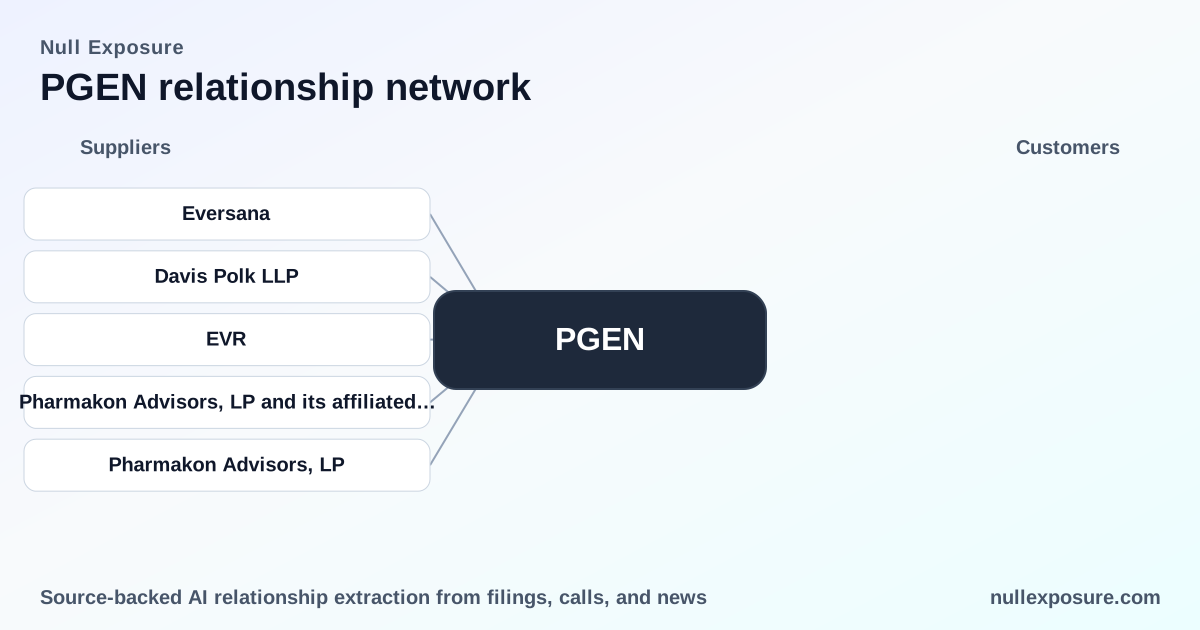
Precigen (PGEN) and Its Customer Relationships: What Investors Should Know
Precigen operates two parallel commercial logics: an R&D-driven therapeutics business and a revenue-generating Exemplar business that sells genetically engineered miniature swine models and related services to life‑science customers. The company monetizes through product and service sales from Exemplar, licensing and collaboration fees for its biological platforms, and research‑stage partnering income, with Exemplar representing the clearest, recurring revenue stream today.
If you want to dive deeper into relationship-level exposure and contract signals for PGEN, visit https://nullexposure.com/ for structured access to the raw references and longer reports.
How Precigen makes money and what that implies for investors
Precigen’s revenue profile is bifurcated. On one side, Exemplar is a commercial manufacturing and services business: it sells porcine research models and associated services to pharmaceutical and academic customers, recognizing revenue when customers obtain control of products or services. This is a realized‑revenue activity with conventional invoicing and payment mechanics. On the other side, the therapeutics pipeline is development‑stage and monetized through licensing, collaborations and milestone receipts — inherently lumpy and contingent.
From the company disclosures and relationship constraints, several operating characteristics are clear:
- Contracting posture is short‑term: payment terms are typically due within 30 days of invoicing, implying tight working capital cycles and exposure to receivable turnover. This is a company‑level signal drawn from revenue recognition and invoicing practices.
- Concentration is material: Exemplar revenue is concentrated in a small number of buyers — roughly four customers accounted for the majority of Exemplar segment revenue in recent years — which amplifies single‑counterparty risk.
- Geographic footprint is predominantly North American: reported foreign revenues were effectively zero for recent years, signaling regional concentration in demand and regulatory exposure.
- Business role is seller and service provider: Precigen sells finished research models and provides services rather than acting solely as a research collaborator, which creates visible product margin dynamics and clearer revenue recognition patterns.
These characteristics shape valuation sensitivity: short payment terms accelerate cash realization but concentrate credit risk on a small customer base; limited geographic diversification increases exposure to North American cyclical funding for preclinical research.
The public record on customer relationships (what exists in the data)
Precigen’s customer‑relationship signals in the public sources are narrow but meaningful: two news notices document a third‑party (Alaunos Therapeutics, ticker TCRT) terminating license arrangements that involved Precigen.
Alaunos Therapeutics (TCRT) — FY2024 reference
A QZ report noted that Alaunos terminated its license agreements with the National Cancer Institute and Precigen, a move that affects Alaunos’s ability to resume its TCR‑T clinical trials unless licenses are renegotiated or new approvals obtained. The piece was published in March 2026 and cites company filings around Alaunos’s quarter. (Source: QZ news report, March 10, 2026 — https://qz.com/alaunos-therapeutics-inc-tcrt-quarterly-10-q-report-1851698421)
Alaunos Therapeutics (TCRT) — FY2025 reference
A follow‑up QZ article covering Alaunos’s FY2025 reporting reiterated termination of several R&D agreements and licenses, explicitly including the Precigen license as part of the company’s strategic shift. The reporting is contemporaneous and based on Alaunos’s public filings. (Source: QZ news report, March 10, 2026 — https://qz.com/alaunos-therapeutics-inc-tcrt-reports-earnings-1851773800)
Both items document the same commercial fact from the counterparty side: Alaunos has terminated license arrangements that in prior periods involved Precigen. These are third‑party filings and media summaries of Alaunos disclosures; they confirm a dissolved counterparty relationship rather than establishing new revenue.
What the Alaunos notices mean for Precigen investors
The Alaunos notices are important to catalog but are not evidence of broad customer loss across Exemplar. They represent discrete license terminations from an external partner and should be weighed against two company‑level realities:
- Exemplar revenue is materially concentrated: four customers represented the majority of segment revenue in recent years, so loss or churn among top buyers materially moves topline figures; company filings identify this concentration across 2022–2024.
- Most Exemplar sales are short‑term commercial contracts: payment terms and standard revenue recognition practices indicate Exemplar operates as a seller of products and services rather than a portfolio of long‑dated, non‑reciprocal research collaborations.
Investor takeaway: the Alaunos termination is a counterparty event worth tracking, but the larger risk profile for PGEN derives from concentration in a small number of Exemplar customers, short payment terms that amplify working‑capital sensitivity, and near‑term North American revenue concentration.
If you want a consolidated view of these relationship signals and how they feed into counterparty risk scoring, see the home page at https://nullexposure.com/.
Operational constraints that define the trajectory of Precigen’s customer business
Treat the following as company‑level operating constraints extracted from Precigen’s disclosures and relationship signals — these are not tied to any single counterparty unless the excerpt explicitly names one:
- Short‑term contract lifecycle: revenue invoicing and recognition tied to delivery with 30‑day payment terms creates high cash conversion speed but also concentrates receivable risk. This structure drives a need for tight credit control and can make reported revenue volatile if a major buyer delays payment.
- Governmental payers and reimbursement considerations: corporate filings emphasize the role of third‑party payers and governmental policies in commercialization success, a reminder that regulatory and reimbursement dynamics shape near‑term demand for therapeutics and downstream partner activity.
- Regional concentration: negligible foreign revenue in recent years indicates a primarily North American revenue base; this concentrates exposure to U.S. biotech funding cycles and domestic academic and pharma R&D budgets.
- Material customer concentration: the Exemplar segment has historically relied on a handful of customers for a large share of revenue, making top‑customer retention a determinative factor for short‑term growth.
- Commercial maturity of Exemplar: Exemplar operates as a product/service seller with recognizable commercial revenues from genetically engineered models — this segment provides recurring topline that de‑risks some pipeline volatility, but its size and concentration set the pace for near‑term financial performance.
Risk / Opportunity checklist for investors
- Risk — Customer concentration: heavy reliance on four customers for Exemplar revenue elevates single‑client exposure.
- Risk — Cash cycle dependence: 30‑day payment terms create both liquidity benefit and credit concentration risk.
- Risk — Geographic concentration: North America‑centric revenue makes the company sensitive to U.S. funding and regulatory shifts.
- Opportunity — Commercialized Exemplar revenue: recurring product and service sales provide a stable base below the high‑variance therapeutics pipeline.
- Event to watch — License churn with small partners: Alaunos’s termination of Precigen‑related licenses signals that partner behavior can materially change the structure of collaboration revenue.
Conclusion
Precigen’s investor story is dual: a commercial Exemplar business that produces tangible product revenue and a therapeutics pipeline that drives optional value. The salient customer signals are concentration, short payment terms, and North American focus; third‑party license terminations (like Alaunos/TCRT) are confirmatory events rather than structural shifts in the Exemplar model. Monitor customer retention among Exemplar’s top buyers and accounts receivable trends as the near‑term barometer of operational health.
For ongoing monitoring of Precigen’s contract and counterparty landscape, visit https://nullexposure.com/ for the raw relationship records and constraint summaries.