Progressive Corp (PGR) — what customer mentions reveal about market positioning
Progressive sells insurance and related services, monetizing primarily through underwriting premiums, policy fees and investment income on float while distributing products both directly and through agents. The company’s scale in personal auto and growing presence in specialty lines creates recurring premium cash flow and cross-sell leverage into homeowners, motorcycle, watercraft and commercial vehicle segments. For a concise dossier on business relationships tied to Progressive, visit https://nullexposure.com/ for deeper signals and linkages.
How Progressive goes to market and what constrains that model
Progressive operates as a seller of insurance products across direct and agency channels, with a customer mix dominated by individuals and meaningful exposure to small businesses — particularly in transportation and commercial auto lines. Company disclosures emphasize nationwide operations: the business is regulated state-by-state across the United States (and in limited foreign jurisdictions), which reinforces a mature, compliance-heavy operating posture with well-established distribution processes.
Several company-level signals shape how investors should think about customer relationships:
- Contracting posture: Progressive sells product (underwriting and policy administration) rather than acting as a pure technology intermediary; the firm controls pricing, claims reserves and underwriting guidelines. This gives it contractual leverage but also exposes it to regulatory rate pressure.
- Concentration and criticality: Auto insurance represents a material share of revenue, making Progressive more sensitive to trends that reduce demand or compress rates (for example, vehicle automation or car-sharing evolution).
- Customer segmentation and maturity: The business serves mass-market individuals and small commercial buyers, indicating high transaction volumes, pricing scale advantages, and relatively low per-customer revenue, but sizable aggregate profitability when combined with efficient claims and distribution. These company-level constraints come from Progressive’s public filing language describing customer targets, lines of business and geographic scope.
Notable customer/partner mentions investors should track
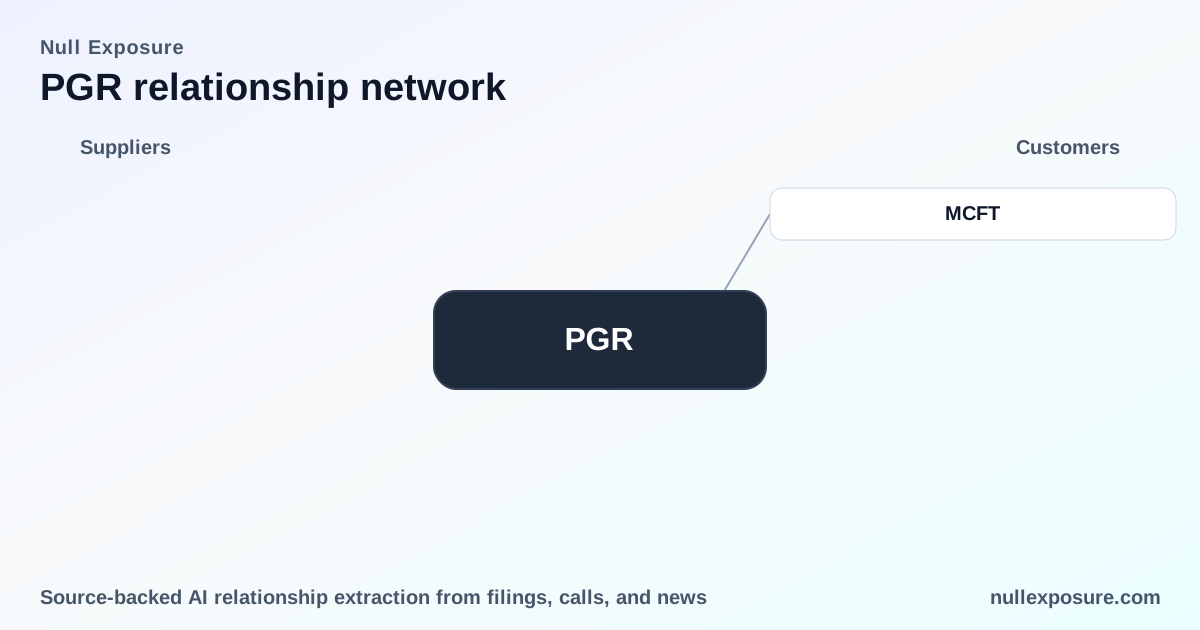
MasterCraft / MCFT — Globe and Mail press pick-up (March 10, 2026)
Progressive is listed as a supporter of MasterCraft’s “Let Her Rip” campaign, positioning Progressive as a sponsor for boating-focused marketing that aligns with watercraft insurance cross-sell opportunities. According to a Globe and Mail press pickup dated March 10, 2026, the campaign was “proudly supported by Progressive.” (source: The Globe and Mail, March 10, 2026)
MasterCraft / MCFT — GlobeNewswire release (March 3, 2026)
A MasterCraft press release on March 3, 2026 via GlobeNewswire restates Progressive’s ongoing support and describes how Progressive’s backing helps expand the Let Her Rip events nationwide, which creates marketing touchpoints for watercraft coverage and brand affinity among recreational owners. (source: GlobeNewswire press release, March 3, 2026)
MasterCraft Boat Company — Globe and Mail (alternate mention, March 10, 2026)
The same Globe and Mail distribution referencing MasterCraft’s campaign explicitly mentions Progressive’s role in powering the initiative, reinforcing the tie between Progressive’s marketing investments and niche leisure-vehicle insurance categories. This reprise confirms multiple media placements tying Progressive to marine insurance promotion. (source: The Globe and Mail, March 10, 2026)
MasterCraft Boat Company — GlobeNewswire (alternate mention, March 3, 2026)
GlobeNewswire’s campaign release highlights that Progressive’s support helps scale the event series, which suggests a deliberate marketing investment in physical events that drive awareness among boat owners — a demographic directly relevant to Progressive’s watercraft insurance product line. (source: GlobeNewswire press release, March 3, 2026)
Hippo Holdings Inc. — earnings/transcript mention (May 3, 2026)
An earnings call transcript for Hippo cited Progressive as providing “a scaled high-volume platform that allows us to efficiently identify and target our ideal customer segments,” indicating that Progressive’s distribution and data capabilities are recognized by other insurers and insurtechs as a channel or benchmark for customer acquisition. (source: InsiderMonkey transcript, May 3, 2026)
What these relationships reveal about strategy and execution
- Marketing and product cross-sell: Progressive’s sponsorship of MasterCraft’s Let Her Rip campaign is a deliberate move to seed demand among owners of recreational watercraft — a relatively small but higher-margin niche where Progressive can cross-sell specialty policies. The repeated press placements show consistent, targeted brand investment rather than one-off ad buys.
- Platform and distribution utility: The Hippo remark frames Progressive not just as a competitor but as an operator of a high-volume distribution and customer-identification platform. That language signals that Progressive’s scale in underwriting and customer targeting is strategically valuable to industry peers and potential partners.
- Proof of multi-channel reach: These mentions together validate that Progressive combines brand marketing, distribution scale and product breadth to capture adjacent markets beyond core auto.
Investor implications: revenue upside and risk profile
- Upside drivers: Targeted sponsorships and events provide cost-effective acquisition channels for specialty lines. Progressive’s recognized distribution platform can be monetized indirectly through partnerships, cross-sell lift and lower marginal acquisition costs for policy cohorts.
- Risk vectors: Because auto remains material to revenue, macro shifts that depress auto premiums or demand will affect overall profitability more than isolated gains in watercraft or homeowners lines. Regulatory rate constraints across states add a structural cap to pricing flexibility.
- Operating characteristics: High volume retail relationships imply low per-customer concentration but operational criticality — claims and pricing systems must scale efficiently to protect margins.
Tactical takeaways for research and operations teams
- Monitor marketing-to-conversion metrics around specialty lines tied to event sponsorships to quantify ROI from relationships like MasterCraft.
- Assess distribution leverage by tracking how peer references (e.g., Hippo) translate into co-marketing or referral arrangements that could expand Progressive’s effective reach.
- Model regulatory sensitivity into pricing scenarios given the company’s material exposure to auto insurance and state-level oversight.
For more structured relationship mapping and signal tracking on Progressive and its customer ties, visit https://nullexposure.com/ — the site provides curated feeds and cross-referenced press evidence for investment due diligence.
Conclusion
Progressive’s customer- and partner-related mentions in early 2026 underscore a two‑pronged commercial approach: scale-driven distribution in core personal auto business plus selective, brand-oriented investments to win adjacent specialty markets. These relationships both diversify Progressive’s addressable market and validate the firm’s distribution muscle, but investors must weigh that against ongoing rate sensitivity and state-level regulatory constraints.