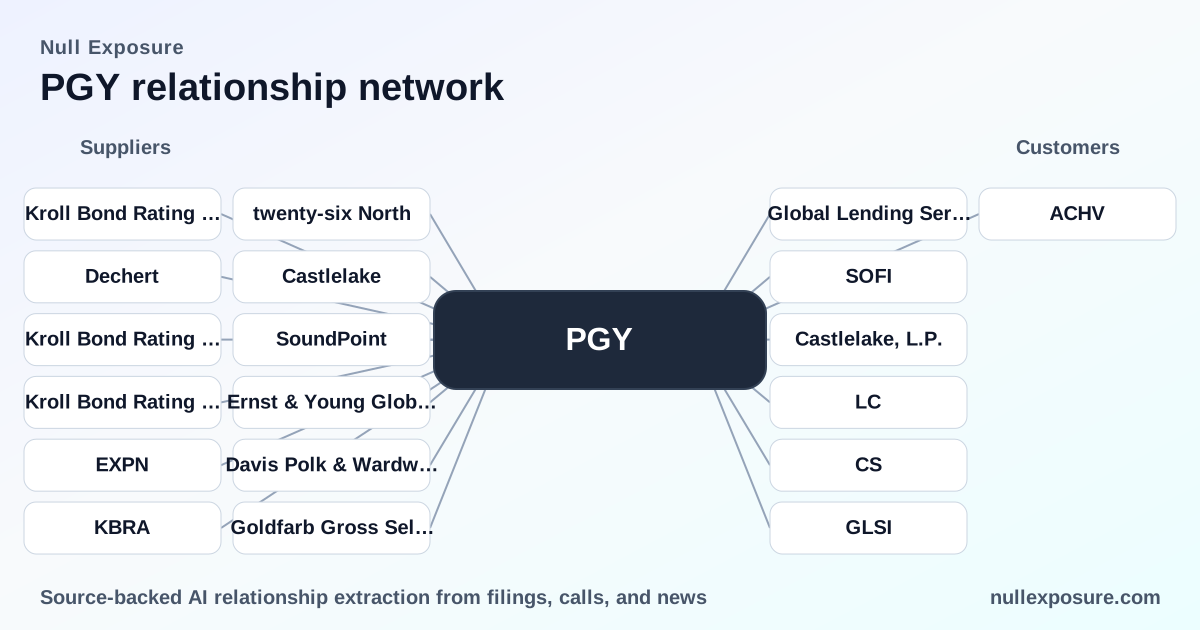
Pagaya’s customer map: who pays for the AI that sources loans
Pagaya Technologies deploys proprietary AI to connect consumer and auto credit originators with institutional funding vehicles, and it monetizes primarily through fees earned when those assets are acquired or sold. The company operates as a product-focused technology provider that sources and underwrites loans on behalf of partners and then transfers those assets into financing vehicles or sells exposure to institutional investors; fee income from these transactions accounts for a majority of revenue. Investors should evaluate Pagaya by the economics of fee capture, the stability of its funding partners, and the durability of short-term purchase agreements that underpin flows.
If you want a concise, investor-ready feed on Pagaya customer relationships and how they drive revenue, review this coverage and follow updates at https://nullexposure.com/.
How Pagaya actually contracts and where the risks live
Pagaya’s operating model combines software, data science, and transaction execution rather than a traditional lending balance sheet. From the relationships and company disclosures we observe several company-level signals:
- Contracting posture: short-term purchase agreements (1–3 year typical tenor) — Pagaya generally structures purchase agreements with financing vehicles that run for one to three years with optional extensions, which implies frequent re-contracting and potential revenue volatility as counterparties reset terms.
- Geographic concentration: United States — fee revenue is materially concentrated in the U.S., making macroeconomic and regulatory shifts in the U.S. the dominant demand driver for Pagaya’s business.
- Materiality of partner flows: core to topline — fees tied to assets acquired from partners represent a majority of Pagaya’s revenue, so partner health directly maps to Pagaya’s cash generation.
- Role: service provider to financial institutions — Pagaya acts as an AI-enabled service provider to banks, fintechs and funding sponsors, which creates regulatory and operational dependencies.
- Relationship stage: active and scaling — the company reports more than 30 active partners using its technology, signaling customer maturity and commercial traction.
- Product posture: software-first, transaction-enabled — Pagaya’s value is derived from its AI and transaction execution capabilities rather than spread capture on a warehouse balance sheet.
Collectively, these characteristics point to high growth optionality with corresponding counterparty and funding concentration risk, and they frame how investors should stress-test scenarios for revenue continuity and contract renewals.
Every named customer and what matters to investors
Below I cover every relationship found in the records and what each partner contributes to Pagaya’s commercial story.
Global Lending Services (GLS)
Pagaya referenced onboarding Global Lending Services, a leading auto finance provider serving ~20,000 franchises and independent dealerships, as a source of new auto loan flows and distribution reach. This was disclosed on Pagaya’s Q4 2025 earnings call (March 7, 2026).
Source: Pagaya Q4 2025 earnings call transcript (Mar 7, 2026).
Castlelake, L.P.
Pagaya negotiated multi-year sourcing relationships with Castlelake that include large-scale purchases and forward flow capacity; Dechert reported an agreement to source up to US$1 billion in consumer loans to Castlelake in a 2024 filing context, and Pagaya later announced a $500 million auto forward flow expansion with Castlelake (FY2024–FY2025 reporting). Castlelake functions as a strategic funding partner and a large buyer of Pagaya-originated paper.
Source: Dechert announcement advising Pagaya (Oct 2024); Pagaya press disclosure reported FY2025.
SoFi (SOFI)
Pagaya partnered with SoFi to broaden member access to personal finance products; the relationship was first announced in 2021 and cited in reporting tied to Pagaya’s capital-raise and partner expansion narrative. SoFi represents an example of a large fintech originator integrating Pagaya’s underwriting and distribution capability.
Source: Company partnership announcement and market press (FY2022 reporting).
LendingClub (LC)
LendingClub adopted Pagaya’s marketing affiliate product and became a multiproduct partner, expanding the channel mix through which Pagaya sources and places consumer credit. This adoption was noted on Pagaya’s Q4 2025 earnings call and signals cross-sell potential into marketing and distribution services.
Source: Pagaya Q4 2025 earnings call (Mar 7, 2026).
Credit Suisse (CS)
Credit Suisse is identified as a client of the Pagaya Opportunity Fund, investing on behalf of its customers; Pagaya experienced fund flow sensitivity tied to large withdrawals from Credit Suisse in FY2023. This relationship illustrates fund-level distribution risk when institutional intermediaries face liquidity stress.
Source: Globes reporting on Pagaya and Credit Suisse (FY2023).
Ally (ALLY)
Pagaya positions its bank-ready platform as tested and scaled with banks including Ally, representing traction with incumbent bank partners and signalling enterprise-grade compliance and integration capability for auto and consumer finance products.
Source: Company remarks and press coverage referencing bank partnerships (FY2025 reporting).
One William Street Capital Management
One William Street purchased the residual certificate in a $400 million RPM auto transaction, acting as a strategic funding partner for Pagaya’s auto securitizations and demonstrating the use of third-party investors to complete structured transactions. This shows Pagaya’s ability to place residual risk with institutional investors.
Source: Pagaya transaction disclosure reported in company press (FY2025).
US Bank (USB)
US Bank appears among the bank partners that have tested Pagaya’s platform, reinforcing the bank channel as a growth route for institutionally distributed products. Pagaya frames US Bank as part of its bank-ready platform adoption narrative.
Source: Company press and transcript excerpts discussing bank partnerships (FY2025 reporting).
Achieve (ACHV)
Pagaya announced a partnership with Achieve to expand consumer access to personal loans via AI-powered underwriting, and Pagaya reported onboarding “Achieve GLS” in its partner rollouts. Achieve represents a fintech originator channel that complements Pagaya’s bank relationships and supports consumer loan origination growth.
Source: Company press and earnings call statements (FY2025 reporting; investing.com piece).
What investors should watch next
- Counterparty concentration and renewal risk: short-term purchase agreements and heavy reliance on fee income mean that a small number of funding partners can materially affect revenue if they reduce allocations or fail to renew.
- Funding stability across channels: Castlelake, One William Street, and other strategic buyers illustrate diversified funding options, but Pagaya’s revenue sensitivity to large institutional clients (e.g., Credit Suisse withdrawals) is a persistent vulnerability.
- Regulatory/service-provider exposure: as a service provider to financial institutions, Pagaya is exposed to compliance and third-party risk that can increase onboarding friction with banks.
- Proof points with banks and fintechs: successful integrations with US Bank, Ally, SoFi, and LendingClub provide validation of the bank-ready platform thesis and improve the company’s capacity to scale product offerings.
For a concise feed of changes to Pagaya’s customer relationships and how they affect revenue risk, see more at https://nullexposure.com/.
Bottom line
Pagaya has built a software-forward, transaction-enabled model that captures fees by sourcing and placing consumer and auto credit into institutional funding vehicles. The company’s growth thesis is credible given active partnerships with banks, fintechs and structured capital providers, but investors must underwrite short contract tenors, U.S.-centric revenue concentration, and counterparty funding risk when modeling earnings persistence and valuation.