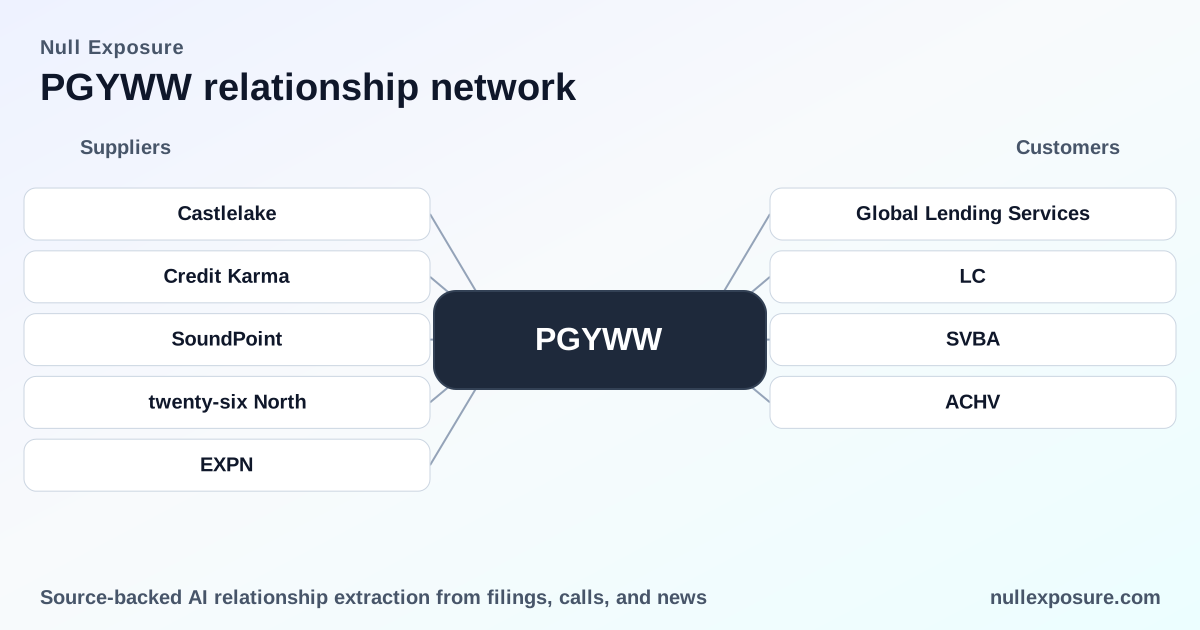
Pagaya (PGYWW) — Customer relationships that drive revenue and define risk
Pagaya monetizes an AI-driven asset management and credit-origination platform by selling software-enabled services, marketing affiliate offerings, and sponsoring financing vehicles that attract institutional capital. Revenue flows from Network AI fees recognized at the point of performance, transaction-level economics tied to financed assets, and fee income from managing financing vehicles—an ecosystem where product adoption by large financial partners directly scales revenue and cash flow. For investors in PGYWW instruments, the most consequential signals are partner adoption (multiproduct relationships), concentration among significant customers, and short payment terms that compress working capital. Learn more about how we source and present this intelligence at https://nullexposure.com/.
How Pagaya turns models into commercial value
Pagaya operates as a hybrid software and asset-manager: it licenses proprietary AI that helps partners originate and price loans and then sponsors or manages financing vehicles that provide the capital side of those transactions. The company recognizes Network AI fees primarily at a point in time, and the typical payment term is approximately 30 days, which establishes a short-term contracting posture and exposes Pagaya to near-term collections risk. Pagaya reports that it generally recognizes revenue on a gross basis because it integrates and controls partner services delivered to Financing Vehicles—this amplifies revenue when volumes scale but also places execution responsibility squarely on Pagaya.
The business model carries three structural characteristics investors should internalize:
- Concentration and materiality: Pagaya discloses at least one customer representing greater than 10% of revenue in recent years, underlining sensitivity to individual partner relationships.
- Large-enterprise counterparties: The firm's counterparties include large institutional investors and established financial partners, making business development a function of enterprise sales and regulatory/commercial due diligence cycles.
- North America focus and software maturity: The operating geography is primarily North America, and core offerings are positioned as proprietary AI/software solutions supplemented by financing-sponsorship capabilities.
Customer relationships investors need on their watchlist
Below are every customer-relationship mention extracted from Pagaya’s recent disclosures, each summarized in plain English with source attribution.
Global Lending Services
Pagaya referenced Global Lending Services (GLS) as a leading auto finance provider with financial solutions for almost 20,000 franchises and independent dealerships, signaling an origination channel for auto finance assets. This was stated on the company’s 2025 Q4 earnings call (reported March 7, 2026).
LC
Pagaya noted that LC adopted its marketing affiliate offering and became a multiproduct partner, indicating an expansion from a single product to a broader commercial relationship. This was discussed during the 2025 Q4 earnings call (reported March 7, 2026).
LendingClub
Pagaya disclosed that LendingClub recently adopted Pagaya’s marketing affiliate product and transitioned to a multiproduct partnership, which demonstrates active enterprise-level adoption by an established consumer-lending platform. This detail was provided on the 2025 Q4 earnings call (reported March 7, 2026).
SVBA
In Pagaya’s FY2024 Form 10‑K, the company recorded $90.0 million of repayments of the SVB revolving credit facility and $14.0 million of repayment of long‑term debt, reflecting a past financing relationship and active balance-sheet deleveraging tied to SVB facilities. This information is drawn from the FY2024 Form 10‑K (filed/seen February 14, 2026).
SVB
The same 10‑K language references SVB in the context of revolving credit and long‑term debt repayments, indicating Pagaya’s prior use of SVB credit facilities and subsequent repayments during FY2024. See Pagaya’s FY2024 Form 10‑K (filed/seen February 14, 2026).
ACHV
Pagaya reported onboarding Achieve GLS (ticker ACHV), citing that Achieve was part of a cohort of new partners including a fast‑growing North American buy‑now‑pay‑later provider; the remark points to growth in BNPL and related point-of-sale channels. This note came from the 2025 Q4 earnings call (reported March 7, 2026).
Achieve
Pagaya described that Achieve was brought onto the platform as a new partner in the period, reinforcing expansion into fast‑growing consumer finance verticals in North America. The remark was made on the 2025 Q4 earnings call (reported March 7, 2026).
How these relationships inform commercial risk and opportunity
The relationships above combine to produce a clear set of operating constraints and opportunities for Pagaya:
- Short-term contracting posture. Network AI fees are recognized at a point in time with about 30‑day payment terms, generating predictable but short-duration receivables and making working capital management critical.
- Large-enterprise counterparties. The investor base for Pagaya’s Financing Vehicles and many distribution partners includes large institutional investors, which increases diligence requirements but also drives sizable capital inflows when adoption occurs.
- Geographic concentration in North America. Operational and economic exposure is concentrated in NA markets, so macroeconomic cycles and the U.S. credit environment materially affect performance.
- Material customer concentration. At least one customer accounted for more than 10% of revenue in recent years, indicating revenue sensitivity to singular partner retention and contract scope.
- Dual buyer/seller role. Pagaya functions as both a buyer (raising capital from asset investors) and a seller/integrator of services, which elevates the firm’s dependence on capital-raising capability and operational execution.
- Software-first segment maturity. The company frames itself as a proprietary AI/software provider; this supports scalable economics if product-market fit continues, but execution on enterprise integrations remains the gating factor.
What investors should monitor next
- Retention and expansion of multiproduct partners such as LendingClub and LC; upsell into adjacent products drives margin expansion.
- Customer concentration trends: any loss or contraction among the >10% revenue contributors will have outsized earnings impact.
- Working capital metrics and DSO: given 30‑day terms, monitor collections and any lengthening of receivables.
- Capital markets access for Financing Vehicles: large institutional investor appetite determines the firm’s ability to scale sponsored assets.
- Balance-sheet liquidity and credit facilities after SVB-related repayments disclosed in FY2024.
- Geographic diversification: new non‑NA channels would reduce cyclical U.S. exposure.
For a concise dossier and continuous monitoring of these partner dynamics, visit https://nullexposure.com/.
Bottom line
Pagaya’s revenue engine is partner-driven and software-enabled, with tangible upside from multiproduct adoption by large financial platforms and tangible downside from customer concentration and short payment terms. The 2025 Q4 earnings disclosure and the FY2024 10‑K together show active commercial expansion (notably LendingClub and Achieve) and prior financing relationships (SVB facility repayments), giving investors a clear set of levers to watch as the company scales its AI‑powered origination and financing ecosystem.