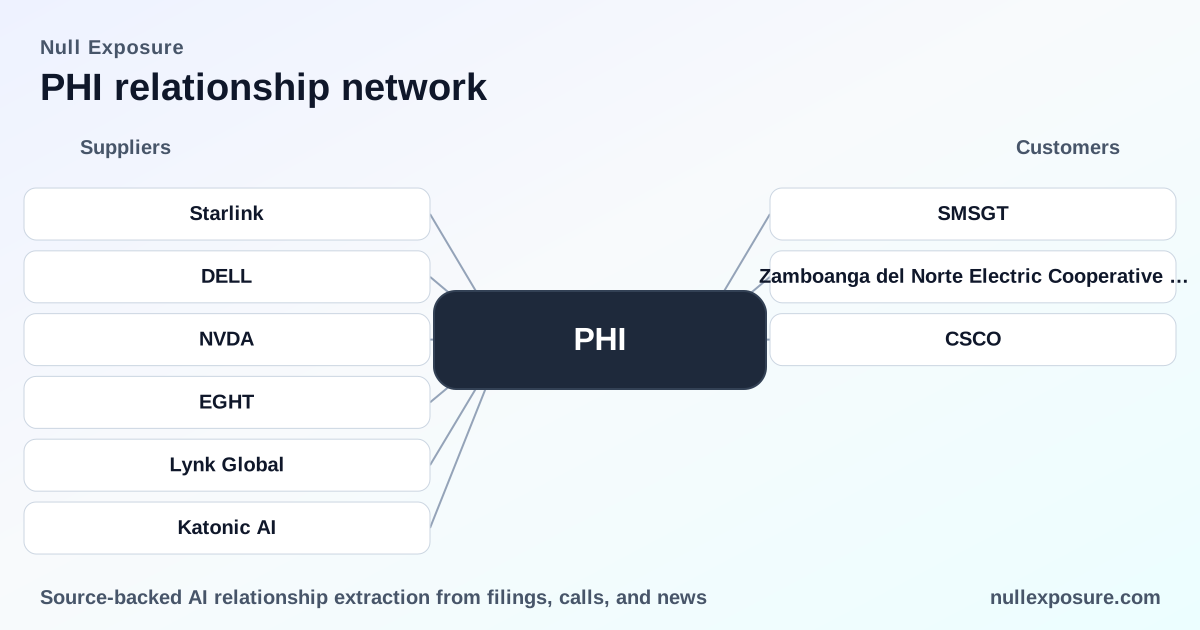
PLDT (PHI): Enterprise Relationships Signal an entrenched, diversified revenue base
PLDT Inc. operates as the Philippines’ dominant integrated telecommunications provider, monetizing through fixed and mobile voice/data services, enterprise solutions, data centers and managed services. Strong enterprise contracts, exclusive public-sector alliances, and a push into solutions for utilities, healthcare and cloud partners underpin PLDT’s recurring revenue profile and justify its above-market cash generation. For quick access to relationship analytics and ongoing monitoring, visit https://nullexposure.com/.
Why enterprise customers matter for PLDT’s valuation
PLDT’s core cash flow comes from a mix of consumer subscriptions and higher-margin enterprise services. The company’s FY metrics—Revenue TTM of PHP 218.4B, an operating margin of 31.7% and a forward P/E around 7.3—reflect the leverage that enterprise and infrastructure contracts provide to topline and margin stability. Enterprise agreements are both a revenue concentration and a moat: they deliver predictable ARPU uplift and raise switching costs through integrated managed services, data center footprints and exclusive program arrangements.
The customer roster — who PLDT is serving today
Below I summarize each customer relationship identified in recent coverage. These relationships illustrate PLDT’s reach across government, utilities, healthcare and global systems integrators.
SMS Global Technologies Inc. (SMSGT)
PLDT’s Starlink-enabled connectivity service is already deployed to commercial integrators including SMS Global Technologies Inc., supporting operations that require stable internet in remote or underserved locations. This highlights PLDT’s role as a solutions integrator that combines satellite and terrestrial connectivity for enterprise clients (backendnews.net, March 10, 2026).
Zamboanga del Norte Electric Cooperative (ZANECO)
PLDT Enterprise reinforced its partnership with ZANECO to ensure uninterrupted communications—particularly critical during emergency power shutdowns—positioning PLDT as the telecom backbone for regional utility continuity and customer service operations (Mindanao Times, March 10, 2026).
Cisco (CSCO)
PLDT and Smart are the exclusive telecommunications partner for the ITU and Cisco’s Global Digital Transformation Centers Initiative, embedding PLDT in a government-facing digital transformation stack that includes Cisco’s networking and security platforms. This exclusivity signals deep systems-integration work and co-branded public-sector deployments (backendnews.net, March 10, 2026).
Metro Pacific Hospital network
PLDT Enterprise and a partner (Apoqlar) are rolling out mixed-reality applications for hospitals and medical training institutions, starting with facilities under the Metro Pacific Hospital network—demonstrating PLDT’s expansion into clinical workflows and specialized enterprise solutions beyond basic connectivity (backendnews.net, May 3, 2026).
NTT (NTT.FRK)
PLDT entered talks to sell up to 49% of its data centre business to NTT, reflecting strategic portfolio optimization and an attempt to monetize mature infrastructure while retaining operational scale; a transaction of this nature signals data center consolidation with a global hyperscale partner (Simply Wall St reporting, May 8, 2026).
What these relationships tell investors about PLDT’s operating model
- Contracting posture: PLDT operates as an integrated provider and strategic partner—winning exclusive public-sector roles (ITU/Cisco) and bespoke enterprise integrations (utilities, hospitals). This posture yields multi-year contracts and elevated switching costs.
- Customer concentration and diversification: The customer list spans government, cooperative utilities, private healthcare networks and global systems integrators, reducing single-industry concentration risk while increasing exposure to regulated sectors that value continuity.
- Criticality: Contracts with power cooperatives and hospital networks establish PLDT as critical infrastructure; outages or degradations would have systemic impact and strengthen renewal economics for PLDT’s services.
- Maturity of offerings: PLDT’s business now encompasses legacy voice/data plus higher-value managed services, data centers and mixed-reality solutions—a shift from commodity connectivity toward bundled enterprise solutions that command higher margins and stickier revenue.
Investment implications and risk drivers
- Upside drivers: Monetization of the data center business through a partial NTT deal would crystallize value and improve capital allocation, while continued enterprise exclusivity (e.g., Cisco/ITU) supports stable, higher-margin revenue. PLDT’s dividend yield and forward P/E reflect attractive cash returns coupled with low beta.
- Risks: Dependence on public-sector and regulated customers concentrates exposure to procurement cycles and political timelines; execution risk exists for large portfolio transactions such as the NTT data center deal. Cybersecurity or network outages would have outsized reputational and contract-renewal consequences.
- Operational focus: Management execution on integrating mixed-reality, satellite-terrestrial hybrid offerings, and data center JV economics will determine incremental margin expansion.
Key considerations for models:
- Treat enterprise revenue streams as sticky and higher-margin relative to consumer services.
- Assume potential one-time proceeds or minority JV economics if a data center sale to NTT completes; model conservatively until a definitive agreement is filed.
Bottom line for investors
PLDT’s customer relationships reveal a clear strategic tilt: from access provider to integrated enterprise solutions operator. The company combines scale in the Philippines with selective global partnerships to extract higher-margin opportunities from government, utilities and healthcare. For investors focused on telecoms with durable cash flow and strategic optionality in infrastructure monetization, PLDT’s current customer ecosystem supports an income-and-growth narrative—while transaction execution (notably any NTT data center deal) is the primary catalyst for re-rating.
Explore more relationship intelligence and ongoing monitoring at https://nullexposure.com/.