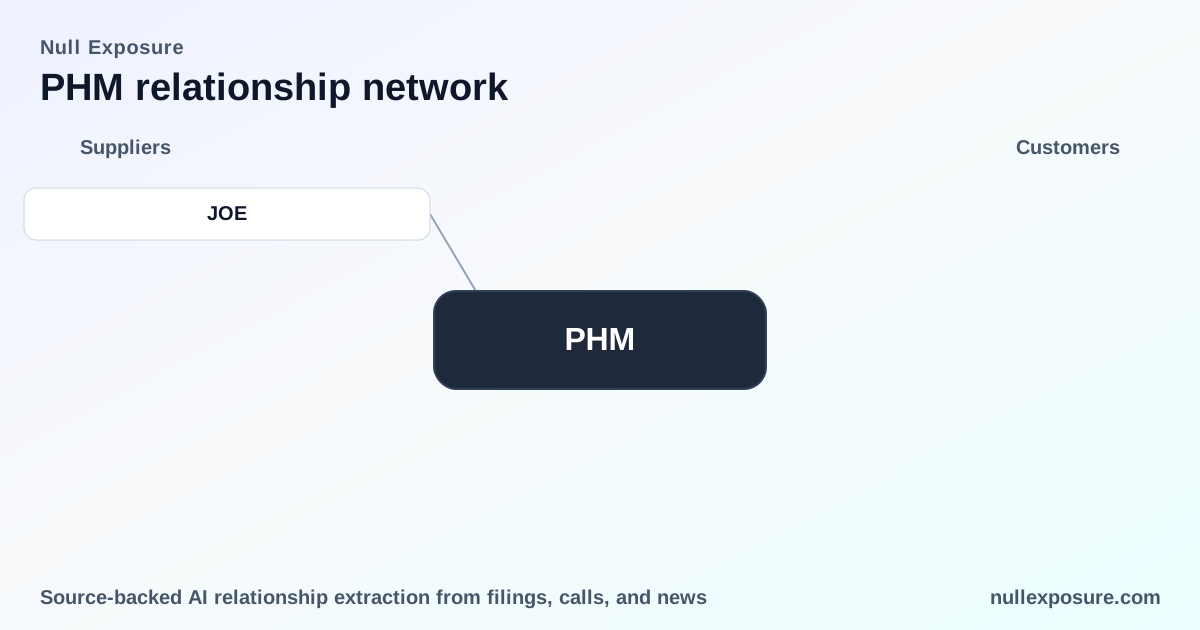
PulteGroup (PHM) — Customer relationships and operational constraints investors should track
PulteGroup builds and sells single- and multi-family homes across the U.S., monetizing primarily through home sales and complementary financial services (mortgage, title, insurance) that capture additional margin and lock buyers into the transaction. Homebuilding accounts for the vast majority of revenue, while mortgage and title services provide secondary, recurring fee streams and financing flow-through. For a concise marketplace view of customer ties and risk signals, see NullExposure. (https://nullexposure.com/)
Executive summary: why customers matter for PHM valuation
PulteGroup is vertically integrated across land acquisition, construction and mortgage intermediation, which concentrates revenue sensitivity to housing demand but also creates multiple levers for margin capture. Key investor takeaways:
- Core revenue is highly concentrated in home sales — the company reported homebuilding generated 98% of consolidated revenues in 2025, making customer demand the principal driver of cash flow.
- Customer counterparties are predominantly individual homebuyers, so credit cycles and consumer affordability directly influence throughput and cancellations.
- Short-term contracting posture for financed products and large irrevocable rate lock commitments (IRLCs) create funding and interest-rate execution risk on the mortgage side.
A visible customer relationship: Canterbury Park (CPHC)
Pulte’s only explicit customer mention in the sourced coverage relates to a residential development referenced by another company:
- Pulte was the residential developer for the final phase of row home and townhome construction at a Canterbury Park project, with completion tracked for winter in FY2025. This indicates PHM was acting as the builder/developer on a named site referenced by CPHC. A March 9, 2026 Yahoo Finance report noted this development activity. (Source: Yahoo Finance, March 9, 2026)
What this single mention demonstrates is tactical: Pulte executes localized build-to-sell programs that are reported by local stakeholders and counterparties, reinforcing the company’s role as a direct construction partner in regional master-planned sites.
Operating model constraints and what they signal for investors
The evidence gathered about PHM’s customer posture points to a consistent, company-level operating profile. These are not relationship-specific unless the excerpt explicitly names the counterparty.
- Contracting posture — short-term execution focus. Company statements indicate that loans originated through Pulte Mortgage are sold in the secondary market “generally within 30 days,” signaling a transactional, near-term funding model for mortgage origination rather than a long-term hold strategy. This reduces balance-sheet loan duration but increases reliance on capital market execution and hedging. (Company filing disclosures, FY2025–FY2026)
- Counterparty type — individual homebuyers dominate. Pulte explicitly segments customers into first-time, move-up, and active-adult buyers and provides warranties oriented to individual purchasers, confirming customer concentration in retail residential buyers rather than institutional developers. This makes PHM revenue more cyclical and consumer-credit sensitive. (Company disclosures)
- Geographic focus — U.S.-centric operations. The company’s homebuilding activity and land development are conducted primarily within the United States, concentrating geographic exposure to U.S. housing markets and regional regulatory conditions. (Company disclosures)
- Materiality — homebuilding is critical to revenues. Homebuilding generated 98% of consolidated revenues of $17.3 billion in 2025, making customer demand for housing the central revenue driver and a single point of economic concentration. (Company filing, FY2025)
- Relationship roles — both buyer and service provider. Pulte sells parcels of land outright when assets fall outside strategic plans (acting as a buyer/seller of land) and also operates Pulte Mortgage to arrange financing primarily for its homebuyers (acting as a service provider). This dual role broadens revenue sources but also ties operational performance to real-estate inventory management and mortgage execution. (Company disclosures)
- Relationship stage — active backlog and refundable deposits. The company reports signed customer contracts and deposits for orders in backlog, indicating active, contracted build-to-order pipelines that can still be subject to refunds under certain conditions — a dynamic that matters for cancellation risk and working capital. (Company disclosures)
- Business segments — core product and services. Pulte’s reporting separates core homebuilding (single-family detached and attached homes) from Financial Services (mortgage banking, title, insurance), reflecting a two-tier monetization model: large, lumpy home-sale revenue with higher gross margins and smaller, recurring financial service fees. (Company disclosures)
- Scale of commitments — meaningful short-term funding exposure. At December 31, 2025, the company reported aggregate irrevocable rate lock commitments (IRLCs) of $820.2 million, up from $469.4 million a year earlier, signaling sizeable short-term execution exposure on interest rates and hedging effectiveness. Large IRLCs mean Pulte is committing to finance many buyer purchases at current rates and must hedge or execute the sales within the short secondary-market window. (Company filing, December 31, 2025)
How these signals shape the investment case
- Revenue sensitivity: With nearly all revenue tied to homebuilding, demand cycles, mortgage affordability, and regional land markets drive valuation volatility. Investors should underwrite scenarios around sales absorption and cancellation rates.
- Execution and funding risk: The short-term sale of originated loans and large IRLC balances create two related risks: funding/market-access risk and margin compression if hedges or secondary-market execution is impaired. Hedging and mortgage flow management are operationally critical.
- Diversification and incremental margin: Pulte’s mortgage, title and insurance services provide incremental margin and buyer stickiness, smoothing some volatility but not offsetting the concentration in homebuilding revenue.
- Customer composition implies retail risk: Predominantly individual buyers mean exposure to employment, wage growth, and consumer credit conditions rather than institutional counterparty shocks.
Practical implications for operators and research teams
- Monitor weekly/monthly community sell-through rates, cancellation percentages, and IRLC roll-off to assess near-term revenue conversion.
- Track hedge effectiveness and the timing of loan sales into the secondary market; transparency on these metrics will signal risk of compressed mortgage margins or balance-sheet strain.
- Evaluate regional land inventory and the pace of lot development, since land sales and parcel dispositions are a tactical lever Pulte uses to optimize capital allocation.
Final takeaways for investors
- Pulte is a U.S.-centric homebuilder with concentrated revenue exposure to retail homebuyers and execution-sensitive mortgage operations. Customer relationships are transactional, often short-term, but the company captures additional margin through Financial Services.
- Key risk factors are housing demand cycles, mortgage market execution (IRLCs and loan sale timing), and regional land inventory management. Earnings will track home-sale volumes first and financial services second.
- For a focused view of Pulte’s customer ties and comparative signals across construction peers, explore NullExposure for structured coverage and ongoing updates: https://nullexposure.com/
Bold claims above are grounded in company disclosures and third-party reporting; investors should incorporate these relationship and constraint signals into scenario models and operational due diligence.