Phreesia’s customer footprint: what six named partners reveal about revenue quality and operational risk
Phreesia operates a healthcare-focused SaaS and payments platform, monetizing through annual subscription fees, variable payment-processing fees tied to patient payments, hardware leasing (PhreesiaPad / Arrivals kiosks), and services for life‑sciences and patient-education programs. These mixed contract economics—subscription backbone plus usage-based processing revenue—produce recurring revenue with variable upside tied to patient-volume and payment capture. For investors, the critical questions are retention among large health systems, concentration of revenue in a handful of customers, and operational exposure because Phreesia handles protected health information. For a quick look at the broader signal set, visit the NullExposure homepage: https://nullexposure.com/.
How contracts, counterparties and geography shape the business model
Phreesia’s operating model blends predictable, auto‑renewing contracts with variable transaction revenue. Company disclosures describe annual, auto‑renewing subscription agreements alongside payment processing fees recorded as variable consideration; the firm explicitly excludes long-term unsatisfied performance obligations because most contracts are short‑dated or variable. This results in a contracting posture that is subscription-centric with meaningful usage sensitivity.
Key company-level signals:
- Contracting posture: Mix of subscription (annual, auto‑renewing) and usage-based payment-processing revenue; hardware is leased and accounted for as leases. (From company filings and disclosures describing revenue mix and leases.)
- Counterparty breadth: Customers range from single‑physician practices to large multi‑specialty health systems and government/non‑profit organizations, indicating broad market coverage but also potential revenue concentration among large systems.
- Geography: Operations and revenue are overwhelmingly U.S.-centric; FY2025 notes patient visits across all 50 states and most revenue located domestically.
- Criticality and regulatory exposure: Phreesia signs Business Associate Agreements and handles PHI, creating high operational criticality and regulatory risk if systems or controls fail.
- Maturity & renewal posture: Customer contracts are active and largely auto‑renewing, supporting recurring revenue but giving large customers negotiation leverage at renewal windows.
- Materiality: Filings note historical reliance on a limited number of clients for a substantial portion of revenue—this is a concentration risk investors must monitor.
These characteristics combine to make Phreesia a recurring‑revenue software company with transactional upside and discrete operational risks tied to payment flows, hardware availability, and PHI stewardship.
Six named partners in recent reporting — direct takeaways for investors
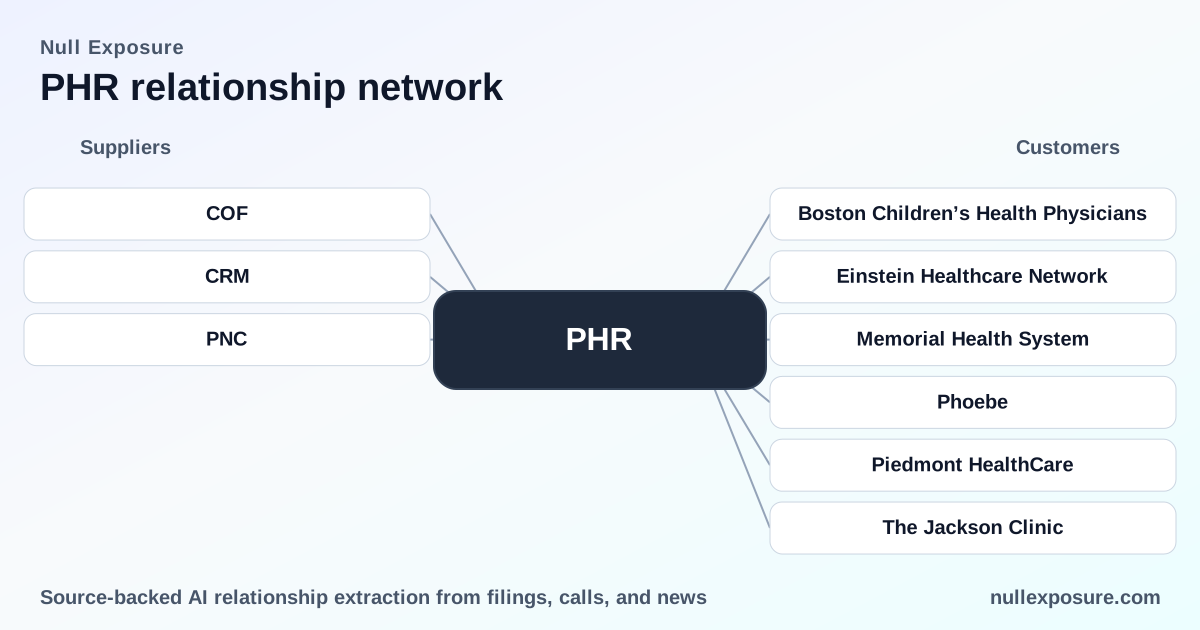
Below are the six relationships called out in recent coverage. Each entry is a concise, plain‑English mention with the reporting source.
Boston Children’s Health Physicians
Boston Children’s Health Physicians is listed among the more than 4,500 healthcare organizations that partner with Phreesia, signaling Phreesia’s penetration into pediatric specialty groups and academic system affiliates. According to StraussBorrelli reporting (Feb 11, 2026), Boston Children’s Health Physicians is included in the enumerated customer list: https://straussborrelli.com/2026/02/11/phreesia-data-breach-investigation/.
Einstein Healthcare Network
Einstein Healthcare Network is named as a Phreesia partner, reflecting relationships with regional health systems that drive both subscription and payment-processing volumes. StraussBorrelli’s February 2026 piece includes Einstein among Phreesia’s customer roster: https://straussborrelli.com/2026/02/11/phreesia-data-breach-investigation/.
Memorial Health System
Memorial Health System appears on the same customer list, indicating engagement with multi‑facility health systems that can contribute meaningful recurring and transaction revenue. The StraussBorrelli article cites Memorial Health System as one of Phreesia’s partners: https://straussborrelli.com/2026/02/11/phreesia-data-breach-investigation/.
Phoebe
Phoebe (a regional health system) is identified among Phreesia’s healthcare organizations, reinforcing the company’s reach into community and regional systems that generate steady patient volumes. This inclusion is recorded by StraussBorrelli (Feb 2026): https://straussborrelli.com/2026/02/11/phreesia-data-breach-investigation/.
Piedmont HealthCare
Piedmont HealthCare is listed as a partner, demonstrating Phreesia’s penetration into larger integrated delivery networks in key U.S. markets where payment‑processing scale and subscription uptake matter. StraussBorrelli’s investigation lists Piedmont among the customers: https://straussborrelli.com/2026/02/11/phreesia-data-breach-investigation/.
The Jackson Clinic
The Jackson Clinic is named on the customer list, typifying the single‑system or multi‑clinic practice customers that comprise much of Phreesia’s breadth across specialties. The StraussBorrelli report includes The Jackson Clinic as a Phreesia partner: https://straussborrelli.com/2026/02/11/phreesia-data-breach-investigation/.
What the roster — and corporate signals — imply for investment risk and upside
The six named partners demonstrate two simultaneous dynamics: depth in system-level customers (Piedmont, Einstein, Memorial) that can deliver scale to payment-processing revenue, and breadth across specialty and community providers (Boston Children’s affiliates, Phoebe, The Jackson Clinic) that underpin subscription revenue and churn resilience.
Investor implications:
- Upside drivers: Continued patient-volume recovery and higher on-site payment capture translate directly into variable processing fees; successful cross-sell of life‑sciences communications increases non‑subscription revenue. Phreesia’s FY2025 results (patient visits across over 4,300 clients) validate the addressable activity base.
- Risk vectors: Handling PHI with Business Associate Agreements makes Phreesia operationally critical; a data security incident creates direct revenue and reputational risk—consistent with the context of the StraussBorrelli article focused on a data‑breach investigation. Concentration of revenue among a limited number of large clients amplifies renewal and pricing risk at contract windows.
- Operational constraints: Hardware reliance for kiosks and PhreesiaPads creates supply and lease accounting considerations; reliance on third‑party manufacturers is a tangible vendor risk noted in filings.
Investor checklist — monitor these metrics and events
- Retention and net dollar retention among large health systems; watch renewal cadence and pricing concessions.
- Payment volume trends and take rates; transaction revenue is the principal source of variable upside.
- Any regulatory or breach disclosures and remediation timelines given PHI exposure.
- Customer concentration disclosures in upcoming filings and whether the company diversifies away from top account reliance.
- Hardware supply and lease utilization metrics that affect capital intensity and margins.
For a structured signal assessment, see additional research at NullExposure: https://nullexposure.com/.
Phreesia’s business model delivers recurring baseline revenue with meaningful transactional upside, but investors should price in operational risk tied to PHI handling and customer concentration. The six named customers in recent reporting are representative: they validate market penetration across large systems and community providers while underscoring the exact counterparties whose contract behavior will determine near‑term revenue volatility.