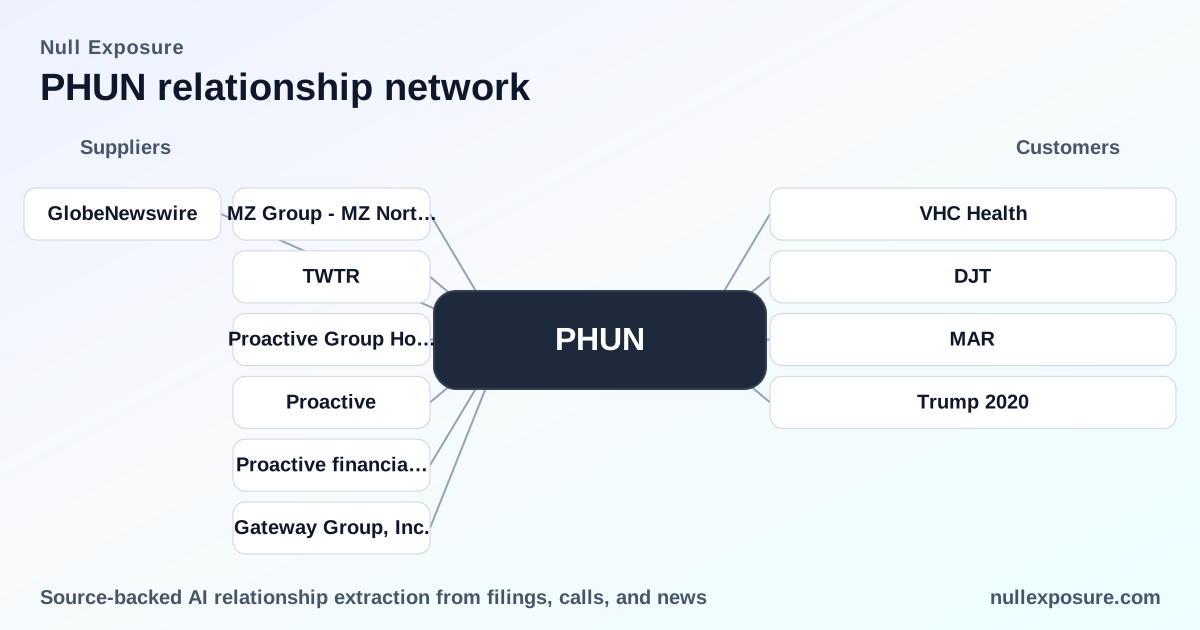
Phunware (PHUN) — Customer Relationships and Revenue Implications for Investors
Phunware operates a cloud-based mobile application platform that licenses SDKs and vertical application frameworks, sells multi-year software subscriptions, and provides development plus in-app advertising services to customers across hospitality, healthcare and political/advocacy use cases. The company monetizes through a mix of recurring software subscription revenue, professional services and advertising insertion orders, with notable customer concentration and a dual-segment business model that blends predictable recurring fees with shorter-term ad contracts. For an at-a-glance institutional view of the product-led revenue model, see Null Exposure’s portal: https://nullexposure.com/
Investment thesis in one paragraph
Phunware’s commercial profile is subscription-led but hybrid: the durable value is in multi-year software license and SDK relationships that drive recurring revenue, while advertising and one-off development work supply episodic cash inflows and higher margin variability. Revenue concentration is meaningful—three customers accounted for 34% of 2024 revenues—so client retention and a small set of marquee deployments determine near-term cash flow stability and growth optionality.
How the business contracts and where risks cluster
Phunware’s commercial contracting mixes multi-year software subscriptions and licensing with short-term advertising insertion orders governed by IAB standard terms. This structure creates a dual contracting posture: core recurring revenue with the counterparty stickiness of subscription licenses, and a volatile, shorter-duration advertising stream that is sensitive to market demand and buyer budgets. The company reports domestic revenue dominance but sells globally, giving it both concentration risk and international optionality. These are company-level signals drawn from the firm’s public disclosures and product descriptions.
- Contract types: Predominantly subscription and licensing for software and SDKs (many multi-year), with advertising governed by short-term insertion orders.
- Counterparty mix: Serves small, mid-market and large enterprise customers across verticals.
- Geography: Revenue primarily reported in the U.S. with global capability.
- Materiality and concentration: High—three customers represented 34% of net revenues in 2024.
- Segments and maturity: Two reportable segments — software subscriptions & services (more predictable) and advertising (less predictable).
For deeper client-level signals and to monitor relationship shifts, institutional subscribers can use the Null Exposure customer insights hub: https://nullexposure.com/
Customer relationships: what the public record shows
Below I list every relationship captured in the available results and summarize the commercial signal each provides for investors.
VHC Health — multi-year client in FY2026
Phunware announced that VHC Health signed a multi‑year (five-year) agreement for Phunware’s digital front door and location-based services, highlighting an enterprise health-care use of its hospitality/hospitality-adjacent products and a push into vertical solutions; this underscores the company’s ability to win multi‑year subscription deals in regulated sectors (Proactive Investors, March 2026: https://ca.proactiveinvestors.com/companies/news/1086418/phunware-unveils-new-website-and-hospitality-products-to-elevate-guest-experiences.html and https://www.proactiveinvestors.com/companies/news/1086407/phunware-sharpens-focus-on-hospitality-as-demand-from-marquee-customers-accelerates-1086407.html).
VHC Health — reiterated across multiple releases (FY2025–FY2026)
Phunware’s communications repeatedly reference VHC Health as a key client across FY2025–FY2026, with several press items stressing the five-year contract and the client’s role in the company’s hospitality/healthcare momentum (Proactive Investors releases, March–May 2026: https://www.proactiveinvestors.com/companies/news/1083603/phunware-names-elliot-han-as-new-board-chair-1083603.html and https://www.proactiveinvestors.com/companies/news/1089240/phunware-q4-revenue-jumps-as-it-leans-into-ai-hospitality-1089240.html). This repetition signals that VHC Health is a material and active customer relationship.
Marriott / MAR — enterprise hospitality deployment (FY2026)
Phunware announced the launch of its Smart Hospitality Solution across Marriott properties, indicating a commercial relationship with a major hospitality chain and validating Phunware’s product-market fit in travel and lodging (Proactive Investors, March 2026: https://ca.proactiveinvestors.com/companies/news/1086418/phunware-unveils-new-website-and-hospitality-products-to-elevate-guest-experiences.html). The releases list Marriott with ticker MAR, affirming enterprise-scale referenceability in the hospitality vertical.
Marriott (listed also as MAR) — duplicate entry confirming the same engagement
A second listing shows Marriott referenced again under the ticker MAR, reinforcing that Marriott is cited as a named enterprise customer in Phunware’s hospitality push (Proactive Investors, March 2026: https://ca.proactiveinvestors.com/companies/news/1086418/phunware-unveils-new-website-and-hospitality-products-to-elevate-guest-experiences.html). The duplication in public reports is consistent with investor-facing PR emphasizing marquee wins.
Trump Media & Technology Group (TMTG) — rumor-driven market reaction (FY2021)
A Shacknews report recalled a market rumor that Phunware would be working with TMTG on the Truth Social app, a story that triggered speculative buying in PHUN shares in 2021; the connection was rumor-based and drove short-term momentum rather than disclosed contractual evidence (Shacknews, March 2026 retrospective on the rumor: https://www.shacknews.com/article/127291/phunware-phun-stock-closes-up-471-on-trump-truth-social-network-rumor).
DJT — duplicate rumor entry (FY2021)
The dataset separately lists DJT (the same entity referenced above) in connection with the same 2021 rumor; this duplicate entry reinforces that market narrative, not confirmed contract filings, drove the 2021 price action (Shacknews, March 2026: https://www.shacknews.com/article/127291/phunware-phun-stock-closes-up-471-on-trump-truth-social-network-rumor).
Trump 2020 — historical advocacy client (FY2022 disclosure)
Phunware disclosed that its Smart Advocacy Solution powered the Trump 2020 mobile application portfolio, identifying a prior political/advocacy customer relationship and demonstrating legacy capability in high-profile campaign app work (GlobeNewswire release, July 12, 2022: https://www.globenewswire.com/news-release/2022/07/12/2478086/0/en/Phunware-Announces-Twitter-Integration-for-Smart-Advocacy-Solution.html). This is a historical reference that shows the company’s experience in campaign-grade mobile applications and integrations.
Key takeaways for investors
- Revenue mix is hybrid and concentration-sensitive. Multi-year subscriptions and SDK licensing create recurring revenue, but advertising insertion orders are short-term and increase volatility. The company explicitly reports that three customers represented 34% of 2024 revenues—an acute concentration risk for cash flow and valuation sensitivity.
- Enterprise validation exists in hospitality and healthcare. Named customers such as Marriott and VHC Health signal successful vertical penetration and referenceable enterprise deployments that support subscription upsell and cross-selling.
- Public-market sentiment can be narrative-driven. Historical rumor-driven spikes (TMTG/DJT) demonstrate how non-contractual news can move the stock; investors should distinguish confirmed contract wins (VHC, Marriott) from market rumor.
- Operating posture blends predictable and opportunistic revenue streams. That mix supports upside in renewal cycles but imposes downside risk if marquee customers churn or advertising demand contracts.
Final note
Phunware is a small-cap, high-beta technology play with a platform that combines durable subscription economics with an advertising overlay; monitor client renewals for the three largest customers, follow announced multi-year deals (e.g., VHC Health, Marriott) for revenue visibility, and discount rumor-driven sentiment when assessing fundamental valuation. For ongoing monitoring of client relationships and event-driven revenue signals, visit Null Exposure’s customer intelligence center: https://nullexposure.com/