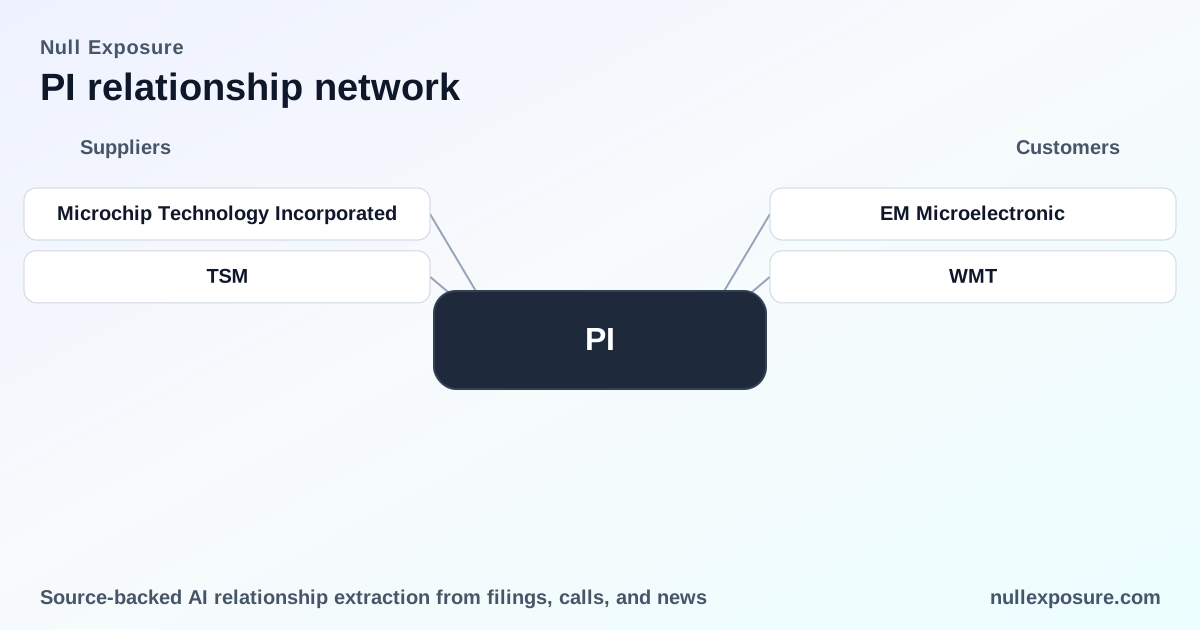
Impinj (PI): Customer relationships that drive the RFID platform thesis
Impinj builds and monetizes a hardware-led RAIN RFID platform—selling tag ICs, readers and edge devices while extracting recurring value through licensing and software services. The company’s business model combines product sales (hardware) with intellectual property licensing and growing attachment of services, selling primarily to large OEMs, solution providers and enterprise customers across retail, logistics and fresh-food supply chains. For investors, the key questions are how durable licensing and pricing power are, how concentrated revenue is by enterprise accounts and geographies, and whether partnerships or competitive IC designs shift gross margins or addressable market penetration. Learn more at https://nullexposure.com/.
What the recent headlines reveal about customer relationships
Below I cover every customer relationship named in public sources gathered in FY2026. Each listing is a plain-English summary followed by a concise source reference.
EM Microelectronic
Impinj announced a licensing agreement with EM Microelectronic to integrate Gen2X into future EM endpoint ICs—extending Impinj’s technology into third‑party tag chips and broadening addressability for dual‑frequency endpoint products. This deal was disclosed in industry press in March 2026 and positions licensing as a strategic lever. (BizWire / Iconnect007, March 10, 2026.)
Walmart (WMT)
Analysts and press noted Walmart as an adopter as Impinj expands from apparel into food and grocery, indicating accelerated enterprise deployment in large-scale retail categories. Market commentary in March 2026 highlighted Walmart as a reference customer for grocery use cases. (Finviz news summaries, March 10, 2026.)
Abercrombie & Fitch (ANF)
Management cited new program growth at Abercrombie & Fitch during the Q1 FY2026 earnings call, illustrating continued expansion into fashion apparel accounts that are core to Impinj’s retail base. (Earnings call transcript, Investing.com / InsiderMonkey, May 3, 2026.)
NXP (NXPI)
Management discussed payments received in a dispute and the possibility that NXP must sunset or redesign older ICs that previously used Impinj IP, underlining IP enforcement as a revenue and strategic consideration. The timing for NXP’s redesigns remained an open execution variable. (Earnings call transcript, Investing.com / InsiderMonkey, May 3, 2026.)
Smart Label Solutions LLC
Smart Label Solutions publicly described its SLS D‑Series dock‑door solution using Impinj R700-series readers to improve reads and event detection—showing direct product adoption among logistics solution providers. This highlights reader hardware as a practical ROI driver in shipping and warehousing. (SiliconANGLE, April 16, 2026.)
Fabletics
Fabletics was listed among a cohort of retail accounts with new program growth, reinforcing Impinj’s depth in omni‑channel apparel partners and recurring hardware deployments. (Earnings call transcript, Investing.com / InsiderMonkey, May 3, 2026.)
Old Navy
Old Navy was named by management as a source of program expansion, signaling continued penetration into large mass‑market apparel retailers where scale deployments matter for revenue concentration and unit economics. (Earnings call transcript, Investing.com, May 3, 2026.)
Aritzia (ATZ)
Aritzia appears on the account list driving “new program growth,” which supports the narrative of multiple mid‑ to large‑size apparel rollouts working in parallel rather than reliance on a single retail anchor. (Earnings call transcript, Investing.com / InsiderMonkey, May 3, 2026.)
Athleta
Athleta was also mentioned among retailers showing program expansion, further validating Impinj’s role across brand portfolios managed by larger retail groups. (Earnings call transcript, Investing.com, May 3, 2026.)
Avery Dennison (AVY)
Avery Dennison’s AD IdentiFresh Co series leverages Impinj technology to advance readability and speed in fresh‑food RFID labels, pointing to momentum in perishables where traceability and speed create new hardware and tag demand. (MassMarketRetailers report, March 9, 2026.)
How these relationships inform the operating model and business risks
Impinj’s customer mix and public disclosures reveal a hybrid operating posture: hardware-first sales with an increasingly strategic licensing layer.
- Contracting posture — licensing plus point sales. Management language and filings indicate licensing is an explicit, recognizable revenue stream that is recognized at delivery or as usage occurs; settlements and annual license fee recognition are part of reported operations. This is a company‑level signal, not tied to any single counterparty.
- Concentration and counterparty type. Impinj sells largely to large enterprise OEMs, OEM/ODMs, solution providers and distributors, and the company itself acknowledges reliance on a small number of customers for a large share of revenue—meaning customer concentration is a material business risk.
- Geographic breadth and revenue mix. In 2025 Impinj reported 79% of revenue outside the U.S., with heavy Asia Pacific exposure alongside meaningful Americas and EMEA revenue—this is a global revenue profile that amplifies supply‑chain and regional demand cycles.
- Criticality and maturity. Relationships range from lighthouse enterprise pilots (retail rollouts like Walmart and apparel brands) to embedded partnerships with tag‑IC manufacturers (EM Microelectronic, NXP) that signal longer‑term product embedding and IP monetization. Hardware remains the largest revenue driver while software and services are growing but currently non‑material line items.
- Segment mix. The company generates primary revenue from hardware, with smaller contributions from software, extended warranties and services, consistent with a product‑led IoT vendor transitioning toward higher recurring value.
Investment implications: what matters to valuation and downside
- Licensing unlocks scale but increases dependency on third‑party IC roadmaps. The EM Microelectronic deal expands market access but requires careful modeling of license cadence and margin impact. (March 2026 press coverage.)
- Customer concentration is a live risk. Large retail and OEM accounts deliver scale but also create revenue volatility if a major program slows; management’s public admissions of concentration make this a primary downside scenario.
- Geographic exposure requires macro sensitivity. With the majority of sales outside the U.S., APAC demand cycles and supply constraints materially affect top‑line outcomes.
- IP enforcement and competitor IC plans can swing near‑term cash flow. The NXP discussion shows that settlements and redesigns generate one‑time payments and create timing uncertainty around recurring device revenue. (Q1 FY2026 earnings call, May 2026.)
If you want an investor‑grade summary mapping these customer relationships to revenue scenarios and downside stress cases, visit https://nullexposure.com/ for modelable insight.
Bottom line: what investors should track next
- Monitor announced licensing rollouts and the cadence of license fee recognition.
- Watch large retail pilots (Walmart, major apparel rollouts) for conversion to scale deployments.
- Track IC partner product roadmaps (EM Microelectronic, NXP, Avery Dennison) for signs of broader adoption or competitive redesigns.
- Evaluate quarterly disclosures for shifts in customer concentration and geographic revenue mix.
Impinj’s balance of hardware scale and licensing leverage creates asymmetric upside if enterprise rollouts convert and third‑party IC partners accelerate adoption—but it also concentrates risk around a few large accounts and regional demand cycles. The next two quarters of customer‑level disclosures and licensing receipts will decide whether the company sustains its recent re‑rating or faces renewed skepticism.