Picpay (PICS) — Marketplace Partnerships Signal Distribution, Not Dependence
Picpay operates as a Brazilian digital payments and consumer-finance platform that monetizes through transaction fees, merchant services, interest and fee revenue from embedded financial products, and partner-driven customer acquisition via marketplace integrations. Picpay’s commercial model leverages wallet engagement and third-party marketplaces to scale payment volume and reduce customer acquisition costs, creating a two-sided revenue engine anchored in merchant acceptance and platform-financial services cross-sell. Learn more about our coverage at https://nullexposure.com/.
Why marketplace and travel partnerships matter for investors
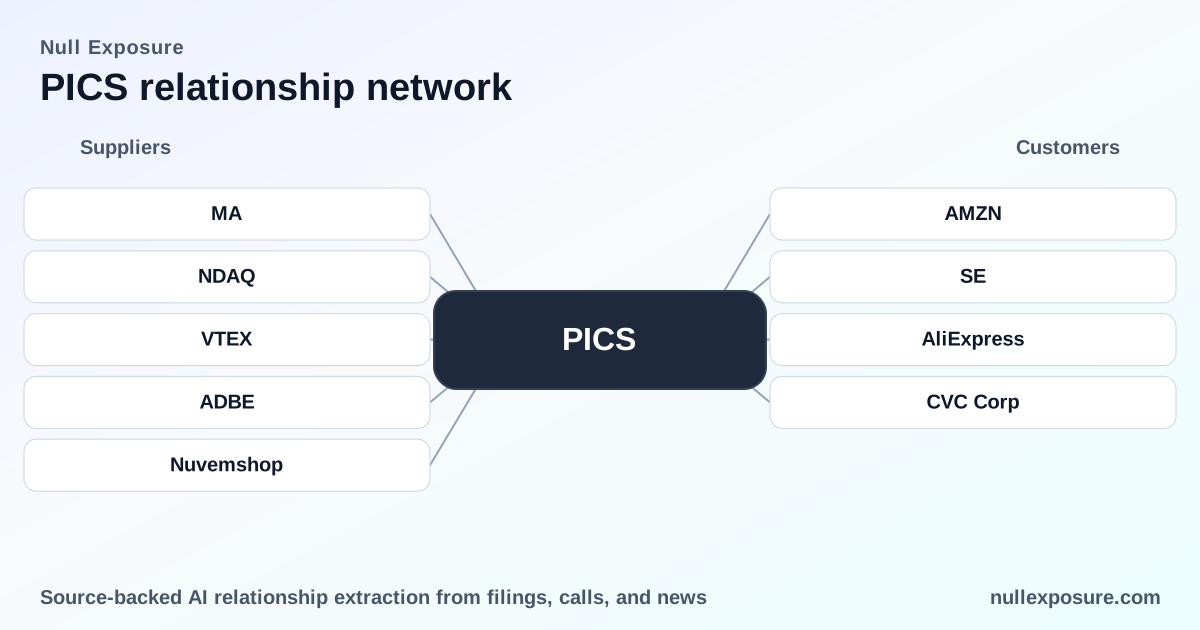
Picpay’s cited relationships with global marketplaces and a major travel seller are distribution multipliers rather than raw credit providers. Integrations with channels like Amazon, AliExpress and Shopee accelerate payment flow through Picpay wallets and merchant rails, while travel partnerships extend use cases for higher-ticket transactions. From an investor perspective, these relationships imply a commercial posture that prioritizes: volume scale via partner channels, fee capture on transaction rails, and monetization through embedded finance.
- Contracting posture: Picpay’s partnerships suggest standard commercial integrations and referral or acceptance agreements with marketplaces rather than exclusive, long-term vendor lock-ins—favoring flexibility in go-to-market execution.
- Concentration: the presence of multiple large marketplace partners signals diversified distribution, but marketplaces themselves are high-impact partners—loss of any major channel would be meaningful.
- Criticality: marketplace relationships are highly material to payment volume and customer acquisition economics, so operational stability and settlement reliability are strategic priorities.
- Maturity: partnerships with established platforms and travel brands indicate commercial traction beyond early-stage pilots and a move into scale economics.
For investors wanting a concise commercial read, these relationships are growth accelerants with moderate partner concentration risk. Additional detail and context are available at https://nullexposure.com/.
Relationship roll call — what the evidence shows
Below are each of the customer relationships picked up in public reporting; each entry is summarized in plain language with the original reporting cited.
Amazon (entry 1)
Picpay is listed among marketplace partners alongside Amazon, indicating integration for payments or acceptance on the global e‑commerce giant’s platform in Brazil; this supports customer acquisition and transaction volume growth through a major ecommerce channel. Source: TradingView coverage of Picpay’s Nasdaq filing (March 10, 2026): https://www.tradingview.com/news/tradingview:f760856e55fdc:0-picpay-brazilian-digital-wallet-and-banking-platform-files-for-nasdaq-global-select-market-ipo/.
AMZN (entry 2)
A duplicate mention of Amazon (labeled AMZN) reinforces the same marketplace partnership signal captured in Picpay’s IPO filing commentary and third‑party reporting, confirming Amazon’s inclusion among Picpay’s partner ecosystem. Source: TradingView (March 10, 2026): https://www.tradingview.com/news/tradingview:f760856e55fdc:0-picpay-brazilian-digital-wallet-and-banking-platform-files-for-nasdaq-global-select-market-ipo/.
Shopee
Shopee is named as a marketplace partner for Picpay, representing another large e‑commerce channel that can drive mobile-first payment volume in Latin America and complement Picpay’s wallet-led distribution. Source: TradingView (March 10, 2026): https://www.tradingview.com/news/tradingview:f760856e55fdc:0-picpay-brazilian-digital-wallet-and-banking-platform-files-for-nasdaq-global-select-market-ipo/.
AliExpress
AliExpress appears with Picpay as a marketplace integration, indicating Picpay’s alignment with cross-border and domestic e‑commerce flows that can expand merchant acceptance and consumer payment choices. Source: TradingView (March 10, 2026): https://www.tradingview.com/news/tradingview:f760856e55fdc:0-picpay-brazilian-digital-wallet-and-banking-platform-files-for-nasdaq-global-select-market-ipo/.
CVC Corp
Picpay’s reported partnership with CVC Corp (a leading Brazilian travel company) positions the platform to capture travel-related payment volume and potentially higher average transaction values through travel bookings. This broadens Picpay’s payment use cases beyond retail and into services. Source: TradingView (March 10, 2026): https://www.tradingview.com/news/tradingview:f760856e55fdc:0-picpay-brazilian-digital-wallet-and-banking-platform-files-for-nasdaq-global-select-market-ipo/.
Constraints and company-level signals
The public relationships dataset returned no explicit contractual constraints, term limitations, or exclusivity clauses disclosed in the cited reporting. That absence is itself a signal: no partner-level restriction was reported in the March 2026 filing coverage, which aligns with a commercial model built on broad marketplace integrations rather than exclusive tie-ups. Investors should treat this as a company-level attribute indicating flexible partnering and go-to-market openness, not a guarantee of zero counterparty risk.
Investment implications — upside and risks for PICS
- Upside: Large marketplace integrations accelerate volume and customer acquisition at low incremental cost, enabling Picpay to scale payment fees and cross-sell financial products while leveraging existing merchant reach.
- Revenue mix: expect transactional fees and merchant‑service revenue to remain the cornerstone of top-line growth, supplemented by finance product yields as wallet balances and credit products scale.
- Risk: partner concentration with a handful of high-traffic marketplaces creates a binary exposure—loss or contract re-pricing with any major partner would pressure volume and economics. Operational resilience in settlements and fraud controls is critical given increased exposure to external transaction flows.
- Competitive dynamics: global marketplaces run alternative payment options; Picpay must preserve preferential positioning through user experience, pricing, and localized services to maintain share.
What investors should monitor next
- Disclosure trends in subsequent filings or press releases for formal commercial terms with marketplaces (revenue share, exclusivity, or co-marketing commitments).
- Volume and take-rate trends tied to partner channels in quarterly reporting to assess realized monetization from these relationships.
- Any operational incidents or settlement disputes that could signal elevated counterparty or operational risk.
Conclusion
Picpay’s relationship map in public reporting is dominated by marketplace and travel partnerships that function as distribution levers. These partnerships materially support Picpay’s payment-volume growth strategy and embedded finance ambitions while introducing measurable partner concentration risk. For investors, the critical questions are how deeply integrated Picpay is into each partner’s checkout flow, the economics of those integrations, and whether Picpay can convert partner-driven acquisition into durable finance revenue.
For a concise, investor-focused briefing on partner exposure and commercial strategy, visit https://nullexposure.com/.