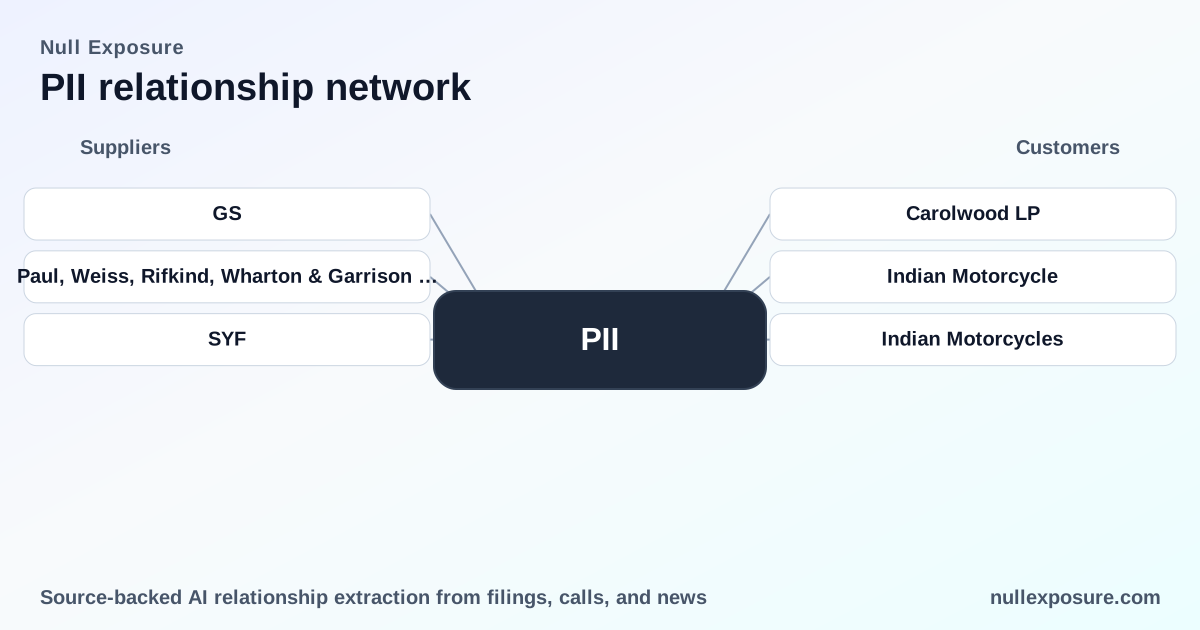
Polaris (PII) — customer relationships that reshape revenue and manufacturing
Polaris Industries designs, manufactures and distributes motorized recreational vehicles and aftermarket service contracts, monetizing through vehicle sales, separately‑priced extended service contracts (ESCs) and a global dealer/distributor network. Recent corporate actions — notably the separation and majority sale of the Indian Motorcycle brand — materially change Polaris’ customer mix and manufacturing footprint while leaving its dealer and ESC economics intact. For investors and operators, the operating model now centers on capital-light brand monetization, retained dealer channels, and long‑term service contract revenue recognition. Learn more at https://nullexposure.com/.
How Polaris actually makes money and runs the go‑to‑market
Polaris sells products through a large network of independent dealers and international distributors and recognized ESC revenue over contract terms. The company collects payment for many ESCs at inception and recognizes that revenue over periods ranging from 12 to 84 months, creating predictable deferred revenue streams that support aftermarket margins. Polaris distributes through approximately 2,500 independent dealers in North America, over 1,500 international dealers and roughly 70 independent distributors serving 90+ countries, producing a balance of scale and channel complexity that is strategically important for cash flow and inventory management.
- Contracting posture: Polaris operates with a material long‑term service contract footprint (12–84 months), and prepaid maintenance agreements that produce multi‑period revenue recognition.
- Geographic diversification: Primary markets are North America alongside Western Europe, Australia and Mexico; company filings also support presence across APAC, EMEA and LATAM corridors through subsidiaries and distribution partners.
- Channel concentration and criticality: Heavy reliance on an independent dealer network creates distribution concentration risk in North America but preserves gross margin capture through ESCs and aftermarket services.
- Maturity and role: The company’s relationships are largely traditional OEM→dealer/distributor arrangements (distributor and reseller roles), and relationships identified in the record are categorized as active.
What the market moves mean for customers and manufacturing
Polaris executed a strategic separation of Indian Motorcycle that changes who sits at the other end of certain manufacturing and brand agreements while Polaris retains significant channel and servicing obligations. The company also consolidated engine production plans that shift manufacturing capacity and workforce allocations.
Carolwood LP — the new majority owner of Indian Motorcycle
Polaris completed the separation and sold a majority stake in Indian Motorcycle to Carolwood LP, a California (Los Angeles) private equity and real estate investor. Multiple news outlets reported the transaction in October 2025 and subsequent confirmations in early 2026, positioning Carolwood as the controlling financial buyer. According to KTIV reporting on October 14, 2025, Polaris sold Indian Motorcycle to Carolwood LP; Finviz and SimplyWall.st later reported the completed separation and majority stake sale in early 2026. (Sources: KTIV, Oct 14, 2025; Finviz coverage of Polaris’ Q4 disclosures and SimplyWall.st, May 2026.)
Indian Motorcycle — separated brand with manufacturing realignment
Indian Motorcycle will operate as a standalone business following the sale and Polaris announced consolidation of engine production, moving powertrain manufacturing from Osceola, Wisconsin, to Spirit Lake, Iowa, and planning a plant closure in 2026. PowersportsBusiness reported the engine-production consolidation on January 27, 2026, and local coverage in late January 2026 documented the Osceola plant closure and related layoffs. (Sources: PowersportsBusiness, Jan 27, 2026; Wausau Pilot & Review, Jan 28, 2026.)
RDNW (RumbleOn / dealer channel exposure) — sizeable OEM exposure in retail sales
Public SEC filings from RumbleOn show Polaris accounted for a large share of new powersports vehicle revenue for the dealer/retail channel — Polaris represented roughly 28% of RumbleOn’s new vehicle revenue in 2024 — underscoring Polaris’ importance to multi‑channel retailers. That concentration demonstrates channel-level exposure and the economic linkage between Polaris’ OEM shipments and independent retail reseller economics. (Source: RDNW 10‑K for year ended Dec 31, 2024.)
ENVX — third‑party validation and technology testing
Third‑party commentary referencing Polaris’ verification of an ENOVIX battery metric was published in March 2026; the Polaris‑verified 935 Wh/L figure strengthened a technology narrative while not eliminating execution or qualification risk in high‑volume consumer manufacturing. This signals that Polaris’s engineering verification is used by partners as a credibility lever in advanced component testing. (Source: SimplyWall.st coverage referencing ENOVIX, Mar 2026.)
Constraints and what they tell investors about Polaris’ business model
The company disclosures and the relationships above establish a clear operating profile for Polaris as a mid‑cycle OEM with durable aftermarket tails and meaningful channel dependence.
- Long‑term contracting posture: Polaris sells ESCs and prepaid maintenance agreements with durations up to 84 months and recognizes revenue over those terms; payment at contract inception creates predictable, multi‑year deferred revenue that supports aftermarket margins and cash flow.
- Global footprint but North America‑centric: Primary markets list the United States, Canada, Western Europe, Australia and Mexico; the company also reports activity across APAC, EMEA and LATAM. This geographic mix reduces single‑market risk while concentrating core volume in North America.
- Channel role and concentration: Polaris distributes through independent dealers and distributors (distributor role confidence high), producing channel concentration risks in North America but preserving dealer economics that drive replacement parts and ESC penetration.
- Relationship maturity: Dealer and distributor relationships are active and longstanding, with an established network of thousands of independent partners.
These constraints are company‑level signals drawn from Polaris’ filings and public commentary; they are not attributed to any single third‑party relationship unless the underlying excerpt explicitly names that third party.
Investment implications — what operators and investors should watch
- Balance sheet and cash flow: ESCs create deferred revenue that stabilizes aftermarket cash flow; investors should track deferred‑revenue roll‑forward and ESC penetration as a margin stabilizer.
- Brand monetization tradeoffs: The Indian Motorcycle sale to Carolwood realizes value and reduces Polaris’ direct brand exposure, but Polaris retains exposure through dealer aftermarket and component supply; investors should watch separation economics and any ongoing supply or licensing arrangements announced in filings.
- Manufacturing concentration risk: Consolidating powertrain production into Spirit Lake centralizes technical capability and cost, but creates single‑site operational risk and local labor exposure; monitor production ramp metrics and workforce disclosures.
- Channel concentration: Dependence on large dealer partners — illustrated by RumbleOn’s Polaris share — creates demand risk if dealer inventories or unit demand shift.
Key takeaway: Polaris transitions from a vertically integrated owner of brands to a leaner OEM and service‑contract engine, with long‑term ESC revenue and a deep dealer network as core stabilizers and the Indian Motorcycle sale materially altering brand and manufacturing dynamics.
For a deeper read on how these customer relationships influence Polaris’ investment profile and operational risks, visit https://nullexposure.com/.