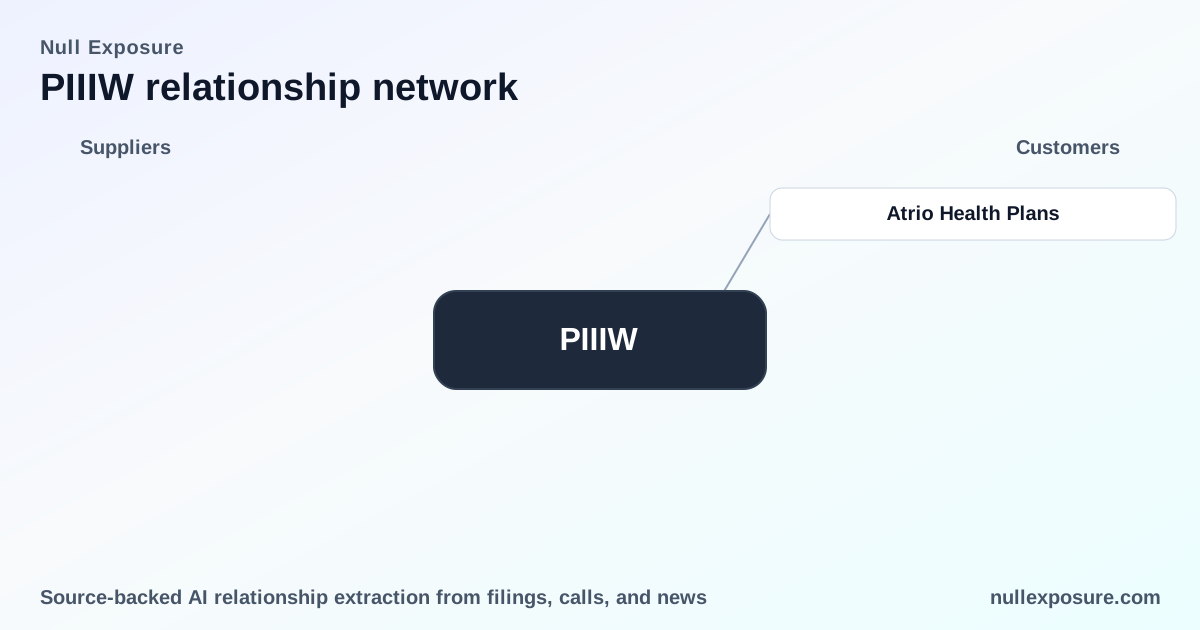
P3 Health Partners (PIIIW) — Customer Relationships That Drive a Capitated Business
P3 Health Partners operates as a physician-led population health manager that contracts with Medicare Advantage payors on a capitated, per-member-per-month (PMPM) basis, taking clinical and financial risk to deliver care to assigned members. The company monetizes by collecting recurring PMPM fees from large health plans and retaining the spread between capitation payments and the cost of delivered care while pursuing quality incentives. For investors, the core thesis is simple: predictable, subscription-like revenue under long-term capitated arrangements creates durability, but revenue concentration across a small number of large plans and negative operating margins create near-term execution risk.
For an institutional view of P3’s commercial footprint visit https://nullexposure.com/.
How P3 gets paid and what that implies for cash flow
P3’s commercial model is built on capitated contracts with Medicare Advantage plans in which the company is paid PMPM fees to provide a defined set of services to covered beneficiaries. According to the company’s FY2024 10‑K, P3 “predominantly enter[s] into capitated contracts with the nation’s largest health plans” and describes its revenue as recurring and subscription-like. This operating posture produces predictable top-line streams but also concentrates operational and actuarial risk: if cost trends or utilization deviate from assumptions, P3 directly absorbs the financial impact.
- The company reported approximately 123,800 at‑risk members and a PCP network of about 3,100 physicians across five states as of December 31, 2024, reflecting a scaled clinical footprint capable of delivering delegated care at volume (FY2024 10‑K).
- P3 discloses that four health-plan customers collectively comprised approximately 59% of its capitated revenue for the year ended December 31, 2024, highlighting customer concentration that investors must factor into revenue durability analysis (FY2024 10‑K).
- All revenue is earned in the United States, anchoring the company’s geographic exposure to North America and U.S. Medicare policy (FY2024 10‑K).
The single reported customer relationship: what investors should record
Atrio Health Plans
P3 has a full‑risk capitation agreement with Atrio Health Plans under which P3 is delegated to perform services for Atrio’s assigned members, meaning P3 assumes responsibility for care delivery and associated financial performance for those members. This is explicitly disclosed in P3’s FY2024 10‑K. (FY2024 10‑K, “full‑risk capitation agreement with Atrio”)
This relationship fits the company’s broader commercial pattern: large payor counterparty, at‑risk delegation, and PMPM revenue flows. The FY2024 10‑K identifies Atrio as one of the counterparty contracts where P3 is acting as the principal in capitation arrangements.
Additional relationship signals that shape operational risk
Beyond the named contracts, the company-level disclosures provide important constraints and signals that affect every customer relationship:
- Long-term, subscription-like contracting posture. P3 states it predominantly enters into long-term capitated contracts and is “entitled to PMPM fees” for delivering a defined set of services, signaling contractual stability and revenue predictability (FY2024 10‑K).
- Very large enterprise counterparties. The company targets “the nation’s largest health plans,” indicating counterparties with strong negotiating leverage and operational sophistication (FY2024 10‑K).
- Geographic concentration in the U.S. All revenue is generated in the United States, with scaled operations in five states across 27 counties as of year-end 2024 (FY2024 10‑K).
- Material revenue concentration. Four customers accounted for about 59%–60% of total revenue in 2023–2024, a clear signal that the loss or adverse repricing of a major plan would be highly material to top-line and margin performance (FY2024 10‑K).
- Active, at‑risk relationships. The firm had at‑risk contracts in effect with 23 health plans across five states as of December 31, 2024, confirming that P3’s risk-bearing model is operational and ongoing (FY2024 10‑K).
- Services-led segment with high clinical control. P3 functions as a provider/service organization that controls and provides medical care to assigned members, acting as the principal in capitation arrangements (FY2024 10‑K).
- Scale of spend signal. Revenue magnitude and concentration create an inferred spend band consistent with large customer accounts; the company reported roughly $1.46 billion of revenue TTM in public filings, underlining the material economics at play (Company financials through 2025‑12‑31).
For deeper detail on the company’s commercial profile and customer exposures, see https://nullexposure.com/.
Investment implications: upside drivers and asymmetric risks
P3’s model offers highly predictable recurring revenue and a route to improved margins through clinical optimization and scale. The upside is realized if P3 reduces per‑member costs through better care coordination and secures favorable renewals with major plans.
Key risks that investors must weigh:
- Concentration risk: Four payors account for the majority of revenue; contract renewal or adverse repricing with any of those plans is materially consequential (FY2024 10‑K).
- At‑risk economics: Capitation transfers clinical downside to P3; negative operating performance is reflected in reported losses — EBITDA and EPS are negative on the latest filings — which increases the importance of actuarial accuracy and utilization management (company financials).
- Operational scale required: Delivering capitated care across thousands of physicians and more than 100,000 members demands mature clinical infrastructure and execution discipline; lapses translate directly into margin erosion.
Bottom line for investors and operators
P3 Health Partners runs a capital-light, recurring-revenue healthcare services model anchored on long-term capitated contracts with large Medicare Advantage plans. The commercial model is durable but concentrated — a single lost or re-priced large customer would materially alter revenue and margin profiles. Investors should track contract renewals, enrollment trends with the top four payors, and margin improvement from care management programs as the decisive indicators of value creation. Operational diligence on clinical outcomes and utilization metrics will determine whether the company converts predictable top-line streams into sustainable profitability.
For institutional clients evaluating P3’s customer exposures and contract mechanics, our research platform maintains a consolidated view of filings and relationship disclosures at https://nullexposure.com/.