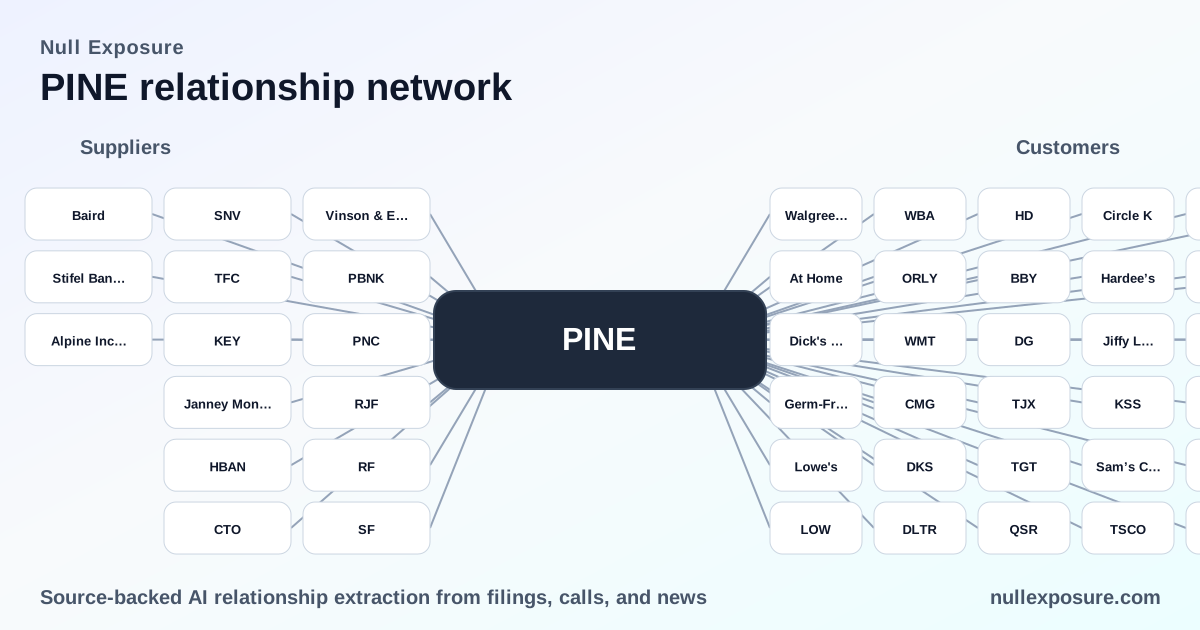
Alpine Income Property Trust (PINE): Tenant Map and Commercial Risk Profile
Alpine Income Property Trust (NYSE: PINE) operates as a focused net-lease REIT that acquires, owns and manages freestanding retail and commercial properties leased under long-term, triple-net arrangements to national and regional tenants. The company monetizes through stable rental cash flows, selective accretive acquisitions, and complementary commercial loan originations, with a portfolio skewed toward investment-grade retail names that drive portfolio yield and underwriting resilience.
For a concise institutional briefing and tenant-level sourcing, visit https://nullexposure.com/.
Why the tenant roster matters to investors
Alpine’s model is straightforward: buy long-term net-leased real estate to investment-grade and resilient retail operators, collect contractual cash flow, and grow ABR via disciplined acquisitions and short-duration commercial lending. That strategy produces high lease predictability but also concentrates counterparty risk: management reports that investment‑grade tenants generate roughly 50% of ABR, while a handful of tenants account for double‑digit percentages of lease income—an outcome that drives both yield stability and concentration exposure. (See Alpine’s FY2025 10‑K and subsequent press releases and earnings calls for ABR breakouts.)
Business model constraints and operational signals investors should note
- Contracting posture — long-term leases: Alpine’s properties are primarily subject to long-term triple-net leases (examples include 30‑year sale‑leaseback arrangements with contractual escalations). This produces durable cash flow and low turnover, but also ties capital to existing leases. (Alpine FY2025 10‑K.)
- Geographic concentration — United States only: The company’s portfolio is entirely U.S.-based, so macro and retail trends in the U.S. drive asset performance. (Alpine FY2025 10‑K.)
- Materiality / concentration — meaningful single‑tenant exposure: Alpine discloses that certain tenants individually accounted for more than 10% of lease income across recent reporting years; top tenants (Lowe’s, Dick’s Sporting Goods, Walmart) collectively represent a large share of ABR. That concentration is a deliberate underwriting tradeoff—higher credit quality for concentrated exposure. (Alpine FY2025 10‑K; Q1 2026 releases.)
- Relationship role — owner/seller of leased real estate: Alpine acquires properties leased to third‑party tenants and operates as landlord; this seller/owner posture underpins its revenue model. (Alpine FY2025 10‑K.)
- Relationship stage — active and highly occupied: The portfolio is 99.5% occupied with a weighted average lease term of 8.4 years (by ABR), signaling a mature, cash‑generative operating base. (Alpine FY2025 10‑K.)
If you want a stratified view of tenant risk and sourcing for modeling, check the institutional brief at https://nullexposure.com/.
Tenant-by-tenant rundown (one- to two-sentence takeaways with sources)
Below are the relationships referenced across Alpine’s filings, earnings calls and press releases. Each entry is a plain‑English fact with the source called out.
-
Lowe’s (LOW) — Lowe’s is a core investment‑grade anchor for Alpine and represented roughly 12% of ABR in early‑2026 disclosures; the company also acquired ground‑leased Lowe’s properties in 2026 transactions. (Alpine Q1‑2026 operating results; GlobeNewswire & Finviz coverage, FY2026 / FY2025 reporting.)
-
Dick’s Sporting Goods (DKS) — Dick’s is another top tenant, accounting for around 10–11% of lease income in FY2025–FY2026 and consistently cited among the largest contributors to ABR. (Alpine FY2025 10‑K; Q4/FY2025 and Q1/FY2026 commentary.)
-
Walmart / Sam’s Club (WMT) — Walmart moved into Alpine’s top tenant ranks after acquisitions, representing about 7% of ABR by March 2026 and anchoring recent retail acquisitions. Several press releases and earnings call transcripts cite Walmart as a top‑four tenant. (GlobeNewswire transaction releases; Q4 2025 earnings call; Q1 2026 reporting.)
-
Best Buy (BBY) — Best Buy is listed among the company’s investment‑grade tenants and cited as one of the top five contributors to ABR (investment‑grade bucket). (Q1 2026 earnings call transcript, InsiderMonkey coverage; Q1 2026 operating results.)
-
Walgreens (WBA) — Walgreens historically contributed material lease income (11% in earlier periods) but has been reduced in relative importance; Alpine’s FY2025 accounting shows Walgreens represented about 4% of ABR with five properties remaining in the portfolio by early 2026. (FY2025 10‑K; Q4 2025 and Q1 2026 earnings call summaries; GlobeNewswire releases.)
-
At Home (HOME) — At Home is a non‑rated tenant occupying a small but noted share of ABR (~3% disclosed as of Q1 2026), with management commenting on the high performance of At Home locations. (Q1 2026 operating results; SahmCapital and InsiderMonkey coverage.)
-
GermFree Laboratories / Germ‑Free Labs — Alpine owns higher‑yielding assets leased to GermFree Laboratories (headquarters and manufacturing), cited in earnings call remarks as an example of non‑investment‑grade, higher‑yielding property investments. (Q4 2025 earnings call transcript; GlobeNewswire reporting.)
-
Family Dollar / Dollar Tree / Dollar General (DLTR, DLTR, DG) — Dollar store tenants appear across the portfolio; Family Dollar and Dollar Tree are cited as contributors (~2–4% ABR each) while Dollar General is disclosed at roughly 5% of ABR, reflecting Alpine’s exposure to value‑retail formats. (GlobeNewswire FY2026 releases; Q1 2026 results.)
-
O’Reilly Auto Parts (ORLY) — O’Reilly appears as a leased tenant in transaction summaries (included in multi‑tenant acquisitions), cited in GlobeNewswire deal releases. (GlobeNewswire transaction notices, FY2025–FY2026.)
-
Chipotle (CMG) — Chipotle is mentioned as a leased tenant in certain transaction summaries, included among retailer tenants in press releases. (GlobeNewswire transaction activity, FY2025.)
-
TJ Maxx / TJX Companies (TJX / TJ Maxx) — TJ Maxx is an anchored tenant in a multi‑tenant, triple‑net acquisition; TJX Companies is disclosed among top tenants (about 2% ABR). (GlobeNewswire acquisition release, FY2025; Q1 2026 operating results.)
-
Home Depot (HD) — Home Depot is listed among tenants representing ~2% of ABR in Alpine’s Q1 2026 tenant schedule. (Q1 2026 operating results, GlobeNewswire.)
-
BJ’s Wholesale Club (BJ) — BJ’s appears in top‑tenant listings at roughly 3% of ABR in Q1 2026 disclosures. (Q1 2026 release, GlobeNewswire / SahmCapital.)
-
Burlington (BURL) — Burlington is listed at roughly 2% of ABR among the Company’s top tenants as of March 31, 2026. (Q1 2026 operating results, GlobeNewswire.)
-
Beachside Hospitality Group — Identified as a non‑rated tenant representing ~8% of ABR, Beachside Hospitality Group is one of the larger single non‑investment‑grade exposures disclosed by Alpine. (Q1 2026 operating results, GlobeNewswire / press commentary.)
-
Target (TGT) — Target is referenced as part of collateral for a first‑mortgage loan investment and a retail center development that Alpine financed through loan activity. (GlobeNewswire loan announcement; Bitget and ManilaTimes coverage, FY2026.)
-
Publix — Publix is mentioned as an adjacent, complementary tenant to a Target‑anchored development financed via Alpine’s loan—part of the commercial loan collateral set. (GlobeNewswire loan release; Bitget coverage.)
-
Kohl’s (KSS) — Kohl’s is included in multi‑tenant portfolios acquired or announced by Alpine in year‑to‑date transaction summaries. (GlobeNewswire transaction activity, FY2025–FY2026.)
-
Tractor Supply Company (TSCO) — Identified among tenants in transaction announcements, included in multi‑tenant acquisitions. (GlobeNewswire transaction releases, FY2025.)
-
Burger King / Hardee’s / Jiffy Lube / QSR — These quick‑service and automotive service tenants are present in small property portfolios detailed in transaction releases (four‑property portfolio examples). (GlobeNewswire transaction notice, FY2025.)
-
Sam’s Club — A large Sam’s Club property (131,039 sq ft) is noted among acquisitions, referencing Walmart’s subsidiary credit profile (AA). (GlobeNewswire transaction activity, FY2025.)
-
CTO Realty Growth (CTO) — CTO is disclosed as the external manager and a meaningful owner/manager interest holder related to Alpine, signalling an external management/affiliate relationship. (CTO press release referencing management/ownership ties, FY2025.)
-
Academy Sports (ASO) — Academy Sports is listed with credit rating indication and a small ABR percentage (~3%) in Q1 2026 tenant schedules. (Q1 2026 operating results, SahmCapital / GlobeNewswire.)
-
Alamo Drafthouse — Alamo Drafthouse is shown as a top tenant at ~2% of ABR in Alpine’s Q1 2026 tenant disclosures. (Q1 2026 operating results, GlobeNewswire / SahmCapital.)
-
Aspen Retail — Aspen Retail is listed as a tenant contributing around 2% of ABR in Q1 2026 summaries. (Q1 2026 operating results, GlobeNewswire.)
-
Bass Pro Shops — Bass Pro Shops is disclosed as a tenant representing a modest share (~3% ABR) in Q1 2026 schedule items. (Q1 2026 operating results, GlobeNewswire.)
This tenant list synthesizes Alpine’s FY2025 10‑K, Q4/FY2025 earnings call, and Q1 2026 operating and press releases (GlobeNewswire, InsiderMonkey, SahmCapital and related coverage) used by management to describe ABR composition and recent transactions.
Investment implications — what investors should price in
- Stability through credit quality: The concentration in investment‑grade anchors (Lowe’s, Dick’s, Walmart, Best Buy) underpins predictable cash flow—a structural positive for NAV stability and dividend coverage.
- Concentration risk: A few tenants drive a material share of ABR; downside scenarios tied to retail restructuring of a top tenant would disproportionately affect Alpine’s cash flow.
- Active capital deployment: Alpine is supplementing property ownership with short‑term, higher‑yield loan investments and selective acquisitions—this diversifies return sources but introduces credit and repricing risk into the balance sheet.
For an institutional snapshot and model inputs, consult the Alpine company filings and the strategic tenant schedule summarized above — and see more context at https://nullexposure.com/.
Bold takeaways: Alpine delivers predictable rent from long‑dated triple‑net leases and high occupancy, but the concentrated ABR mix requires investors to balance yield stability against single‑tenant concentration risk.