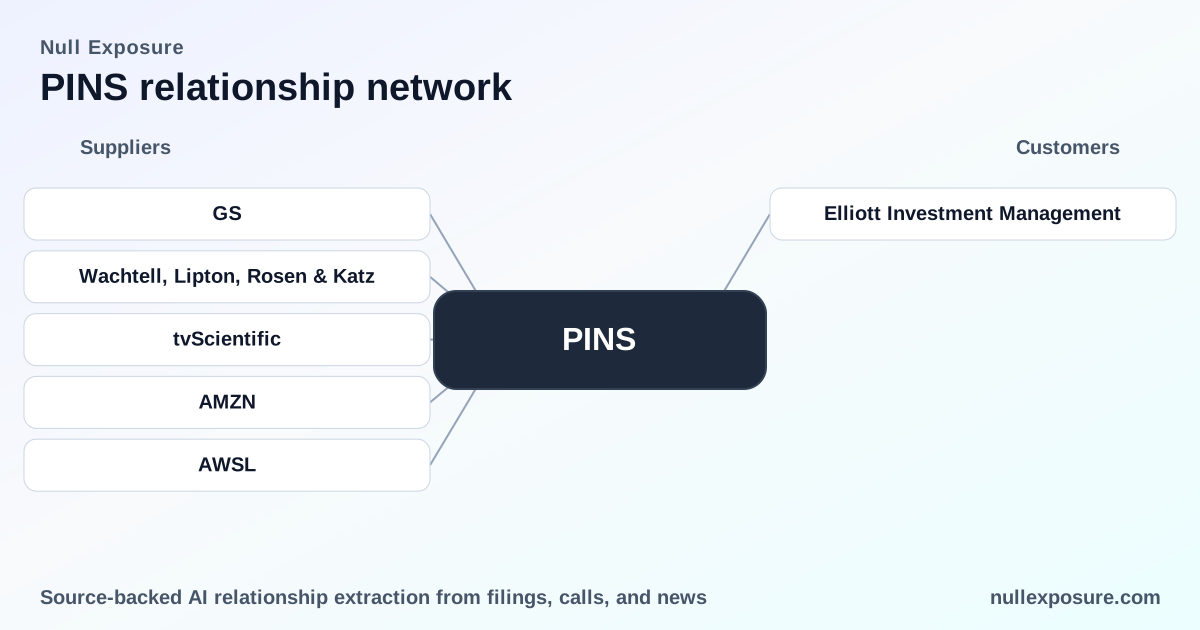
Pinterest (PINS) — Customer relationships and what they signal for investors
Pinterest operates a visual discovery advertising platform that monetizes primarily through third‑party advertising sold on auctioned, usage‑based terms (CPC/CPM/CPV/CPD). The company converts user attention into ad revenue at scale, with a heavy concentration in the U.S. and Canada and a global sales footprint that supplements self‑serve and agency channels. For investors, the critical facts are simple: advertising is the business, advertiser behavior drives top‑line volatility, and strategic partnerships that expand first‑party data or advertiser access materially change the addressable market. For a concise operational view and relationship tracking, visit https://nullexposure.com/.
How Pinterest’s customer economics actually work
Pinterest sells ad placements on a mostly usage‑based, short‑term basis — advertisers pay when users click, view, or otherwise consume ad inventory, and most engagements are not locked into long multi‑year contracts. This contracting posture produces high revenue elasticity: revenue follows advertiser budgets and campaign performance rather than long‑dated contractual inflows. The company’s public filings show revenue is concentrated by geography (roughly 72% U.S. & Canada as of the latest reported period) while the sales organization operates globally to extend advertiser reach.
Key operating signals:
- Usage‑based pricing and auction mechanics mean revenue scales with advertiser demand and pricing power in ad auctions.
- Short‑term advertiser commitments increase churn sensitivity but preserve pricing flexibility for Pinterest.
- Critical dependence on advertising: substantially all revenue is third‑party ad driven, making advertiser retention and ad product efficacy the primary value lever.
- Global distribution with U.S. concentration: strong domestic base with international growth vectors supported by a direct sales force and agency relationships.
- Services orientation: the business mixes upper‑funnel brand solutions with lower‑funnel performance products, requiring continued product iteration to capture full‑funnel spend.
Customer and partner disclosures found in public reporting
The raw relationship signals in recent press and filings cover three discrete items. Below I summarize each in plain English and point you to the source.
Elliott Investment Management — $1 billion convertible note purchase (FY2026)
Elliott agreed to buy $1.0 billion of Pinterest convertible senior notes at 1.75% interest, maturing March 1, 2031, with a conversion price of $22.72, a transaction tied to a broader share buyback initiative reported in the press. This is an investor capital transaction rather than a commercial customer deal, but it changes balance sheet flexibility and signals activist investor engagement. (MLQ.ai reporting, March 10, 2026 — https://mlq.ai/news/elliott-management-injects-1-billion-into-pinterest-with-share-buyback-initiative/)
The Home Depot — retail media integration expands advertiser access (FY2026)
The Home Depot became the first home improvement retailer to plug into a cross‑platform retail media program that includes Pinterest, enabling Home Depot’s first‑party shopper data to be used for campaigns on Pinterest and positioning Pinterest as a social platform where non‑endemic brands can activate with retailer insights. This partnership widens Pinterest’s addressable ad spend for CPG and retail categories. (Chain Store Age, May 3, 2026 — https://chainstoreage.com/home-depot-integrates-retail-media-network-reddit-pinterest)
The Home Depot — beta test for advertiser audiences (FY2026)
Separately reported, Home Depot’s beta with Pinterest allows brands that do not sell at Home Depot to deploy Home Depot’s audience signals on Pinterest campaigns — effectively monetizing retailer shopper data beyond physical shelf relationships and enabling demand generation across inspiration‑focused inventory. This is a direct commercial tie that strengthens Pinterest’s performance and audience targeting capabilities. (RetailDive, May 3, 2026 — https://www.retaildive.com/news/home-depot-advertisers-diy-audiences-reddit-pinterest/818405/)
What the constraints tell investors about Pinterest’s commercial profile
Pinterest’s own disclosures and the evidence above paint a coherent commercial portrait rather than a collection of isolated facts.
- Contracting posture: usage‑based pricing and auction mechanics make the business responsive to macro ad budgets and seasonal cycles; investors should expect higher variance in quarterly revenue but a direct lever for price realization when demand tightens.
- Concentration and geography: the U.S. and Canada represent the majority of revenue, creating geographic concentration risk even as a global sales force supports expansion into Europe and Rest of World markets.
- Criticality: advertising is the company’s core product and revenue engine; advertiser churn or systemic ad market contraction directly compresses top‑line outcomes.
- Maturity of relationships: a large share of advertiser relationships are short‑term and transactional, which increases sensitivity to competitive ad platforms but preserves the company’s ability to reprice and reallocate inventory quickly.
- Roles in the value chain: Pinterest operates as both seller (direct ad placements) and buyer (when it promotes its own content or activates media), with reseller dynamics present through agencies that buy on behalf of advertisers.
- Product mix: the emphasis on services across the funnel — brand to performance — requires continuous product development to hold share against larger social and search ad players.
Investment implications and what to watch next
- Partnerships like Home Depot are strategic multipliers. They extend Pinterest’s targeting capability with first‑party retail data and create new commercial levers to capture retailer‑adjacent ad spend. That reduces reliance on traditional ad demand cycles and increases monetization avenues.
- Capital structure activity matters. The Elliott convertible purchase and buyback narrative is a signal about shareholder returns and balance sheet strategy; monitor how this capital is used — buybacks, debt servicing, or product investments.
- Ad pricing vs. volume is the immediate lever for results. Given usage‑based contracts, improved auction dynamics or higher CPMs/CPCs translate quickly to revenue upside; conversely, advertiser pause decisions translate rapidly to downside.
- Geographic diversification is a medium‑term growth vector. Increasing non‑U.S. revenue will lower concentration risk and make aggregate performance less tied to U.S. ad cycles.
For investors focused on customer signaling and partnership risk/reward, tracking retail media integrations, auction pricing trends, and advertiser engagement metrics is the highest‑value activity. For a cohesive monitoring toolkit and relationship tracking, see https://nullexposure.com/.
Bottom line
Pinterest is a pure advertising platform whose revenue and valuation hinge on advertiser behavior, auction economics, and strategic data partnerships. Recent retail media deals with The Home Depot materially expand Pinterest’s addressability in retail categories, while capital market activity from investors like Elliott influences shareholder return expectations and balance sheet capacity. Investors should prioritize ad pricing, partnership rollouts, and geographic diversification as the most consequential drivers of future performance.