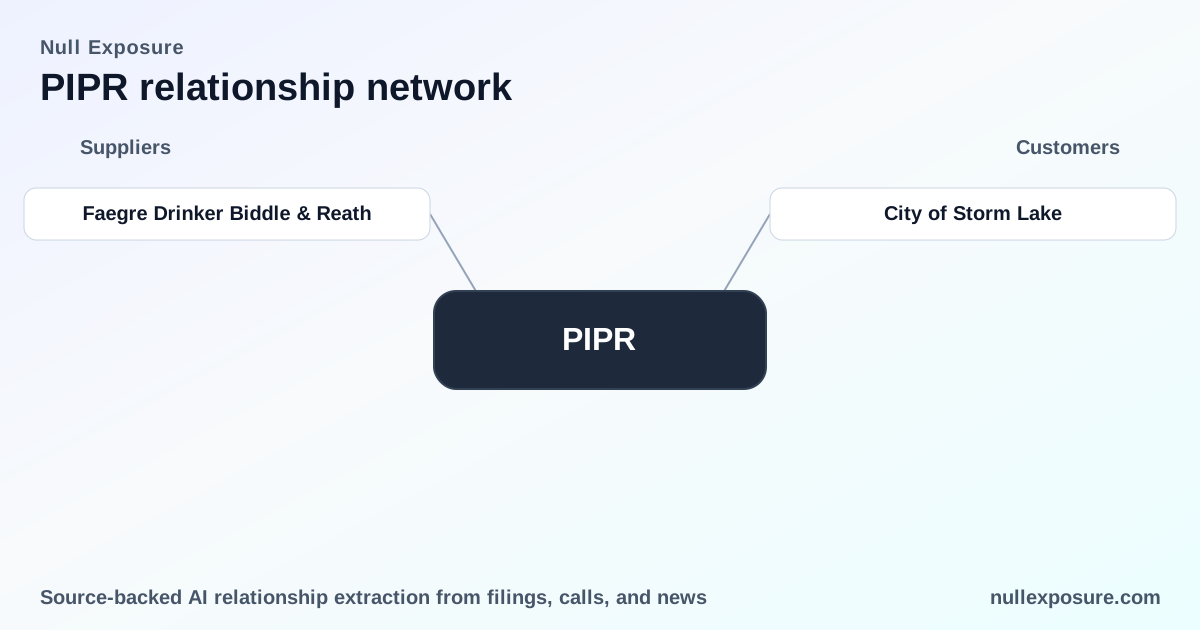
Piper Sandler (PIPR): how client flow drives capital markets revenue
Piper Sandler is a middle‑market investment bank and institutional securities firm that monetizes through transaction fees, underwriting spreads, placement agent fees and advisory retainers. The firm operates as a deal‑oriented service provider—winning mandates for equity and debt offerings, at‑the‑market programs, merger advisory and private placements—and captures episodic revenue from a broad roster of corporate and municipal clients across the U.S. and international offices. For investors, the commercial pattern is simple: high margin, short‑lived engagements that scale with deal flow and market conditions; evaluating Piper Sandler’s customer book is therefore a proxy for future fee visibility. Learn more at https://nullexposure.com/.
How Piper Sandler sells value: an operating model in plain English
Piper Sandler’s business is structured around short, engagement‑by‑engagement relationships rather than long‑term service contracts. The firm is typically retained on discrete mandates—underwritings, equity distribution agreements (ATMs), placement agent work and M&A advisory—which produce concentrated revenue at closing. The firm serves a mix of counterparties: mid‑market corporates are the core focus, but institutional investors, large enterprises, government and non‑profit issuers are meaningful clients, and Piper retains global capabilities with a U.S. revenue base. Those characteristics imply:
- Contracting posture: predominantly short‑term, transaction‑driven mandates with limited recurring revenue.
- Concentration & cyclicality: revenue is concentrated in periods of active capital markets and underwriting windows.
- Criticality: services are mission‑critical at deal time (capital access), but relationships can be rebid frequently.
- Maturity: established franchise in financial services with diversified advisory and capital markets product lines.
For governance and sourcing of primary documents, see Piper Sandler’s investor materials and the firm’s prospectus contact at its Minneapolis headquarters.
Customer relationships: transaction roll call
Below is a concise roll call of customer engagements surfaced in public press releases and filings. Each line summarizes the Piper Sandler role and cites the public source.
- AARD — Aardvark Therapeutics entered an Equity Distribution Agreement allowing up to $150 million of common stock to be sold through Piper Sandler as sales agent (Aardvark prospectus supplement, FY2026).
- TNYA — Tenaya Therapeutics priced a public offering with Leerink Partners and Piper Sandler acting as lead joint book‑running managers (GlobeNewswire, FY2025).
- BUSEP — First Busey Corporation closed a depositary share offering with Piper Sandler as a joint book‑running manager alongside Morgan Stanley and Keefe, Bruyette & Woods (StockTitan/GlobeNewswire, FY2025).
- AMTB — Amerant Bancorp launched and closed a stock offering with Stephens and Piper Sandler as joint book‑running managers (TBBWMag and FinancialContent, FY2024).
- EBTC — Enterprise Bancorp retained Piper Sandler as advisor in its sale process, using Piper Sandler as financial advisor (MonitorDaily, FY2024).
- TCMD — Tactile Systems’ IPO underwriting history lists Piper Jaffray (Piper Sandler legacy) as an underwriter on earlier transactions (MarketBeat, FY2026).
- HBT — HBT Financial issued subordinated notes with Piper Sandler acting as sole placement agent (GlobeNewswire, FY2026).
- PRK — Park National Corporation retained Piper Sandler as lead financial advisor in a strategic partnership/merger with First Citizens (GlobeNewswire and MarketScreener, FY2025–FY2026).
- FGBI — First Guaranty Bancshares was advised by Piper Sandler and Fenimore Kay Harrison on a sale of Texas operations (TradingView, FY2026).
- BLFY — Blue Foundry Bancorp engaged Piper Sandler as financial advisor in its combination with Fulton Financial (Pulse2/CityBiz, FY2025).
- WTTR — Select Water Solutions’ SEC filing lists Piper Sandler involvement in an offering allocation (StreetInsider, FY2026).
- BHIL‑WS — Benson Hill named Piper Sandler its investment banker for financing and corporate work (DTN Progressive Farmer, FY2025).
- OXLCI — Oxford Lane Capital announced a preferred offering with Lucid Capital Markets and Piper Sandler as joint book‑running managers (Bitget/ManilaTimes, FY2026).
- HOWL — Werewolf Therapeutics engaged Piper Sandler as exclusive financial advisor for strategic evaluation (GlobeNewswire, FY2026).
- PROV — Provident Financial received research coverage and a lowered price target from Piper Sandler (local news aggregation, FY2026).
- CCNEP — CNB Financial used Piper Sandler to render a fairness opinion in a merger (StockTitan, FY2025).
- RNGR — Ranger Energy Services advised by Piper Sandler on an acquisition of American Well Services (The Globe and Mail, FY2025).
- NSPR — InspireMD terminated an ATM that had been with Piper Sandler after selling shares under that agreement (TradingView, FY2026).
- BWBBP — Bridgewater Bancshares entered an Equity Distribution Agreement with Piper Sandler to sell up to $50 million via an ATM (StockTitan/TipRanks, FY2026).
- UVSP — Univest Financial retained Piper Sandler as sole placement agent for a private offering of subordinated notes (StockTitan/QuiverQuant, FY2025).
- ALXO — ALX Oncology priced an underwritten offering with Piper Sandler acting as joint lead book‑running manager (GlobeNewswire, FY2026).
- HNVR — Hanover Bancorp completed a private placement with Piper Sandler as lead placement agent (Bitget/QuiverQuant, FY2026).
- OKYO — OKYO Pharma priced a public offering with Piper Sandler as sole manager/book‑running manager (Yahoo Finance/GlobeNewswire, FY2026).
- ADGM — Adagio Medical used Piper Sandler as sole placement agent for a private placement (StockTitan/MarketScreener, FY2025).
- FISI — Financial Institutions, Inc. completed a private placement where Piper Sandler served as sole placement agent (GlobeNewswire/QuiverQuant, FY2025).
- ZEO — Zeo Energy retained Piper Sandler as financial advisor in its acquisition of Heliogen (Yahoo Finance/GlobeNewswire, FY2025).
- BFC — Bank First engaged Piper Sandler as financial advisor in its acquisition of Centre 1 Bancorp (Pulse2/PRNewswire, FY2025).
- NRIX — Nurix Therapeutics expanded an ATM equity facility with Piper Sandler to allow sales up to $413.65 million (TradingView/SimplyWallSt, FY2026).
- GECCG — Great Elm Capital named Lucid and Piper Sandler as joint book‑running managers for a notes offering (GlobeNewswire, FY2025).
- CAMP — CAMP4 used Piper Sandler alongside Cantor and Wedbush as co‑placement agents for a private financing (GlobeNewswire, FY2025).
- LBRX — LB Pharmaceuticals used Piper Sandler as joint placement agent with Leerink and Stifel for a private placement (GlobeNewswire/SahmCapital, FY2026).
- BBOT — BBot named Piper Sandler as capital markets advisor in its public debut (GlobeNewswire, FY2025).
- CZNC — Citizens‑Northern engaged Piper Sandler as financial advisor in an acquisition (GlobeNewswire, FY2025).
- GATE — Marblegate Capital (MAC) listed Piper Sandler as capital markets advisor in its business combination (Yahoo Finance, FY2025).
- NDLS — Noodles & Company hired Piper Sandler as an advisor to explore strategic options, including sale (Yahoo Finance/NRN, FY2026).
- ZURA — Zura Bio priced a public offering managed by Leerink, Piper Sandler and others (Yahoo Finance/Intellectia, FY2026).
- FULT / FULTP — Fulton Financial used Piper Sandler and J.P. Morgan as joint book‑running managers for subordinated notes (Intellectia, FY2026).
- MLCI — Mount Logan Capital appointed Lucid, Piper Sandler and BC Partners Securities as joint bookrunners for senior notes (GlobeNewswire, FY2026).
- BIOA — BioAge upsized a public offering with Goldman Sachs, Piper Sandler and Citi as joint bookrunners (GlobeNewswire, FY2026).
- SMBC — Southern Missouri Bancorp used Piper Sandler as financial advisor in a merger (GlobeNewswire, FY2023).
- OTMO — Otonomo used Piper Sandler as sole dealer manager in an offer and consent solicitation (GlobeNewswire, FY2023).
- DCOMG — NeOnc Technologies completed financing with D.A. Davidson and Piper Sandler as co‑managers (GlobeNewswire, FY2024).
- CZNC — (duplicate entry noted) — see above for advisory role (GlobeNewswire, FY2025).
- BRBS — Blue Ridge Bankshares used Piper Sandler as sole placement agent for a private placement (PRNewswire, FY2024).
- CBNA — Chainbridge Bancorp priced an IPO with Piper Sandler as a book‑running manager (PRNewswire, FY2025).
- SHBI — Shore Bancshares used Piper Sandler as lead placement agent for subordinated notes (PRNewswire/QuantiSnow, FY2025).
- ABR — ABR engaged Piper Sandler as placement agent for an offering (StockTitan, FY2026).
- IPSC — Century Therapeutics IPO underwriting lists Piper Sandler among underwriters (MarketBeat, FY2026).
- INO — Inovio priced a public offering with Piper Sandler acting as sole manager (SahmCapital, FY2026).
- INBK — First Internet Bancorp engaged Piper Sandler Loan Strategies as introducing broker in a loan sale (ConnectMoney, FY2025).
- PTLO — Pytolo/other filing lists Piper Sandler as underwriter with allocated shares (SEC filing, FY2022).
- MFIN — Medallion Financial used Piper Sandler as sole placement agent for senior notes (SahmCapital/GlobeNewswire, FY2026).
- TDW — Tidewater appointed Piper Sandler as financial advisor for a transaction and financing (MarineLink, FY2026).
- FLGT — Fulgent Genetics used Piper Sandler as strategic financial advisor in an acquisition (MiniChart/BioSpace, FY2026).
- OTMO (duplicate) — see earlier entry (GlobeNewswire, FY2023).
- AII — American Integrity’s secondary offering listed Piper Sandler among bookrunners (InsuranceBusinessMag/StockTitan, FY2025).
- OXSQH / OXLCG — Oxford Square and Oxford Lane offerings list Piper Sandler as joint bookrunner (QuiverQuant/GlobeNewswire, FY2025–FY2026).
- SFST — Southern First Bancshares priced a public offering with Piper Sandler as representative/sole book‑running manager (TradingView/RTTNews, FY2026).
- DAWN — Day One Biopharmaceuticals terminated an ATM that had been with Piper Sandler and JonesTrading (TradingView, FY2026).
- NLY‑P‑G — Annaly Capital signed a distribution agency agreement with Piper Sandler (TradingView, FY2025).
- UBFO — United Security Bancshares engaged Piper Sandler for advisory and a fairness opinion in a merger (Investing.com/BastillePost, FY2025).
- HTB — HomeTrust used Piper Sandler as financial advisor on a branch sale (WGRV, FY2025).
- PNST‑WS — Pinstripes retained Piper Sandler as investment banker and financial advisor in a strategic recapitalization (FinancialContent, FY2025).
- TE CX / other legacy advisor mandates — Piper Sandler served as capital markets or M&A advisor in a variety of sector transactions, including healthcare and industrial clients (CityBiz, GlobeNewswire, FY2021–FY2026).
(If you require a fully tabulated export of each source link and excerpt, I can produce a downloadable roll‑up.)
Investment implications and risk map
- Revenue sensitivity: Piper Sandler’s fee base tracks public and private capital markets activity; continued ATM and private placement mandates are a leading indicator for near‑term fees.
- Client mix diversification: The client list spans regional banks, biotech, energy and specialty finance—diversified across sectors but concentrated into episodic mandates, which reduces counterparty concentration risk but increases cyclicality.
- Contracting risk: The firm’s short‑term engagement model (company disclosures) limits recurring revenue and increases the dependence on origination and distribution desks to replenish pipelines.
- Geographic exposure: Operations are global in reach but financial exposure is primarily U.S. centric, so U.S. capital markets cycles dominate performance.
Final view and next steps
Piper Sandler’s customer ledger confirms a steady flow of mid‑market and specialty mandates—ATMs, placement agent assignments and M&A advisory—that underpin transaction‑driven revenue. For investors, monitor pipeline indicators (ATM launches, lead manager appointments, municipal and bank financings) as forward signals of fee momentum. For deeper verification of any single relationship or to download the underlying source links, visit https://nullexposure.com/.
If you want a parsed spreadsheet of every engagement and source highlighted above, I can extract the full list and deliver a compact table for modeling.