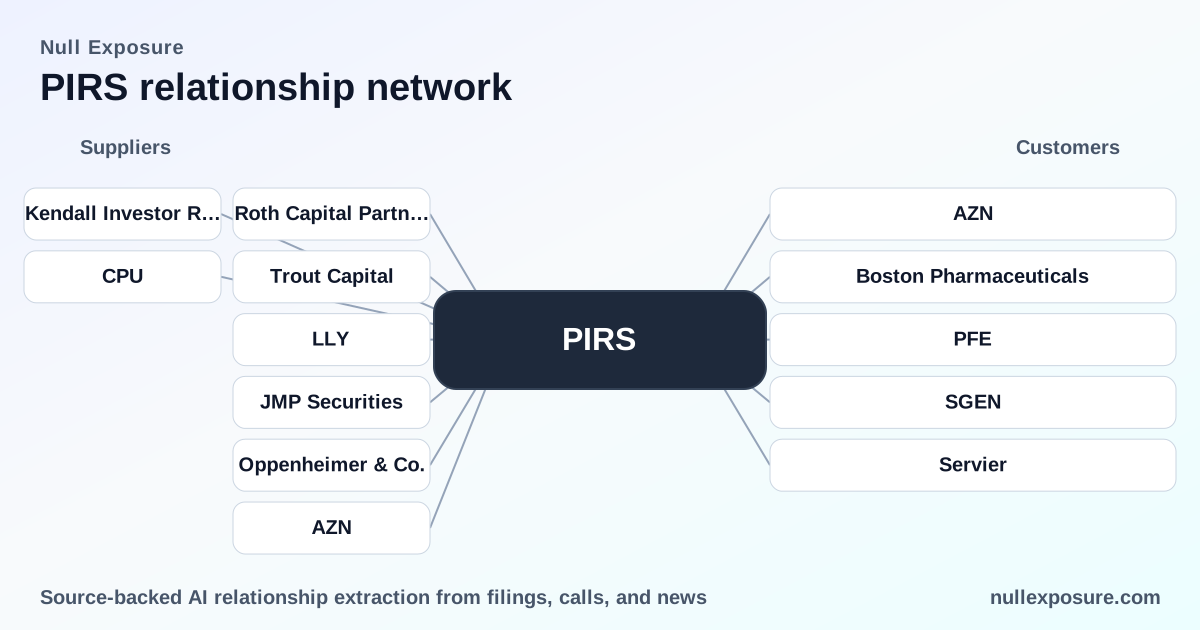
Pieris (PIRS) — Partnership-driven returns with milestone optionality
Pieris Pharmaceuticals operates as a partner-centric biotech: it licenses differentiated Anticalin and bispecific assets to large pharma and specialty partners, monetizing primarily through upfront payments, development and regulatory milestones, and future sales royalties. For investors, Pieris is a play on nondilutive, milestone-tied cashflows and contingent upside from partnered 4‑1BB bispecifics and respiratory programs rather than near-term product revenue.
If you want a concise map of these partner cashflows and contract mechanics, see the company’s relationship roll-up below and further analysis at https://nullexposure.com/.
How Pieris converts science into value
Pieris’s commercial model is straightforward: external partners fund most development and commercialization, while Pieris retains structured upside via milestone payments and royalties. This reduces cash burn volatility but concentrates value capture in a small set of partner performance events—a binary payoff structure driven by partner clinical progress and eventual commercialization timing.
- Key monetization drivers: upfront/cash milestones, event-based payments (e.g., first‑in‑human, Phase starts), and royalties on future sales.
- Contracting posture: partners generally assume development and commercialization responsibility, leaving Pieris as an IP/licensing originator.
- Concentration and criticality: a small number of transactions account for the majority of contingent value; partner execution is therefore critical to Pieris’s realized revenue.
Explore the company overview and relationship insights at https://nullexposure.com/ for more context.
Relationship roll‑call — one entry per item in the record
Below I list each relationship entry present in the dataset with a concise, plain‑English summary and the source.
-
SGEN / Seagen — FY2023 (InsiderMonkey transcript): Pieris reported earning a $5 million milestone from its Seagen collaboration when Seagen initiated a Phase 1 study for SGN‑BB228 (PR‑346), a CD228/4‑1BB bispecific Anticalin construct. Source: Q4 2022 earnings call transcript republished by InsiderMonkey (FY2023) — https://www.insidermonkey.com/blog/pieris-pharmaceuticals-inc-nasdaqpirs-q4-2022-earnings-call-transcript-1136984/.
-
PFE / Pfizer (reference) — FY2024 (Yahoo Finance): Market commentary noted Pieris could be eligible for development, regulatory and sales-based milestones — and potential royalties — on its 4‑1BB bispecific immuno‑oncology assets partnered with Pfizer (formerly Seagen). Source: Yahoo Finance summary (FY2024) — https://finance.yahoo.com/news/pieris-pharmaceuticals-announces-1-80-161000641.html.
-
Pfizer (formerly Seagen) — FY2024 (Yahoo Finance): The same Yahoo Finance item reiterated that partnered 4‑1BB programs with Pfizer carry milestone and royalty potential for Pieris if developed to commercialization. Source: Yahoo Finance (FY2024) — https://finance.yahoo.com/news/pieris-pharmaceuticals-announces-1-80-161000641.html.
-
PFE / Pfizer — FY2024 (AccessNewswire, reverse split release): A corporate release referenced the same portfolio-level milestone rights tied to partnerships with Pfizer and others when announcing a corporate action. Source: AccessNewswire (FY2024) — https://www.accessnewswire.com/newsroom/en/biotechnology/pieris-pharmaceuticals-announces-1-for-80-reverse-stock-split-854200.
-
Boston Pharmaceuticals — FY2025 (AccessNewswire milestone): Pieris announced the receipt of an undisclosed milestone payment from Boston Pharmaceuticals, confirming concrete near-term cash realization from that collaboration. Source: AccessNewswire milestone release (FY2025) — https://www.accessnewswire.com/newsroom/en/biotechnology/pieris-pharmaceuticals-announces-milestone-achievement-for-boston-pharmaceuticals-init-774796.
-
AstraZeneca — FY2017 (AstraZeneca press release): AstraZeneca agreed to fund clinical development and commercialization of inhaled Anticalin programs and paid Pieris $57.5 million in upfront and near-term milestones, while granting Pieris a US co‑development/co‑commercialization option from Phase IIa onward. Source: AstraZeneca press release (2017) — https://www.astrazeneca.com/content/astraz/media-centre/press-releases/2017/astrazeneca-and-pieris-pharmaceuticals-collaborate-to-develop-and-commercialise-anticalin-based-inhaled-treatments-for-respiratory-diseases-03052017.html.
-
AstraZeneca / AZN — FY2017 (duplicate source): The AstraZeneca announcement reiterates the $57.5 million upfront/near‑term payments and the funding and option structure for US co‑development from Phase IIa. Source: AstraZeneca media release (2017) — https://www.astrazeneca.com/content/astraz/media-centre/press-releases/2017/astrazeneca-and-pieris-pharmaceuticals-collaborate-to-develop-and-commercialise-anticalin-based-inhaled-treatments-for-respiratory-diseases-03052017.html.
-
AstraZeneca — FY2017 (third AstraZeneca source entry): Same AstraZeneca partnership detail emphasizing the funding and milestone structure. Source: AstraZeneca press material (2017) — https://www.astrazeneca.com/media-centre/press-releases/2017/astrazeneca-and-pieris-pharmaceuticals-collaborate-to-develop-and-commercialise-anticalin-based-inhaled-treatments-for-respiratory-diseases-03052017.html.
-
Seattle Genetics Inc. (SGEN) — FY2018 (BioPharmaDive): BioPharma Dive reported that the Seattle Genetics deal paid Pieris a $30 million upfront and carried potential milestone and royalty payments in excess of $1.2 billion for successful products, underscoring the material optionality embedded in the collaboration. Source: BioPharma Dive (2018) — https://www.biopharmadive.com/news/seagen-pieris-ink-deal-for-bispecific-io-drugs/516764/.
-
Seagen — FY2023 (InsiderMonkey): The earnings transcript entry duplicated above documents the $5 million Phase 1 initiation milestone from Seagen for SGN‑BB228/PR‑346. Source: InsiderMonkey Q4 2022 call transcript (FY2023) — https://www.insidermonkey.com/blog/pieris-pharmaceuticals-inc-nasdaqpirs-q4-2022-earnings-call-transcript-1136984/.
-
Palvella CVR reference to Pfizer — FY2024 (AccessNewswire merger release): In the Palvella‑Pieris merger filing, Pieris pre‑merger stockholders were to receive a CVR representing contingent rights to proceeds received under existing partnership agreements with Pfizer among others, signaling that a portion of shareholder value is contingent on partner receipts. Source: AccessNewswire merger announcement (FY2024) — https://www.accessnewswire.com/newsroom/en/biotechnology/palvella-therapeutics-and-pieris-pharmaceuticals-announce-definitive-merger-agreement-892031.
-
Palvella CVR reference to Pfizer (duplicate entry) — FY2024 (AccessNewswire): The filing also identified Pfizer partnerships as CVR‑eligible sources of contingent proceeds for pre‑merger Pieris holders. Source: AccessNewswire (FY2024) — https://www.accessnewswire.com/newsroom/en/biotechnology/palvella-therapeutics-and-pieris-pharmaceuticals-announce-definitive-merger-agreement-892031.
-
Servier — FY2024 (Yahoo Finance): Media coverage grouped Servier among partners on Pieris’s 4‑1BB bispecific immuno‑oncology assets, listing similar milestone and royalty entitlements as with other collaborators. Source: Yahoo Finance (FY2024) — https://finance.yahoo.com/news/pieris-pharmaceuticals-announces-1-80-161000641.html.
-
Palvella CVR reference to Boston Pharmaceuticals — FY2024 (AccessNewswire): The merger materials also flagged Boston Pharmaceuticals‑related proceeds as part of the CVR, indicating Boston’s programs are a measurable contingent value source. Source: AccessNewswire merger release (FY2024) — https://www.accessnewswire.com/newsroom/en/biotechnology/palvella-therapeutics-and-pieris-pharmaceuticals-announce-definitive-merger-agreement-892031.
-
Boston Pharmaceuticals — FY2023 (InsiderMonkey): The earnings call noted Boston Pharmaceuticals advancing PRS‑342 (BOS‑342) toward first‑in‑human and that Pieris is eligible for a nominal milestone upon initial dosing, reflecting staged, event‑based payments. Source: InsiderMonkey Q4 2022 transcript (FY2023) — https://www.insidermonkey.com/blog/pieris-pharmaceuticals-inc-nasdaqpirs-q4-2022-earnings-call-transcript-1136984/.
-
Boston Pharmaceuticals — FY2024 (Yahoo Finance duplicate): Yahoo Finance also described Boston Pharmaceuticals as a partner with milestone/royalty upside tied to Pieris’s 4‑1BB portfolio. Source: Yahoo Finance (FY2024) — https://finance.yahoo.com/news/pieris-pharmaceuticals-announces-1-80-161000641.html.
-
Servier — FY2024 (AccessNewswire duplicate): The reverse split press release reaffirmed Servier’s positioning as a partner in Pieris’s 4‑1BB program set. Source: AccessNewswire (FY2024) — https://www.accessnewswire.com/newsroom/en/biotechnology/pieris-pharmaceuticals-announces-1-for-80-reverse-stock-split-854200.
-
Boston Pharmaceuticals — FY2024 (AccessNewswire duplicate): The same corporate release referenced Boston Pharmaceuticals as a partner with contingent milestone rights. Source: AccessNewswire (FY2024) — https://www.accessnewswire.com/newsroom/en/biotechnology/pieris-pharmaceuticals-announces-1-for-80-reverse-stock-split-854200.
-
AstraZeneca layoffs report — FY2023 (Boston Business Journal): Local reporting connected AstraZeneca’s withdrawal from a partnership to Pieris layoffs and asset disposition activity, highlighting execution risk when a major partner changes strategy. Source: Boston Business Journal (2023) — https://www.bizjournals.com/boston/news/2023/07/19/pieris-pharmaceuticals-layoffs-sale-astrazeneca.html.
Operating constraints and company‑level signals investors should track
-
Partner‑funded development dominates Pieris’s cost profile. Contracts frequently place clinical and commercialization funding obligations on partners, reducing Pieris’s development capital requirements but making revenue realization contingent on partner actions.
-
Concentration of value. A handful of collaborations (Seagen/Pfizer, Boston Pharmaceuticals, AstraZeneca, Servier) concentrate Pieris’s upside; partner execution is the single largest operational risk.
-
Event‑driven cashflow profile. The business produces episodic receipts (upfronts, Phase or first‑in‑human milestones, regulatory events) rather than steady recurring revenue, which creates binary valuation inflections.
-
Maturity mix. Partnerships span early (preclinical/Phase 1) to advanced (partner‑funded Phase II/III options), implying value crystallization is staged and multi‑year.
Investment implications: upside, timing, and risks
-
Upside: Successful partner trials and regulatory progress convert large contingent sums into cash — historically demonstrated by upfronts and announced milestone receipts. Milestone realizations materially rerate intrinsic value.
-
Timing risk: Because milestones depend on partner decisions and trial pacing, calendar predictability is low and near‑term liquidity events are uncertain.
-
Counterparty risk: Changes in partner strategy (e.g., AstraZeneca’s withdrawal) can force re‑scoping of programs or layoffs, reducing expected proceeds.
If you want an investor‑grade briefing and a consolidated timeline of partner milestones, check the relationship dossier at https://nullexposure.com/.
Bottom line
Pieris is a partnership‑centric biotech whose valuation is determined by other companies’ clinical and commercial execution. For investors, the opportunity is concentrated, binary, and potentially high‑reward—monitor partner milestones, CVR disclosures, and announced milestone receipts to track value realization.