Parke Bancorp (PKBK): Customer relationships, concentrations and operational constraints
Parke Bancorp is a regional community bank that earns money primarily through net interest margin on loans and deposits, supplemented by service fees and commercial banking activities concentrated in Southern New Jersey, the Philadelphia region and parts of New York. For investors, the credit and deposit profile of its customers — particularly cash-intensive industries and a small number of large depositors — directly drives liquidity volatility, regulatory attention and earnings stability. For more granular relationship intelligence on PKBK, see https://nullexposure.com/.
How Parke Bank actually monetizes customer relationships
Parke Bank operates a single community banking segment focused on personal and business financial services for individuals, small businesses and mid‑market commercial clients. The bank generates core revenue from:
- Interest income on a portfolio of commercial and consumer loans, funded by customer deposits.
- Deposit services and fee income from retail and commercial accounts.
- Unused commitments and contingent facilities, which create fee potential and contingent liquidity exposure.
Parke’s operating model is business‑to‑business and business‑to‑consumer, with underwriting tailored to local commercial credits and a particular operational emphasis on specialized verticals such as cannabis-related accounts. The balance sheet shows material relationships with a handful of large depositors, which amplifies both earnings potential and concentration risk. If you want a concise, relationship‑level view for diligence, visit https://nullexposure.com/ for structured summaries.
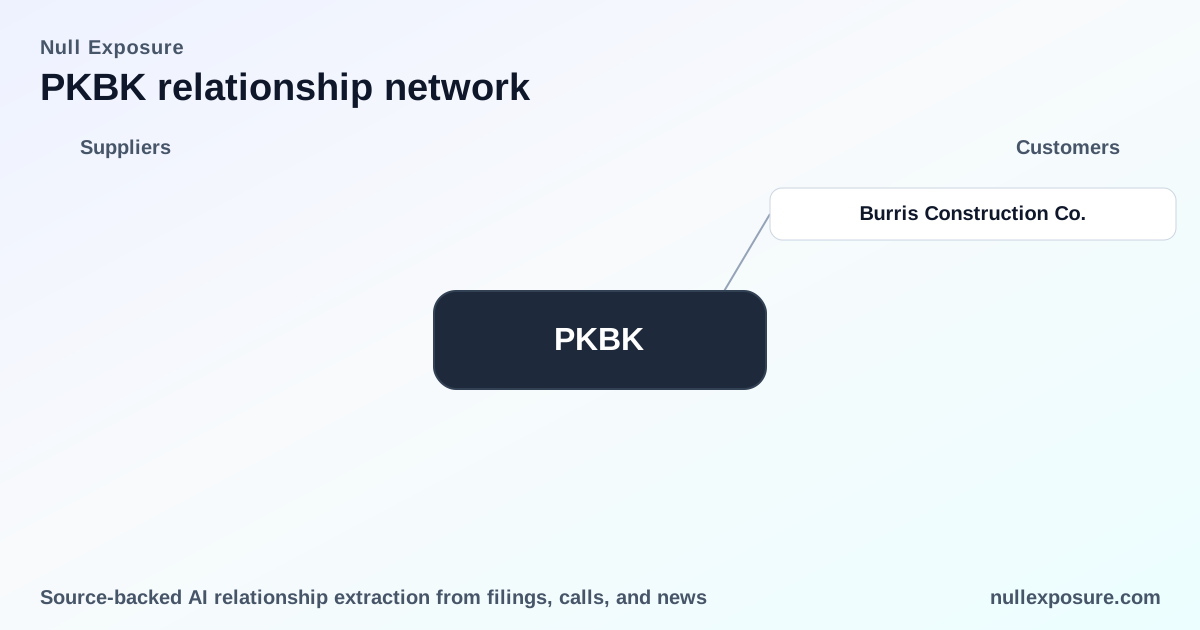
Publicized customer transaction: Burris Construction Co.
Burris Construction Co. purchased a 50‑acre parcel that Parke Bank had held unused since 2009, with the sale recorded at $3.2 million in FY2014. This transaction represents a straightforward asset disposition rather than an ongoing lending or deposit relationship. The sale was reported by the Courier‑Post in June 2014. (Courier‑Post, June 25, 2014).
Company-level constraints that shape customer risk and revenue
Available disclosures and excerpts from company filings surface a set of structural constraints that determine how customer relationships convert to value for shareholders:
- Contracting posture: predominantly short‑term commitments. Variable‑rate commitments are generally issued for less than one year and carry market rates of interest, which limits long‑dated rate risk but increases roll‑over exposure in tightening markets (company filings, Dec 31, 2024).
- Counterparty mix: individuals, small businesses and mid‑market companies. The bank explicitly positions itself to serve retail clients and local businesses, which creates a lending book concentrated in community commercial credits rather than large corporates (company filings).
- Geographic concentration: Southern New Jersey, Philadelphia area and New York City. Substantially all business is with customers in these market areas, which concentrates economic and regulatory exposure to the same regional cycles (company filings).
- Materiality of off‑balance exposure: management reports immaterial off‑balance‑sheet risk. Management states that off‑balance sheet risk is not material to results of operations or financial condition (company filings).
- Role: service provider and lender to local businesses. The bank functions as a classic community banker — deposit taker, lender and financial services vendor to local commerce (company filings).
- Relationship stage: active and monitored, with specialized oversight for higher‑risk verticals. Parke Bank has active deposit relationships with cannabis industry customers and conducts ongoing monitoring, including site visits and license reviews (company filings).
- Segment focus: community banking. Parke reports a single “community banking” segment and consolidates retail and commercial services under that umbrella (company filings).
- Exposure scale: several customer pools exceed typical community bank size thresholds. As of Dec 31, 2024, cannabis customer deposits totaled $151.9 million (9.3% of total deposits) and unused commitments to extend credit were approximately $122.5 million, indicating meaningful contingent funding capacity (company filings).
These signals describe a bank that leans on short‑term, locally focused commercial relationships with heightened concentration in specific verticals, while management asserts that off‑balance contingencies are not material. Those two statements coexist because concentrated deposits are on‑balance but many credit commitments remain undrawn.
Why concentration and the cannabis exposure matter for valuation and risk
Parke’s financial profile — market capitalization ~$359 million, P/B ~1.06, trailing P/E ~8.7, ROE ~13.1% — reflects a profitable regional bank with modest valuation multiples. However, several customer dynamics affect investor return expectations:
- Concentration risk is acute. Two cannabis customers accounted for ~59.4% of cannabis deposit balances at Dec 31, 2024, making the bank sensitive to the behavior of a very small set of counterparties (company filings).
- Funding and liquidity sensitivity. Large deposit relationships can be stable and low‑cost when retained, but they also represent rapid outflow risk if regulatory or operational changes force account closures.
- Regulatory and compliance friction. Handling cash‑intensive, highly regulated industries requires sustained compliance investment and can affect growth of the customer base and pricing.
- Earnings leverage from unused commitments. Unused credit commitments of $122.5 million represent potential asset growth and fee income, but also contingent capital demands if drawn.
Investors should weigh Parke’s material profitability and attractive multiple against the potential downside from a few concentrated relationships and the regulatory complexity of cannabis banking.
Practical checklist for ongoing monitoring
Track these items quarterly to assess whether customer relationships are enhancing value or amplifying downside:
- Deposit concentration trends — watch the percent of total deposits tied to the largest customers each quarter.
- Cannabis portfolio performance and compliance disclosures — frequency of site visits, license actions, and any regulatory remarks.
- Unused commitments utilization — movement from undrawn to drawn status signals funding demand and credit conversion risk.
- Regional economic indicators in Southern New Jersey and the Philadelphia area — loan performance will mirror local cycles.
- Insider and institutional ownership shifts — insiders hold ~15.3% and institutions ~60.3%; changes in these stakes can signal confidence or concern.
Bottom line
Parke Bancorp is a profitable, regionally focused community bank that monetizes concentrated local relationships through traditional lending and deposit services. The bank’s customer profile combines steady retail activity with material, short‑term commercial exposures that produce both upside in fee and interest income and downside in concentration and regulatory risk. For a focused, relationship‑level view and ongoing monitoring tools investors use in diligence, visit https://nullexposure.com/.
Relationship referenced
- Burris Construction Co. — In FY2014 Burris purchased a 50‑acre parcel Parke Bank had held unused since 2009, paying $3.2 million. (Courier‑Post, June 25, 2014).