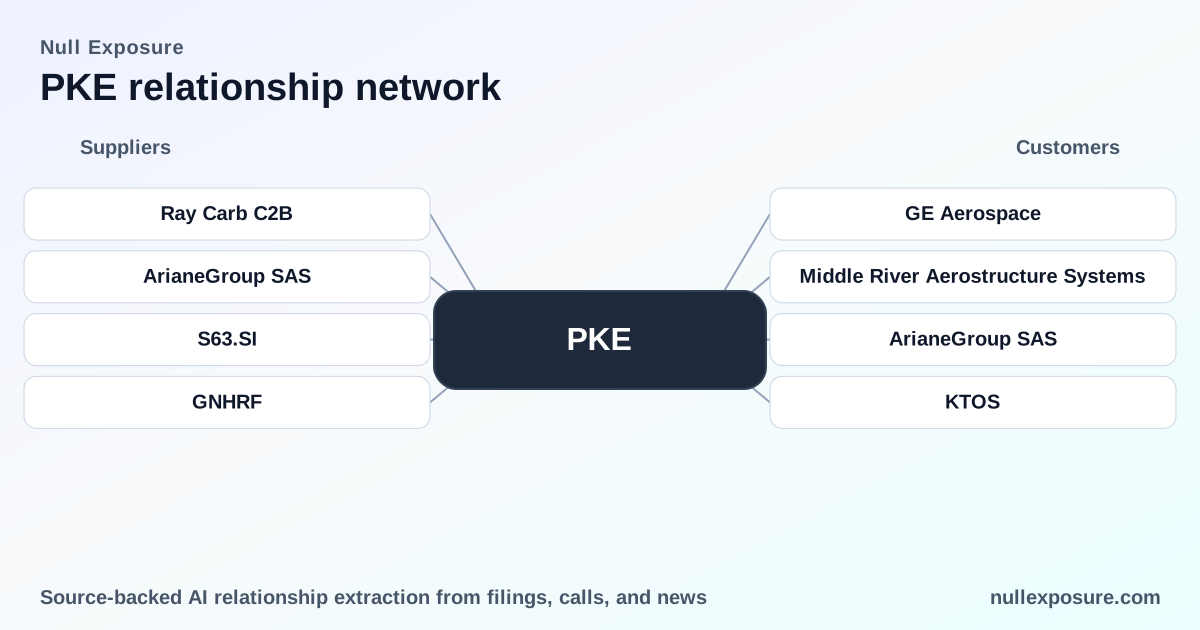
Park Aerospace’s customer map: concentrated, long-term, globally exposed
Park Aerospace manufactures advanced composite and hot‑melt materials sold to leading aerospace OEMs and tier suppliers. The company monetizes by supplying engineered materials under long‑term agreements to aircraft and defense programs, capturing recurring revenue from program lifecycles and aftermarket demand. For investors, the important facts are concentration (a small number of large customers drive a material share of sales), long-term contracting that stabilizes revenue visibility, and global program exposure that ties Park’s growth to aircraft and rocket build rates.
Explore more on customer relationships at https://nullexposure.com/.
Why customer relationships determine the payout profile
Park’s commercial model is not a commodity reseller; it is a specialized materials manufacturer selling into program‑level supply chains. That position produces three investment characteristics: high customer concentration, contractual revenue visibility through LTAs, and exposure to program timing across North America, EMEA and APAC. These dynamics lift margins when program cadence is healthy but create downside if a major customer or program shifts suppliers or slows production. Investors should treat Park as a supplier whose revenue trajectory is driven by OEM program awards and LTAs rather than episodic spot orders.
Customer relationships — who matters and why
Below are all customer relationships surfaced in the research, each summarized succinctly with the cited source.
GE Aerospace
Park reports that a large share of its net sales are to affiliates and subtier suppliers of GE Aerospace; roughly 39.8% of worldwide net sales in FY2025 were to GE‑related subtier suppliers, underlining material dependence on GE programs. This disclosure comes from Park’s FY2025 Form 10‑K.
According to Park’s FY2025 10‑K filing, the GE channel is a core revenue driver (FY2025).
GE Aerospace (LTA 2025–2030)
Park has entered a long‑term agreement with GE Aerospace covering calendar 2025–2030, providing multi‑year order visibility for engine and program work. The company discussed this LTA in an earnings call transcript covering Q2 FY2025 results.
Management referenced the GE LTA in the Q2 FY2025 earnings call transcript published on Investing.com (Q2 FY2025).
Middle River Aerostructure Systems (MRAS)
Park references a long‑term agreement and firm pricing LTA with Middle River Aerostructure Systems (MRAS), covering multi‑year windows and supporting sustained supply to MRAS programs. This relationship is discussed in Park’s earnings calls and related transcripts.
MRAS is mentioned in Park’s 2026 Q1 earnings call (March 2026) and in Q2 FY2025 call coverage (Investing.com and InsiderMonkey transcripts, FY2025–FY2026).
MRAS (Middle River Aerostructure Systems) — contract detail
Park described a firm LTA with MRAS for contract years spanning 2019–2029 in public remarks, signaling long‑dated contractual commitments on selected programs. This firm LTA commentary appears in earnings call and news transcripts.
The MRAS contract window was detailed in Park’s Q2 FY2025 earnings discussion (Investing.com transcript, FY2025).
ArianeGroup SAS
Park has a long‑term supply agreement with ArianeGroup for the RAYCARB C286 product that supports the Ariane rocket program through 2033, providing predictable revenue into the European launch market. This commercial detail was highlighted in media coverage.
A Finviz note cited the ArianeGroup long‑term supply agreement and its revenue visibility (March 2026).
Airbus
Park is a supplier of composite materials for the Airbus A320 family and is expanding Midwest manufacturing capacity to meet growing demand tied to Airbus programs. This underlines OEM exposure in commercial aircraft.
Manufacturing Dive reported on Park’s A320 program supply and capacity expansion in May 2026.
Kratos (KTOS)
Park referenced defense program work tied to systems such as the Patriot missile and related platforms where Kratos is a contractor, indicating defense program exposure that complements commercial aerospace sales. Management discussed these program relationships on recent calls.
Kratos and program mentions were raised during Park’s 2026 Q1 earnings call (March 2026).
KTOS (ticker reference for Kratos)
Public commentary and call transcripts use the KTOS ticker when discussing Kratos‑associated programs, reinforcing the linkage between Park’s defense supply activity and Kratos prime contracts.
This reference appears in the 2026 Q1 earnings call transcript (March 2026).
CFM (LEAP‑1A engine)
Park confirmed participation on the CFM LEAP‑1A engine program, reflecting content on a high‑volume narrow‑body engine platform and associated supplier demand. This program exposure supports recurring engine‑related sales.
The LEAP‑1A mention appears in the Q2 FY2025 earnings call transcript published on Investing.com (FY2025).
Valkyrie
Park supplies components for a number of classified and public defense programs, including the Valkyrie uncrewed aerial system recently cleared by the U.S. Marine Corps, showing Park’s role in emergent unmanned systems.
Manufacturing Dive and other coverage noted Park’s supplier role on Valkyrie and related defense programs (May 2026).
Constraints that shape Park’s operating model and commercial risks
The company narrative and filings point to several company‑level constraints that are critical for investors to internalize.
- Long‑term contracting posture: Park’s strategy is to develop and maintain LTAs and multi‑year agreements with a select group of customers, which provides revenue visibility but increases dependency on contract renewals and program continuations.
- Global market footprint: Park sells in North America, Europe and Asia, and explicitly positions products for the global aerospace market; program exposure is therefore global in nature and sensitive to regional aircraft build rates and defense budgets.
- Customer concentration and materiality: Management discloses that the loss of a major customer or group could have a material adverse effect; while no single non‑GE customer exceeded 10% in recent years, concentration remains a principal risk.
- Seller role and manufacturing segment: Park operates as a specialized manufacturer and direct seller to OEMs and tier suppliers, not a distributor, which increases technical switching costs but also ties revenue to program engineering specifications.
- Mature relationships: The company’s strategy to cultivate long‑term relationships yields a mature commercial posture—orders tend to be program‑driven rather than transactional, which amplifies both revenue stability and program concentration risk.
None of these signals is an isolated statistic; they collectively define Park as a manufacturing supplier with concentrated, long‑dated customer exposure and meaningful program dependency.
Investment implications and checklist
- Positive: LTAs with GE, MRAS, ArianeGroup and participation in LEAP‑1A and Airbus A320 programs provide multi‑year revenue visibility and upside from program ramp or content share gains.
- Risk: Near‑term stock volatility ties to OEM delivery cadence and any single‑customer disruption, given the material share of sales to GE‑related channels.
- Actionable focus: Track LTA renewals, program award outcomes (GE, Airbus, Ariane), and Park’s capacity expansions as leading indicators of revenue upside or pressure.
For further investor‑level intelligence on supplier relationships and commercial concentration, visit https://nullexposure.com/ for deeper coverage and relationship mapping.