Packaging Corporation of America (PKG): customer relationships that shape revenue and risk
Packaging Corporation of America manufactures containerboard, corrugated packaging and paper products and monetizes through direct product sales to commercial customers plus limited logistics services. The company sells containerboard and corrugated packaging as its core revenue drivers and operates at scale across thousands of customer locations; working capital is managed through short-term receivables (30–60 days) and customer relationships are sufficiently broad that no single buyer crosses the 10% segment threshold in the 10‑K. For a quick look at relationship mapping and deeper signals, see Null Exposure’s overview at https://nullexposure.com/.
What investors must know about PKG’s customer economics
Packaging Corp runs a classic industrial supplier model: volume-driven margins on commoditized and specialty paper/packaging products, supported by limited third-party transport services. Receivables are short-term and turnover matters for cash conversion; the company reports selling to roughly 13,000 customers across ~29,000 locations, which creates scale benefits but also exposes PKG to large-account renewal dynamics in specific end-markets. The business is primarily North American in operation with export channels for containerboard, giving it a mixed domestic/foreign revenue footprint.
- Contract posture: Receivables are predominantly short-term (most payments within 30–60 days), which constrains working capital but reduces long-tail credit exposure.
- Customer concentration: The 10‑K states no single customer exceeds 10% of segment sales, so concentration is officially immaterial at the reporting cutoff; nonetheless, public commentary highlights particular reliance of the Paper segment on a large retail customer.
- Product mix and role: PKG is principally a seller of core product (containerboard, corrugated packaging, communication-based papers), with ancillary transportation services offered selectively.
If you want the full relationship map for PKG, visit https://nullexposure.com/ for an expanded view.
The disclosed customer relationships (each item from the filings and press)
Below are the relationships extracted from PKG’s public materials and press mentions; each entry is treated individually in the same order as reported.
-
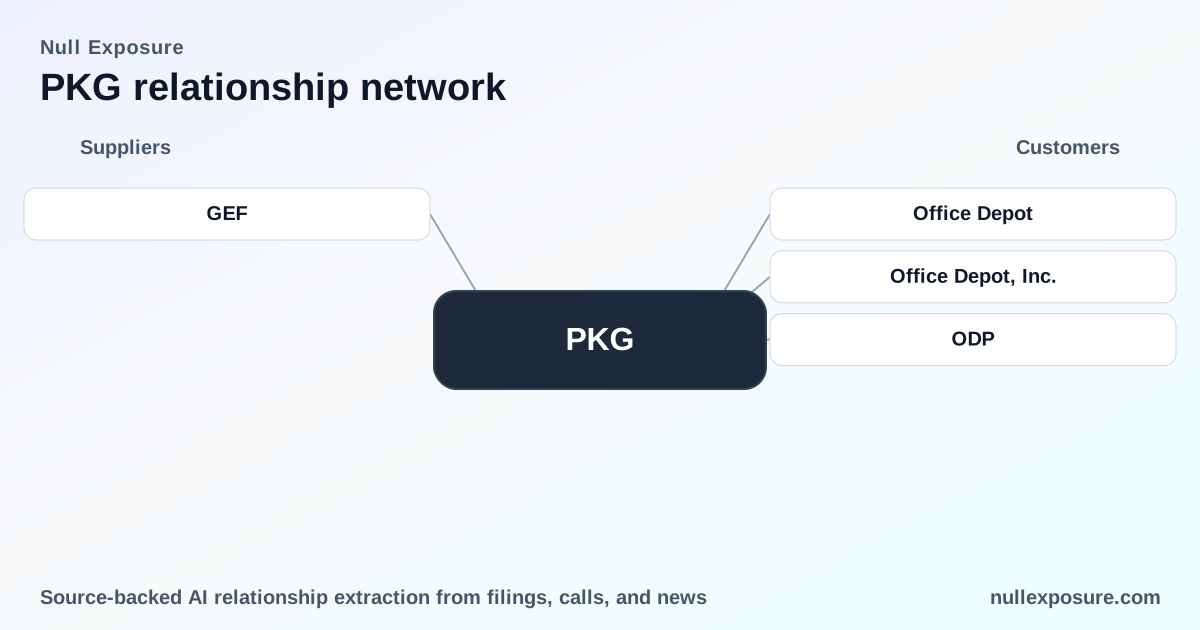
Office Depot — According to Packaging Corp’s FY2024 Form 10‑K, ODP Corporation (formerly Office Depot, Inc.) is identified as the company’s largest customer in the Paper segment, indicating a prominent commercial relationship there. The detail is disclosed in the FY2024 10‑K filing.
Source: Packaging Corp FY2024 Form 10‑K (filed for the year ended 2024-12-31). -
Office Depot, Inc. (Trade Vendor Purchasing Agreement) — The FY2024 10‑K references a Trade Vendor Purchasing Agreement dated December 6, 2019 between Boise White Paper, L.L.C. and Office Depot, Inc., documenting the contractual basis for supply of paper products under that vendor arrangement. This is a contractual reference within the company’s public filing.
Source: Packaging Corp FY2024 Form 10‑K (document references, FY2024). -
ODP (news mention) — A TradingView news piece dated March 10, 2026 flagged that the company is reliant on ODP Corporation for a significant portion of its Paper segment sales and that non‑renewal of the agreement would pose a risk, echoing investor concerns about single-account renewal exposure. This is a press observation tied to the company’s reported customer mix.
Source: TradingView news coverage (March 10, 2026). -
ODP Corporation (news mention) — TradingView’s coverage on March 10, 2026 also references ODP Corporation by name and emphasizes that reliance within the Paper segment represents a potential renewal and concentration risk, mirroring the same assessment described in the prior entry.
Source: TradingView news coverage (March 10, 2026). -
ODP (FY2024 10‑K entry repeat) — The FY2024 10‑K explicitly repeats that ODP Corporation is the largest customer in the Paper segment, reinforcing the company’s disclosure about that account’s materiality to the Paper business unit. This is the company’s own statement in its annual report.
Source: Packaging Corp FY2024 Form 10‑K (FY2024). -
ODP Corporation (FY2024 10‑K entry repeat) — The FY2024 filing again lists ODP Corporation (formerly Office Depot) and its affiliates as the largest Paper‑segment customer, underscoring consistent disclosure across the filing text. Investors should treat these repeated entries as the same underlying commercial relationship being emphasized by the company.
Source: Packaging Corp FY2024 Form 10‑K (FY2024).
How the constraints in filings translate to investor signals
Packaging Corp’s filings and extracted constraints give clear, actionable signals about how customer relationships operate:
- Short-term contracts and receivables: The company collects the majority of trade receivables within 30–60 days, signaling tight payment cycles and limited long-dated trade credit exposure; this supports cash flow predictability but requires effective working capital management.
- Geographic footprint is mixed but U.S.-centric: PKG is headquartered in Lake Forest, Illinois and operates primarily in the United States, while its containerboard organization also services export customers — a balance of domestic stability and export revenue optionality.
- Customer concentration is reported as immaterial: The 10‑K states no single customer exceeds 10% of segment sales, which on its face reduces headline counterparty concentration risk; however, the Paper segment lists ODP as its largest buyer, which creates a practical commercial dependency in that segment that investors must monitor.
- Seller-led, broad customer base: Management describes sales to national, regional and local accounts across industries and geographies (roughly 13,000 customers), which supports resilience through diversification of outlets.
- Products are core to the business: Packaging and paper are core product segments; transportation services are ancillary and provided on a limited, opportunistic basis.
Investment implications and risk checklist
- Positive: Scale in packaging and corrugated products, diversified customer base across thousands of locations, and short receivable cycles support cash conversion and margin stability. PKG’s FY‑TTM revenue (
$9.22B) and EBITDA ($1.89B) reflect sizable industrial scale. - Watchlist: Despite the 10‑K’s immateriality statement, ODP’s prominence in the Paper segment is a clear counterparty risk—renewal dynamics, pricing pressure, or a shift in ODP’s sourcing strategy would have an outsized operational effect on that segment. TradingView coverage in March 2026 explicitly pointed this out.
- Balance-sheet sensitivity: Short payment terms compress the company’s need for working capital financing discipline; any deterioration in collections or large account payment disputes would be quickly felt.
- Geographic exposure: Primary U.S. operations provide stable demand exposure to North American industrial cycles, while exports add a revenue lever but also currency and logistics considerations.
Bottom line for investors
Packaging Corp runs a broad, seller-focused industrial model with core revenues from containerboard and corrugated packaging and an important but clearly disclosed commercial relationship with ODP in its Paper segment. The headline 10‑K signal is diversification — no single customer tops 10% of segment sales — but the operational reality is that ODP is the largest Paper buyer and therefore a renewal risk investors must monitor closely. For a deeper look at the relationship map and to track changes to customer disclosures over time, visit Null Exposure’s platform at https://nullexposure.com/.