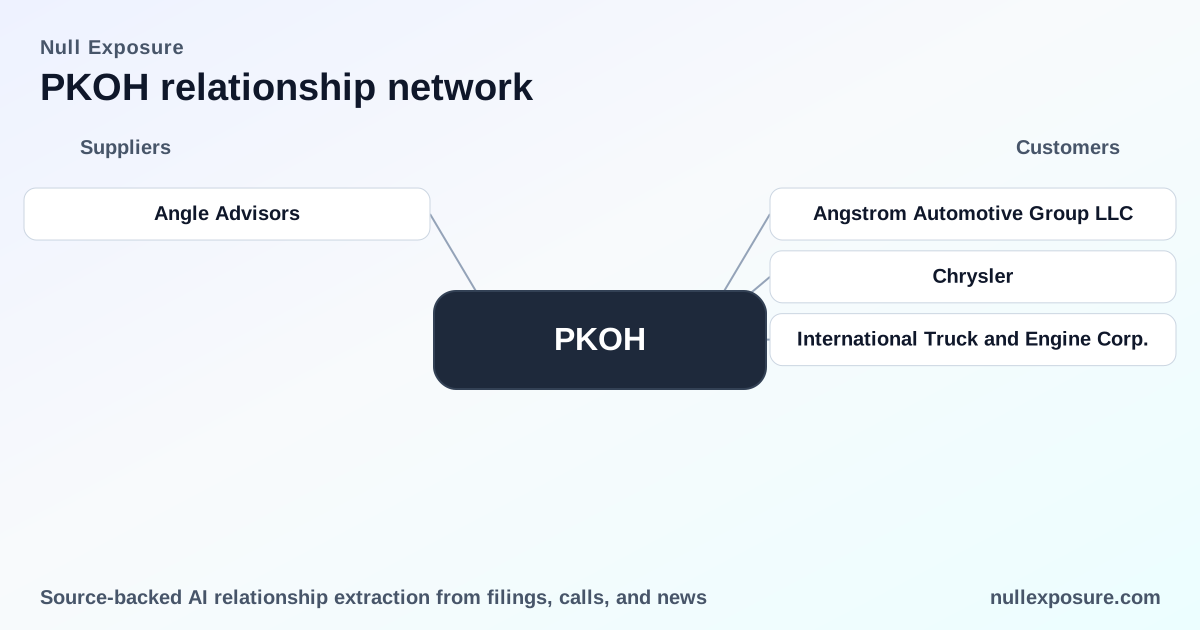
Park-Ohio (PKOH): Customer relationships that define margin durability and concentration risk
Park-Ohio Holdings operates a diversified industrial platform that manufactures engineered components, sells distribution and supply-chain services, and provides integrated logistics and program management to large OEMs and manufacturers. The company monetizes through a mix of manufacturing sales, long-term sole-source contracts and master service agreements, and shorter invoice-as-delivered arrangements for ancillary products and services. For investors, the commercial profile translates into embedded recurring revenue from entrenched programs and episodic, lower-margin transactional sales—a duality that underpins both its EBITDA generation and its exposure to customer concentration. For primary source detail on relationship signals and monitoring, visit https://nullexposure.com/.
Key takeaway up front: Park-Ohio’s customer base is weighted to large manufacturers and OEM programs where long-tenured, sole-source arrangements create predictable volume, while a material slice of revenue is still governed by short-term invoiced contracts that preserve operational flexibility but increase near-term volatility.
Why customer structure matters for valuation
Park-Ohio reported roughly $1.60 billion in trailing revenue with an operating margin profile that benefits from program scale and aftermarket/distribution services. That commercial mix creates three practical investor implications:
- Concentration risk: several large customers account for a concentrated share of segment sales, which creates financial sensitivity to order losses.
- Contracting posture: the coexistence of long-term, master-agreement work and short-term invoiced sales creates a revenue base that is both sticky (programs) and adjustable (spot buys), affecting cash-flow predictability.
- Operating leverage: manufacturing and ILS (Integrated Logistics Solutions) contracts tied to OEM production ramp provide margin upside on volume growth but also fixed-cost exposure if volumes decline.
These characteristics should be reflected in how analysts model revenue visibility, working capital swings, and scenario-based EBITDA sensitivities.
Contracting posture, concentration and maturity — what filings disclose
Park-Ohio’s public filings and segment disclosures make several clear, company-level signals about how customer relationships are structured and where risks sit:
- Long-term sole-source arrangements are material and entrenched. Management discloses that many clients are served through sole-source arrangements and that the average tenure among the top Supply Technologies clients exceeds ten years, indicating operational lock-in and program-level revenue visibility.
- Short-term invoiced business coexists with long-term programs. The filing also states that a substantial portion of revenue is derived from contracts with original lengths of one year or less or from arrangements where revenue is recognized as products or services are delivered and invoiced.
- Framework/master agreements are in use. Supply Technologies sells under master or authorized distributor relationships, supplying production parts against framework terms and individual purchase orders.
- Customer concentration is real and measurable. The five largest customers of the Assembly Components segment represented roughly 55–57% of segment sales in recent years; Supply Technologies’ top five customers accounted for about 34–36% of that segment’s sales, highlighting both concentration and cross-divisional exposure.
- Geography is primarily North American but global exposure exists. For 2024, a majority of segment sales were domestic (roughly 54–66% depending on segment), yet the company also reports meaningful sales to Europe, Mexico, Asia and Canada.
- Roles are multi-dimensional: manufacturer, distributor and service provider. The company explicitly describes manufacturing of specialized components, distribution of wholesale industrial products, and Total Supply Management services for customers’ factory floors.
- Relationships are mature. The combination of long-tenure top clients and master agreements points to mature, programmatic stages for core customer relationships.
Together these items form a clear operating model: entrenched, program-based manufacturing relationships plus complementary distribution and logistics services, with both concentration risk and revenue resilience baked in.
You can review these relationship signals and more at https://nullexposure.com/.
Customer relationship snapshots (what the filings and press show)
Below I cover every customer relationship noted in the available results with concise, plain-English takeaways and source citations.
Angstrom Automotive Group LLC
Park-Ohio completed the divestiture of General Aluminum Mfg. Company to Angstrom Automotive Group LLC, transferring ownership of that business to Angstrom as part of Park-Ohio’s portfolio reshaping. According to an Angle Advisors post dated March 10, 2026, Park-Ohio finalized the sale of General Aluminum to Angstrom Automotive Group. (Angle Advisors, March 2026 — https://www.angleadvisors.com/post/sale-of-general-aluminum)
Chrysler
A local journalism report from 2012 documented that a Park-Ohio plant won a significant contract with Chrysler to produce suspension system parts, a concrete example of Park-Ohio’s long-standing OEM relationships and their role in local employment and capacity utilization. The Beacon Journal noted the plant’s hiring and contract win from Chrysler in a 2012 article. (Beacon Journal, January 2012 — https://www.beaconjournal.com/story/news/local/2012/01/22/once-dead-auto-part-plant/10490586007/)
International Truck and Engine Corp.
Park-Ohio’s Integrated Logistics Solutions (ILS) unit secured an exclusive, multi-year supply agreement with International Truck and Engine Corp. to provide OEM production components, reinforcing the company’s strategy of winning exclusive program work that drives recurring manufacturing volumes. TruckingInfo reported the announcement of this exclusive provider agreement in 2026. (TruckingInfo, March 2026 — https://www.truckinginfo.com/news/park-ohio-named-exclusive-provider-to-international-truck)
Investment implications and risk checklist
- Revenue visibility is asymmetrical. Long-tenured, sole-source programs give strong forward visibility at the program level, while short-term invoiced business creates quarter-to-quarter variability.
- Customer concentration is a double-edged sword. Concentration of Assembly Components and Supply Technologies revenue with a few large customers enhances margins when programs run but poses material downside if a program is lost.
- Geographic mix limits single-market exposure but keeps North America central. A majority domestic revenue base reduces FX and overseas execution risk, yet international customers maintain exposure to global OEM cycles.
- Operational bargaining power is significant but not absolute. Master agreements and long tenures create switching costs for customers, but short-term contracts and purchase-order pricing mechanics preserve customer flexibility.
Bottom line
Park-Ohio’s commercial model blends deep, long-tenured program work with transactional, invoice-driven sales, creating both resilience and concentration risk. The company’s ability to sustain margins will depend on defending sole-source programs, selective growth through exclusive ILS deals, and managing short-term demand volatility. For a focused view of customer-level signals and how they affect credit and equity scenarios, explore the Park-Ohio relationship dossier at https://nullexposure.com/.
Bold claim: Park-Ohio’s best valuation case rests on program continuity and ILS expansion; its downside is dominated by the loss of one or more top Assembly Components customers. Investors should stress-test models for both outcomes when assigning multiples or projecting free cash flow.